Showing posts with label socialism. Show all posts

Thursday, November 14, 2013

Ford Saga: Left Gives Cover To Right Wing Palace Coup

Cuts, what cuts? It's all about bad behaviour
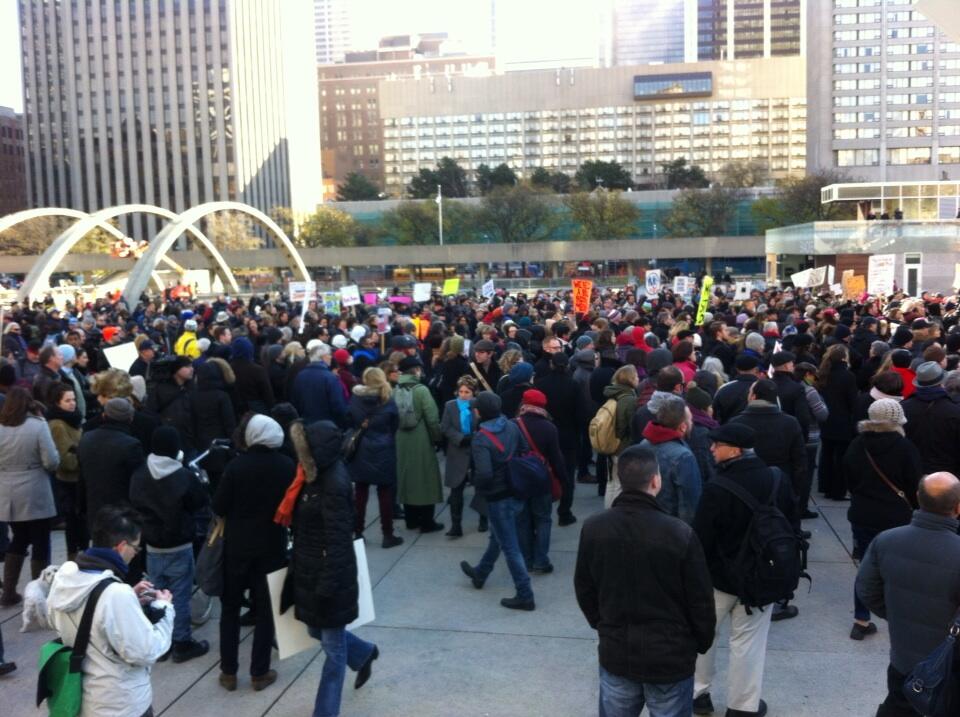
photo credit: @HeartsOnTheLeft

Not one word about cuts. Not one word about privatizing garbage collection. Nothing about his refusal to ever attend a single Gay Pride Parade. Zilch about his actual politics. No, everything is focused on his drinking, his drug use and his public displays of such activities. Oh, and in case you didn't notice: he's fat (because that deserves serious political discussion with regards to the mayoralty). The closest we get to something progressive is a councilor pointing out the hypocrisy in Mayor Ford’s “zero tolerance” stance on illegal drugs when he himself has purchased illegal drugs in the last two years.

Make no mistake, this is a right wing coup to get rid of a difficult former front man. That the left is getting caught up in this is a sign of how off the rails the left is, how disconnected it is from ordinary, working class people. I don’t expect much from the “left” on city council. The best that they could do when they were needed was to vote for a study of how efficient garbage privatization was after it was implemented. And, as I’ve said before, when Ford put forward a motion during the G20 debacle to laud the police, most of the left voted for it with 5 members walking out of the chambers in order to avoid having their vote counted. They couldn’t even bring themselves to publicly abstain on a pro-cop vote after all the round-ups of innocents, the kettling, the home invasions, Officer Bubbles, the display of "weapons"by Chief Blair that included a chainsaw and some medieval role playing gear. I’m not sure how you could manage to be more lame and still get out of bed in the morning.

But now they’re all over this, crusaders for truth, justice and democracy – and being led by the nose by right wing Rob Ford ally Denzil Minnan-Wong to, uh, depose Rob Ford. (edit - except for Gord Perks, who opposes deposing elected officials - though I will never forgive him for leaving the room during the G20 vote).

Besides the city council “left”, I’ve also been shocked by some of the stuff I see on Facebook. I’ve seen articles posted attacking Ford’s drug and alcohol use by people who I know have used drugs and alcohol to excess in the past. And done it in public. Some of them even got into fights while doing it. (For the record I have used both, and made an ass out of myself in public more than once. I also strongly believe in decriminalizing drugs so that users aren’t sent to prison and the drugs trade isn’t turned into a high stakes criminal activity involving guns and violence). Then of course there are the fat jokes, always the fat jokes. And the faux outrage because Ford said "eating pussy". Are you serious? I hear people say worse shit in the cash line at the grocery store for God's sake. Who. Cares.

More seriously, look at the rallies to depose Ford at City Hall. I dare you to find a single sign opposing cutbacks, privatization or bigotry. You won’t because they don’t or, rather, these rallies aren't about that - they're about moral outrage. The kind of morals that are about contempt for the great unwashed, of which I am proudly a member. Let’s take a step back for a second here. As wildly delusional as Rob Ford and his brother are – I mean, they consort with Giorgio Mammoliti and Doug compared Rob to Jesus of Nazareth – they are right that this is a witch hunt. Perhaps, dare I say it, even a conspiracy.

The police staged an expensive and extensive investigation against Ford, including airplane surveillance, stake-outs, interviews, etc. all because he got wasted on tape. Does this strike no one as an unusual use of police resources? They found nothing, apparently, with which they could convict him – and yet the details of this surveillance of an innocent (yeah, the word chokes a bit in my throat) man are released to the media. Does nobody else find this disturbing? Would you be troubled if the cops staked out Maude Barlow’s house, or David Suzuki or Olivia Chow – and then the courts released photos, transcribed interviews and CCTV footage that smeared them without ever laying a charge? Do you think that this is a good precedent for dealing with politicians who rub the powers that be the wrong way? And rub them he does.

Ford is a populist windbag and right wing bigot with a neoliberal agenda that includes cutting services for the most vulnerable in society. But he was not the candidate of the city establishment – George Smitherman was. Ford won because, unlike the left (or Smitherman), he speaks a language and expresses an anger to which many working people can relate – including the non-white, immigrant heavy suburbs. That’s not the route of preference for the ruling elite who would rather see things stay respectable and passionless. (Unfortunately, it’s also not the route of preference for the polite left.)

Sure, after Ford won they were willing to work with him but it was begrudgingly because he’s such a loose cannon and because he’s not totally under their control. Doug Ford’s wild attacks on the Police Chief Bill Blair are demonstration enough of that. As the inability of Ford to drive through an austerity agenda became clear this very conditional support waned. And when he was unable to come up with a credible transit plan in a city where gridlock is costing significant profits (as in billions of dollars every year), there was growing alarm. Not to mention his (and Doug’s) tendency to come up with the most hare-brained ideas when it comes to city development (ferris wheels for the waterfront, anyone?).

At some point this draining of ruling class support became an active desire to remove him. Again, not because he was a right wing bastard but because he was an ineffective right wing bastard. And not because he stirred up some active opposition with his neo-liberal policies. Does anyone really think that the ruling class gives a rat's ass about some protests and a relatively small and contained strike by library workers? Really? Have you seen the ruling class of Greece veer away from implementing harsh austerity in the face of monthly general strikes? Opposition they can deal with - Mike Harris weathered a series of city-wide general strikes and a demonstration in Toronto of 250,000 or more people. He never once lost ruling class backing. This is not about the relatively minor (though welcome) opposition on the streets of Toronto. Mayor Miller, a candidate of the centre-left with labour backing, faced bigger resistance.

Whether the growth in the sentiment amongst the elite turned into active conspiracy, who’s to know. For myself, I have a hard time believing that there isn’t some coordination and discussion going on when the police dedicate a whole squad to following him (Including with airplanes!! I want to know how much that operation cost.), and then the results of those investigations lead to a progressive and systematic tightening of the noose. First, there are hints in the press that there might be some information damaging to Ford in the report. Then his driver, apparent muscle and probable dealer, Alexander Lisi, is arrested and charged with dealing pot. Then part of the report is released and the Chief of Police himself announces – at a press conference – that the crack video exists and that they have it. At each moment Ford has refused to step down and they have upped the pressure on him. My guess is that at some point, if he doesn’t cry uncle and leave office, there will be a warrant for our Chief Magistrate’s arrest. They will destroy him. I won't weep for the guy, given his mendacious and pathological behaviour, but I'll shudder at the precedent.

The left, by trailing along behind this palace coup and acting like it’s some sort of uprising from the people – have given cover to the right wing and the ruling class, putting a progressive gloss on the whole operation. They have facilitated a moral panic about drugs and alcohol and bad manners that won’t be used against cocaine snorting bankers, cavorting with high priced call girls. It will be used against “gangbangers” to launch attacks on visible minority communities and the poor. And the left will be tarnished as being responsible for these attacks and will be seen for the kind of downtown, whitebread, middle class snobbery of which Rob Ford has accused us.

A final note: in all this, where is Karen Stintz? She’s being very quiet and letting people like Minnan-Wong and del Grande – not to mention the left – haul down the big guy. Her name is conspicuously absent on the open letter calling for Ford to resign. She is positioning herself to be the grand unifier who has no blood on her hands. If Stintz, a Tory, wins next year, the left will have itself to blame. Stintz actually stood up to Rob Ford while the left was still cowering at the mention of Ford Nation. She doesn't need to attack him now, she already established her anti-Ford credentials - when it took a spine to do so - now she can reap the reward. The left is helping her become our next mayor. Good work, guys. Just what we need, a more effective conservative.

No, just because Rob Ford is a total bastard it doesn’t follow that all means of getting rid of him are good ways. And it sure doesn’t mean that all ways will lead to a better city. That so much of the left thinks so is a stark reminder that the left has lost confidence in itself and, even worse, lost confidence in the power of mobilizing, particularly working class people. This proxy victory – using right wingers, police chiefs, the courts and the media to eliminate a right wing mayor – is no victory at all. It is a hostage to fortune.

Friday, November 1, 2013

Bye Bye Rob Ford, Hello Karen Stintz

There is the sound of champagne corks being popped and cheers in the streets. Everyone smiles at each other and winks, knowing that soon it will all be over. The hated burgermeister is falling and no one, except perhaps his family, will be sad to see him go. And he has been felled by none other than that champion of democracy, Toronto Police Chief William Blair.

Oh, wait a second. Bill Blair? The same Bill Blair who led the cops in their assault on G20 protesters a couple of years ago? The same Bill Blair who wheeled out props – a la the “Miami model” of protest disruption - and used “kettling” to corral not only peaceful demonstrators but unlucky passersby for hours without food or water? The same Bill Blair whose cops shot a man nine times on a streetcar before tasering him?

Something is rotten in Denmark.

I have watched the left go absolutely bananas with delight in the past week as the official right wing in Canada has imploded. Well, imploded is too strong a word, the game is hardly over for Harper as of this morning. And I’ve also been happy to see the vultures turn on each other. I mean, these guys are scumbags, lets face it. But it has been with growing trepidation.

At the federal level, Stephen Harper’s troubles have nothing to do with his murder of thousands of Afghans in support of NATO’s attempt to subdue that country. It has nothing to do with his shutdown of the national daycare plan that Paul Martin put in place to try and save his own skin, or his scuppering of the deal he made with first nations people. Nor does it have anything to do with his policy record of the past decade – his cuts to cultural funding, his government’s attacks on funding for international women’s organizations that support choice on abortion or domestic religious groups like KAIROS that support Palestinian rights. It has nothing to do with his unbridled support for big oil and their enthusiastic destruction of the environment of Alberta and, indeed, the whole world with the tar sands. Nothing to do with his support for fracking to recover natural gas. The list goes on as to the odious reasons why Harper should be unceremoniously turfed from office.

Not one of those reasons has come up. And the same can be said for Rob Ford. Ford privatized west end garbage collection, leading to a degradation in working conditions for sanitation workers, and worse service. He tried to close libraries and de-fund childcare subsidies for single parents and poor families. He has attacked cyclists and environmentalists. He shut down the much needed transit plan for the city to wage an ideological fight for subways vs LRTs.

No, the reason why Harper is in trouble is a stupid, piddling, little scandal – a couple of his senators took extra expenses – a time honoured tradition in Canada’s undemocratic chamber of “sober second thought” (oh, the delicious irony of that title as I watched Duffy roast Harper last week). His office then tried to head off the scandal by covering the expenses of Mike Duffy. Aboriginal people are living in conditions worse than the developing world on many reserves and working class people can’t afford daycare – and I care that Duffy took an extra $100K?

Sure, it is Harper’s famous arrogance and micromanagement that is bringing him down. And if he goes the way of Brian Mulroney 20 years ago I won’t shed a tear. But we all ought to remember how that celebration ended. The Tory party was destroyed, not by the left, but because it was so thoroughly rotten and hated by both left and right (the right because Mulroney supported concessions to Quebec viz Meech Lake Constitutional Accord). It gave the Liberals 4 terms in office under Jean Chretien and Paul Martin. And it gave Canada the harshest austerity regime in the western world under Paul Martin. The fact that it was not a shift to the left was also expressed in the fact that out of the ashes of the Tories arose an even more right wing party, Reform – whose ultimate victory was that they got to remove the words “progressive” from the “Progressive Conservative Party of Canada” (confirming that they are, in fact, against any progress). In Ontario the NDP was decimated for a generation (by their own right wing policies, it should be said) and replaced by the rabidly right wing Tories under Mike Harris.

Not that the present round of defenestrations will necessarily end the same way. But people need to sober up and take a look at who is putting in the knife and why. That will tell us a bit about why it is happening and why now.

In Toronto the city elite have always hated Rob Ford. Their horse was George Smitherman – a smooth, connected lawyer with right wing politics and a progressive gloss because he’s openly gay. He would have had an easier chance of maintaining consensus while implementing austerity. Ford is a bumbling, personally troubled, brash populist with few political skills beyond brawling and personal insults. His agenda is no different than Smitherman, except in the details (in particular his weird opposition to a transit plan that was supported by the Chamber of Commerce, because gridlock is a big, costly headache for Ontario capitalists). At first, after the election, the city elite reached out to Rob Ford and tried to work with him. Some media supported him, just as they had supported Mike Harris years earlier because sometimes a right wing populist can break the logjam of “business as usual” to put things on the “right track” by harnessing popular anger in a pro-capitalist direction.

But Ford was too erratic, too self-serving, too unable to build a coherent team with a coherent agenda to get through what is needed from the point of view of Toronto’s corporate elite. And they hate him because he’s a trashy, nouveau riche, petty bourgeois piss-tank who won’t play ball the way they want him to. He gets drunk in public and is rude to people. He hangs out with trash and thugs. He behaves in ways that remind them too much of the dirty unwashed masses. That’s why the focus of attacks on Rob Ford has almost always revolved around his personal behavior. Does anybody think that it’s an accident that the police released a photo of Rob Ford taking a piss in a public park? Jesus, I’ve taken a piss behind buildings more than once – because there’s no freaking public washrooms anywhere in the city. Or, horror of horror, Ford has to sneak around to buy drugs? Um, I don’t know if any of you have ever smoked pot but you don’t buy it at the corner store either (and for all we know it could have been pot that Lisi was dropping in Ford’s car – not that I particularly care). Is Rob Ford a hypocrite on these things? Would he attack drug users and homeless people who are forced to piss behind buildings? Of course he would but just because he’s an asshole doesn’t mean I have to be. Build more public washrooms for crying out loud. Decriminalize drug use.

It’s so blindingly obvious I can’t believe the left doesn’t see this. When I talk to working class people who aren’t leftists it’s obvious to them. They know that Rob Ford is being attacked because he looks and sounds like them – he has family problems and swears and drives an SUV and he drinks too much and has trouble keeping it together. Surprise, surprise, so do most working class people (not exactly that constellation of challenges but similar ones). That the left hops on board this attack uncritically and says, frankly, the snobbiest, most elitist crap in attacking Rob Ford does the left no favours. The right wing will win on this terrain. I saw people laughing at Rob Ford yelling at reporters who were at his house and wouldn’t get off his property yesterday. I hate Rob Ford but I was sympathetic to him to be honest. The media are vultures and I’d have lost my shit if I were him too. I don’t find public dismemberment of anyone a pleasure to watch and while the left might think it’s fun because he’s so odious you ought to remember: this isn’t about you, it’s about the confidence of ordinary people to take control of their lives. Public humiliation of Rob Ford in this way isn’t going to raise their confidence in themselves. It’s going to further cement the idea that only rich, slick and connected operators – like Smitherman – are fit to run the city and the country. Notice the different coverage of Smitherman's family challenges about a month ago - his husband disappeared on some kind of binge, part of a long term problem apparently, and the police were called in - to Ford's troubles. Nobody laughed at Smitherman (nor should they, not for that). That’s why this idea that “Ford Nation” are stupid or brainwashed because they continue to support their man is so odious to me. On this one thing they are right – this is a concerted attempt to oust their man by city elites (though they are wrong that it has anything to do with the left).

Or Karen Stintz. Does anybody think that it’s an accident that Ford’s legal dossier was leaked now? Does anybody think that it’s odd that the police – on the basis of a newspaper report with no physical evidence – put their top investigators on the case to nail Ford? Since when have the police followed a politician to reveal his personal foibles or cared about political corruption? I mean, they released a report that doesn’t demonstrate any proof of illegal activity on the part of Ford. If they had any proof they would have arrested him. This is about destroying Rob Ford while there is still enough lead-time before the next municipal elections to rebuild the right wing on city council. This is about giving Karen Stints – who, coincidentally, announced her candidacy last week – a clear shot for the mayoralty. Stintz is also a Tory but one who knows how to work with city capitalists and who saved the transit plan from Rob Ford. And she doesn’t get drunk in public.

I would argue that a similar process is under way at the federal level. Not that there is a conspiracy (I do think that there’s a conspiracy to destroy Rob Ford, by the way) but rather a sense of malaise amongst the elite at the effectiveness of Stephen Harper. Let’s face it, Harper never really represented more than a fraction of Canadian capitalists. But he was the best alternative on offer after the meltdown of the Liberals because of corruption and infighting. But now the Liberals have recovered and Justin Trudeau is a rising star – while Harper’s star is on the wane. Everybody prefers consensus. This is true of workers as much as it is of capitalists. That’s always been the power of the Liberals – to implement the ruling class agenda through consensus, whenever possible, rather than conflict. That’s why they are Canada’s “natural governing party.” The Tories are the fallback position for Canada’s capitalists (and workers, traditionally). With a recovered Liberal Party and people getting tired of Harper’s open Machiavellianism and not-so-hidden right wing extremism, it looks like there might just be an opportunity to restore the historic coalition that the Liberals represented. Harper is now discovering just how shallow his support was in most of the country.

Will any of this benefit the left? Let's be frank, the union movement has done zero to resist austerity (outside of a few pockets of heroic, sectional struggles). Ford privatized garbage collection and there was not even an information picket. There were a few demonstrations against Ford on an anti-austerity platform and the strike by library workers – that was quickly settled, wisely, by Ford’s people before it could become a focal point. But that’s it. The Occupy movement was great - but it was small (compared to the tasks) and short-lived. It never generalized into a sustained movement.

Since the decline of the anti-war movement there has been almost zero public opposition to Harper’s agenda. And, of course, the ever-craven federal NDP under the leadership of ex-Liberal Tom Mulcair, is rushing to prove that they are the new Liberal Party of Canada. We’ll see how that goes for them. Even in Quebec, the PQ, which benefited from the brilliant student movement has managed to turn the debate away from austerity and towards attacking Muslims.

These are, in short, challenging times. And the over-the-top celebrations by the left at the predicaments of Ford and Harper is a sign of desperation. We’ll take any crumbs of hope that fall from the table. Sure, it’s true that splits in the ruling class can be to our benefit but it would be silly to think that the ruling class is split in Toronto. They are united in wanting Ford out – Blair is simply fronting for them. I expect that Ford will be getting some phone calls to offer him a cushy parachute if he jumps now along with a reprieve from criminal charges. The particular madness that is Alberta politics is, of course, always a problem for Canadian capitalists but when the Toronto Sun comes out for Harper’s neck don’t kid yourself that there isn’t a growing consensus at the national level.

So, the left shouldn’t pretend that this defenestration has anything to do with us or with workers or social programs or any of that good stuff. This is a night of the long knives, a ruling class drama that is entertaining, perhaps, but will do little to strengthen the ability of our side to take back that which was taken from us. And, in the case of Ford, the snobbery can actually damage our side’s confidence.

Wednesday, August 7, 2013

On Pythons & Media Generated Paranoia

My partner and I have been talking much about the horribly tragic death of two boys in New Brunswick a couple of days ago. KP is snake-o-phobic and this just confirmed her worst fears, especially with a reptile shop around the corner that sells large snakes.

For me, while it horrified me as a father of two young children to think of losing my kids so senselessly, what was also striking was how utterly random and titillating it was meant to be as a news item. I was reminded of one time when I was standing on a subway platform, waiting for the train and reading the newsfeed screen. There was a "breaking story" that kept scrolling again and again across the bottom of the screen: 12 people had died when their boat capsized in Lake Victoria. In case you don't know, Lake Victoria is the world's second largest freshwater lake, next to Lake Superior. It also happens to be in Africa, providing an interior coastline to Uganda, Kenya and Tanzania.

Now what, you might ask, is the purpose of telling me (and a couple of hundred thousand other commuters) about the tragic deaths of 12 people in a boating accident on the other side of the world? Probably the same thing as telling us about the tragic deaths of two young boys in New Brunswick, more or less. I won't be the first to say this but the widespread publicizing of events like this reminded me that these items are publicized for a reason. It's not that the individual stories, in and of themselves, provide us with any sort of useful information. (Well, I suppose it might be useful to wear a lifejacket when on a boat or to ban predatory, wild animals that are large enough to kill children. But I don't think that's why these stories are in the paper.)

I mean, look at the follow-up on the python story. A quick glance at thestar.com and I can see a video on the eating and hunting habits of the African Rock Python. There's an accompanying story that suggest the python might have been attracted to the boys because they had been petting farm animals earlier in the day and they smelled like prey as a result. And, finally, there's a story about how the python has been killed in punishment for the crime of being a large, deadly predator. There will be more in the days to come but that's four stories on one news site in two days. Millions of people are talking about this story, forming opinions on it, arguing about it over coffee and drinks, at the water cooler at work, etc. etc.

It's my opinion that the reason stories like this are considered news in this way is the fundamental acceptance of the political and economic system under which we live. Sure, there are pushes by newspapers to win support for their particular reformist bent - the Star wants less austerity, the National Post wants to cook and eat the poor to save money so the rich can buy bigger yachts. But they both fundamentally accept the dynamics of a system based upon profit and competing nation states. Thus the problems in the world aren't fundamental to the system itself. They are of the nature of accidents, individual acts of cruelty, or stupidity. It becomes difficult to differentiate in importance between a boat capsizing in Lake Victoria and a drone attack in Yemen or a war in the Congo, sponsored by different major powers jockeying for control of important resources.

In other words, the media through its undifferentiated focus on tragedy as a series of disconnected accidents, tells us that the world is incomprehensible and that accidents, personal foibles and, especially, crime and criminals are as much a threat (or more) than political and economic decisions. The latter are seen in isolation from their impact. The poverty in Africa that leads to mechanically faulty boats still sailing Lake Victoria, crammed with people to save money, isn't connected to the competition to keep the price of smartphones low, using key minerals from Africa, etc. etc. The relationship between keeping enormous pythons that kill children and immediate political and economic policy is rather less straightforward (and we should allow for some people to be the kind of idiots who think that such dangerous predators are charming pets). But I do believe that the craving for the exotic - usually defined in relationship to colonialist narratives of the dark continent and places like the Amazon - and for adventure is related, on the one hand to the mundane and monotonous existence that most people have to endure (go to work, repeat tasks endlessly & without purpose, come home to repeat tasks endlessly, go to bed, go to work...on the weekend get drunk to forget about the week, repeat). On the other hand the definition of what is exotic and exciting is shaped by historical and continuing policies in relationship to the developing world.

Nonetheless, the larger point here is that the media obfuscates the truth not just in terms of misrepresenting actual events, through the use of language that shapes meaning (is someone called a "Jamaican immigrant" or a "bank CEO", for instance) but also through the repetition of meta-themes (eg. tragedy is the result of accident, etc), the placement of articles in relationship to each other, etc. This has the impact of making the world more difficult to comprehend and generating a kind of paranoia of everything amongst the population. Death and injury could be lurking anywhere at any moment, when the truth is that most premature deaths and serious injuries in the world are the result of being features of the system and the policy choices that flow from it.

It also means the media shamelessly exploits the unfortunate tragedies suffered by ordinary people in order to sell newspapers. A good story is defined by how much gory detail a particular newspaper can uncover. It is not defined as something that allows us to better understand the world in order to change it and make it less tragedy prone. Given that almost all media is dominated by major corporations, this shouldn't surprise us. It should, however, disgust us.

Monday, July 8, 2013

Massacre in Egypt: Is Revolution Worth The Price?

As I sat down to write this post the news of a tragic massacre of at least 32 Muslim Brotherhood-affiliated protestors, and the injury of 300 more was plastered all over the internet. That much is clear, the rest is yet to be disentangled (if ever) from two completely opposing stories by the Egyptian military and people on the scene. This is now one more massacre in a two year revolutionary process in which hundreds have died, chaos has reigned and nothing has been settled. I'm sure that millions of people in Egypt and even more around the region and around the world are asking: Is this what is necessary to win democracy and freedom? Is the price worth it?

There is obviously the danger of being glib in writing a judgment on the value or danger of  revolution from the safety of my office in Toronto, Canada - a country founded on the solid business principle of avoiding the messiness of revolution; a country that hasn't seen war in any significant way in 200 years. I'll try to avoid that as much as possible.

For certain the revolutionary process in the Middle East more generally, since the launch of what has become known as the Arab Spring, has had its share of chaos and tragedy. Dozens died in Bahrain in the struggle for democracy against a US/Saudi client regime - and suffered greater repression as a reward for their efforts and aspirations. In Yemen hundreds died only to see their aspirations deflected into a shabby compromise  that suited regional power-brokers - Saudi Arabia and the US (their involvement in aborting democratic movements is a theme and not a coincidence). In Libya, the west and their backers in the Middle East, in particular the Qatari emirate, swooped in quickly to ensure that the initial explosion of grassroots opposition to the Gaddafi dictatorship was controlled using western arms and logistics to suit the ends desired by the big oil companies, the US state department and the agenda of the EU. In Syria the repression of a popular movement led to civil war and the sickening sight of various imperialist powers - all of whom have happily repressed democratic movements around the world for generations - jockeying to gain the upper hand through the cynical manipulation of the various players caught in the Syrian tragedy. As always it is at the expense of local civilians, whether man, woman or child. As a former US Secretary of State, Madeleine Albright, once put it when asked about US sanctions against Iraq that had killed perhaps a million children: "We think that the price is worth it."

And yet, it isn't as though the region or Egypt, in particular, is descending into tragedy from a state of pre-revolutionary bliss. The meddling of imperialism - from US financing of the military in Egypt and of the Occupation in Israel/Palestine to Russian arming of the Syrian dictatorship - has ensured a repressive and inhumane set-up in the region. And for the people of Egypt, in particular since the Camp David Peace Accords of the late 1970s, which won the compliance of the Egyptian state to the American agenda in return for billions of dollars in "aid", it has meant decades of, effectively, martial law, police repression, torture and dictatorship in all but name. The compliance of the Egyptian regime also freed Israel's hand to steal more land, kill more Palestinians and launch wars and attacks on their neighbours whenever it suited their colonialist agenda. All this was largely ignored by western media who, when they even bothered to notice, usually put the blame at the feet of "uncivilized Arabs" who needed "strong regimes" to maintain control and protect Israel, the "plucky little democracy" of the region.

What has changed in the present moment is that the masses, the tens of millions of people who have endured the tender mercies of imperialist-backed dictatorships, have attempted to force their way onto the political and historical stage. The "chaos" and "instability" that the media and governments bemoan is really the emergence of democracy in the form of the people waking up to their own power to control their destiny. In the first instance this is, by definition, chaotic as the old institutions, designed to guarantee dictatorship and the rule of both state and market capital, are destabilized and collapse. The ruling class loses many of the levers, primarily fear and quiescence, that it once had to maintain "order" and "stabillty". On the other hand, the newly awakened people haven't yet created their own institutions to replace the old. In this gap between old and new is a ferment of experimentation. Some of it involves the creation of new forms of organization - Egypt saw neighbourhood committees to defend the revolution appear and disappear, only to reappear again during the past two and a half years. There has been an explosion of independent trade unions involving millions of Egyptian workers, after decades of top-down, state controlled "unions". 

But they also attempt to use their old organizations and old institutions in new ways. Thus the Muslim Brotherhood, which has existed for almost a century as an organization that sought to alleviate the conditions in Egypt through charity and moral uplift (basically, obedience to a hierarchical and conservative interpretation of Islam) became the immediate beneficiary of a revolution that they didn't support. Similarly, the military has retained the allegiance of the masses from the reflected prestige of Gamal Abdel Nasser, who led the Free Officer's Movement that overthrew the Egyptian monarch and promoted a form of secular nationalism that challenged imperialism (before being sold off to US imperialism by his heirs) and delivered land reform and social progress. The revolution has become an intense testing ground for these institutions and organizations to see if they fit the needs of the masses.

First the Supreme Council of the Armed Forces took over the direct rule of the country after they facilitated the overthrow of the dictator Hosni Mubarak. But their habitual use of repression, torture and corruption, not to mention genetic opposition to the extension of democracy and social justice created growing anger and mobilization that forced them to surrender office to the Muslim Brotherhood. For the SCAF the conservative MB seemed an excellent vehicle to contain the aspirations of the revolution. They would allow the MB to implement their cultural agenda, a certain degree of Islamization of the Egyptian state, and in return the MB wouldn't touch the institutions of the state security apparatus, including the SCAF itself. The bourgeois led MB also happily went to the IMF for loans and imposed austerity on their own supporters at home in order to implement a neo-liberal agenda. The result was an increasingly mobilized opposition that drew up to 20 million demonstrators on June 30.

It was this "dangerous" mobilization, as with the overthrow of Mubarak, and the threat of major strikes that pushed the SCAF to remove Morsi from power and attempt to replace him with another set of faces, a grand coalition, that would be more acceptable to the masses, It was a pre-emptive attempt to prevent a deeper, more radical revolution. In this sense it was a major victory.

There are several dangers unfolding and that will continue to unfold until the revolution can be completed (and spread to other countries in the region at least, especially Saudi Arabia). Because the military facilitated the removal of Morsy it can empower and embolden them to use their renewed popularity to clampdown not only on the MB but also on the revolutionaries and the popular organizations as well. SCAF's intervention "from above" can also stop the rapid disintegration of the MB that was taking place "from below", giving them the mantle of victim of a Mubarak counter-revolution. This can draw even those skeptical of the MB leadership's intentions and abilities to rally round them in the belief that they are defending the revolution - a revolution that the MB leadership never supported and tried to abort as soon as Mubarak was gone, including supporting the SCAF at every turn (except the one that booted them out the door). This polarization of "masses against masses" as opposed to "masses against the state" opens the door to a potential civil war, on the one hand, and provides an excuse for the SCAF to elevate themselves as being above the fray and thus the legitimate vehicle to separate the two sides and impose a neutral order on the Egyptian people. 

It remains to be seen if the massacre of MB supporters outside of the Republican Guard barracks today was the result of a MB attempt to storm the facility and free former president Morsy from his arrest (with the side benefit of portraying themselves as victims of an army assault if they failed) or the army decided to raise the stakes to provide justification for declaring a state of emergency - or if it were all the result of trigger happy soldiers firing on riled up MB supporters who got too close to barricades (there is no shortage of such "accidents" of history). What is clear is that navigating this confusing terrain and clarifying the next steps in the struggle will require a clear leadership with roots amongst the Egyptian people in order to avoid the twin dangers of supporting the army against the MB or falling in behind the MB as the defenders of the revolution - either of which could lead towards a civil war and defeat of the revolution. That leadership isn't about a few brilliant individuals calling the shots, it will have to be a collective leadership of thousands and tens of thousands of revolutionaries whose collective experience will help them to navigate the chaos and work with others inside the revolution to move things forward. In other words, a revolutionary party.

That doesn't exist yet in Egypt but there are thousands attempting to build one. In the meantime, what is clear is that as in all places the people who have power have no interest in giving it up and will stoop to any depth necessary - murder, torture, conspiracies, lies - to defend what they have. The tragedy and chaos of the present moment is not the result of the revolution, it is the result of that unaccountable an unequally divided power. The solution to ending the tragedy of massacres and misery is not to surrender to the power that imposes such tragedy upon the people. It is to decisively defeat that power so that it is unable to prevent the people from living in freedom and true democracy.

Monday, June 3, 2013

Deflected Marxism: The Poison Of The Intelligentsia

I was thinking recently of an apocryphal story that was told to me many years ago as I sat in a dank basement drinking from a keg of beer. Apparently Lenin was listening to Beethoven with the Russian novelist Gorky and commented something along the lines: “ah, the petty-bourgeois intelligentsia. Sometimes they produce such beauty that one wants to reach out and pat them on the head. But you mustn’t, they must be beaten with a stick.” This also reminded me of Marx’s irreverence towards the German intellectuals, in particular the Young Hegelians, and his response to Bruno Bauer known as “A Critique of Critical Criticism” (or The Holy Family). What these recollections stirred in me was that true Marxism has at its root a disdain of the intelligentsia with their high falutin ways.

This has current relevance because the lack of working class radicalization and mobilization in the English-speaking world means that Marxism has largely become the preserve of academics. Marxism is no longer the ideology of the leading edge of the working class movement. On the one hand it is important that someone keeps alive the ideas of working class revolution and the powerful critical and theoretical tools of Marxism to analyze capitalism. On the other hand the dominance of intellectuals has a high cost.

I have seen over the years a number of arguments about how professors (and teachers) have become proletarianized, their control over their conditions of work eroded. There has been much discussion and analysis of how they face job instability and a curriculum, particularly amongst teachers in elementary and secondary education, that is more tightly controlled by the state. For sure neo-liberalism has eroded the conditions of work of teachers and professors. But, nonetheless, they continue to enjoy privileges and conditions of work that make them unique from other workers and this shapes both their consciousness and practice to the detriment of Marxism. I want to focus on professors here though a lot of this – other than ideological/theoretical production and its impact on consciousness – can also be said about teachers. The first thing that ought to be apparent is that teachers and professors are supervisors. They have a power over their students as the object of their work that is unique amongst workers. They develop a habit of speaking and being listened to, of disciplining others with deadlines, threats of punishment (even if they choose not to use that power), and grades that can determine the future success of their students. For most workers, their day-to-day work lives are about evading power, resisting discipline and even cheating the grading process. They have power over no one, except insofar as they bond together to resist their managers through implied or actual threats of strike action, workplace slowdowns, etc. To say that this doesn’t effect consciousness is to deny material reality.

It is true that the conditions of work of academics have been undermined with tenure becoming more difficult to attain as neoliberalism (and now with Massive Online Open Courses gaining popularity). But the irony of this increased competition for the privilege of a job for life is that it is likely to make academics more subservient to the more odious aspects of academic life, in particular the tendency towards splits over minutiae as well as the tendency to sycophancy towards those with tenure.

The tendency of Marxist organizations led by professors to split and fracture is a direct result of the fact that professors prove their merit at work by demonstrating the novelty of their ideas. You are expected to specialize to the point of spending your life exploring a niche discipline that is usually utterly obscure to the broader population. And you become successful insofar as you can generate some original idea that sets you apart from other academics. The easiest way to do this is not to use an existing methodology to more profoundly understand society so that the masses can more effectively win change. Rather, like the perpetual cycle of the fashion and consumer-products industry, you must come up with something unique – a fusion of this and that thinker, finding the fault in some elevated member of a canon or another professor who is respected in your own field. This leads to a pressure to seek out difference as an end in itself. Novelty sells books, gets you on panels at academic conferences and, ultimately, is how you get to be the head of your department, get tenure, junkets, sabbaticals, etc. For workers, being different and challenging the company’s methods gets you fired. In a similar vein, professors are rewarded for individual effort and work. If they can increase their output of books, papers and placement on prestigious academic panels, they are more likely to receive significant material rewards. For most workers, while some might be promoted to management, rewards accrue to the degree that workers can come together collectively to resist the discipline and conditions of the workplace. You want a raise – you go on strike or form a union. Professors want a raise – publish a book.

Professors have prestige. It may be more difficult to get a full appointment now than it was in the 1980s but the goal of every academic is that position in which people look to you for your ideas. Most workers have no illusion that doing their job well will get them listened to in anything more than the most cursory, tokenistic way (I remember well the suggestion box at Kodak Canada – you dropped in your ideas and never heard from them again). And, of course, it isn’t the sessional professors with unstable employment who, by and large, provide the modern ideological development of Marxism – it is the tenured professors with prestige and job stability.

And those professors have far more free time than do workers. Teachers get two months off every summer and professors get upwards of four months with a year off out of every five to pursue their field and publish a book. Most workers get two to three weeks off if they’re lucky. That has an impact, combined with the pressure to differentiate, in allowing academics to play a destructive role. Literally, they have more time to muck about.

Of course, I’m not the first person to notice this pattern. Besides Lenin, assuming the apocryphal story is true, Tony Cliff also wrote about the role of the intelligentsia in the context of third world revolutions as a critique and updating of Trotsky’s theory of permanent revolution. This relatively recent article described Cliff’s argument about the intelligentsia as follows:

“The desire of this group is always to rise above society. These tendencies can be checked when the intelligentsia are involved in mass politics, but when they are free of the constraints and discipline of a wider movement, ‘they show clearer and much more extreme tendencies towards elitism, arbitrariness, as towards vacillation and splits’.”

As this quote suggests, it is not to say that professors (and teachers) can’t be useful participants and even leaders in the socialist movement. They have the luxury of developing ideas and analysis, with access to research assistants and other forms of resources, which are out of reach for the vast majority of workers. But their habits of domination and elitism, deriving from their day-to-day practice are a strong pull and leads them towards practices that are destructive to the socialist movement. They must be held to account in a profoundly sharp way. Like union officials – and the reality is that the most activist-inclined leftist or Marxist professors have a relationship to the workers movement that is mediated through the union bureaucracy – they are prone to high-handed methods and unused to democratic accountability. Challenge your professor and you’re likely to get a failing grade.

Insofar as they are allowed to hold offices of responsibility in the socialist movement they must be disciplined by the workers and not the other way around. Their habits of unquestioned authority from students who are desperate for good marks, especially grad students who hope to be the next in line for these positions, must be constantly challenged. The only real way to challenge the bad habits of intellectuals – the tendency to splitting over personal slights elevated to the level of theory, to authoritarianism and command rule, etc. – is a mobilized and confident working class with an organized leadership of worker-intellectuals, whose authority comes not from social power but from the respect of leading collective struggles. I’m often reminded of a story told to me by a postal worker militant who reminisced about my grandfather, also a militant. In the 1970s, when the postal workers were a powerful and leading edge of the Canadian working class, wildcat strikes were a regular occurrence. They would keep their bosses in line by having one of them pick a fight with a supervisor and when the supervisor lost their temper and disciplined them, the whole workplace would walk out (and go sit on a patio and drink beer). Workers who will risk their jobs to challenge people who have real social power over them will also challenge the pretensions of professors who want to provide ideological leadership to the movement.

And that brings us to the problem of today: the working class is not confident and mobilized. There are no significant rank-and-file movements in the English-speaking world, outside of a few pockets. The passivity of the working class has left Marxism to be the preserve of a few workers, students and academics, which gives the academics greater weight inside of Marxist organizations. That leads those organizations to becoming sclerotic and bureaucratized, to become inculcated in habits of deference and prestige mongering, where the brilliance of this or that individual is valued over the collective experience of the worker-members. And, of course, where individual “brilliance” and “achievement” become more highly valued, these traits tend to accrue to those from higher social classes, who have the confidence to dominate through wit and rhetoric. It isn’t an accident that few people from working class backgrounds become professors and where they do it usually is the result of “fitting in” to the predominant modes of advancement and recognition. From being the servants of the workers’ movement, giving it ideological strength and depth, they become more like a form of gout, weakening and hobbling the movement further, causing splits, acrimony and cliqueism (after all, in academia, currying favour, aka brown-nosing, is the next best thing to splitting hairs when it comes to winning personal advancement).

A quick survey of most Marxist organizations in the western world will illustrate this point. Until the working class begins to move in a serious way the tyranny of the intelligentsia will continue to make Marxism a form of career advancing rhetoric that lacks the kind of life that is necessary if it is to be a vital movement. Like my previous discussion of revolutionary bureaucracy, the lack of struggle can only lead to the dead hand of orthodoxy and cliqueism. To be a vital and revolutionary ideology, Marxism will have to smash the domination of what Lenin called the “committee men” and academics, whose experience tends to lead them towards a natural alliance. They will have to fear and revere the working class more than the dean of their department, the heads of the academic publishing houses or, indeed, the full-time leadership of revolutionary organizations.

Monday, July 23, 2012

Spain & The Madness of Europe

There's a saying that defines madness as doing the same thing over and over while expecting different results. By that criteria, it's clear that the European Union's response to the long and painful crisis unfolding on that continent is utterly and completely mad.

With the appearance a few years ago of a Greek sovereign crisis - it must be said for debt levels that weren't much higher than those of the USA - the alpha and omega of the EU's response has been to demand austerity. There's two things to be said for Greek austerity. The first is that Greece's difficulties - condemned by German politicians and capitalists as being the result of greedy workers living the high life - is actually the result of the fact that the Euro is too high given the level of development of the Greek economy. On the other hand, the downward pressure that Greek underdevelopment exerted on the EU had the effect of boosting German exports. Not only did German capitalism sell abroad, it also colonized the European economy, competing on an equal footing with unequally developed economies, like those of Portugal and Greece. So, German finger-wagging is utter hypocrisy. The greasy Euro notes that line the pockets of German capitalists were squeezed out of the pockets of Greek and Portuguese workers.

But the second thing that must be said about austerity is this: it doesn't work. As Larry Elliott notes in today's Guardian:

"The lesson from Greece is absolutely clear: slashing spending and increasing taxes when an economy is in free fall leads to higher, not lower, levels of debt. Spain is following Greece down the vicious spiral that starts with weak growth and rising unemployment and ends with expensive bail outs that do more harm than good."
And therein also lies the madness. Having haughtily and with much chest-thumping bravado, utterly destroyed the Greek economy, these idiots are now proceeding to perform the same savage surgery on the Spanish economy. But if the Greek economy represents merely cutting off an EU earlobe, the Spanish economy - the fourth largest in the EU - is like losing an arm or a leg. Such a large wound won't cauterize itself and Europe could easily bleed out with Italy following Spain down the path to ruin. European capitalists, again, led by the Germans, remind me nothing so much as a medieval leech, who cures the patient by killing them. The only hope for both Greece & Spain is that the revolt of the masses, still on a simmer in Greece and heading for a boil in Spain with demonstrations last week involving millions, forces the ruling class of Europe to give up on austerity as a strategy. The long term hope is that the masses kick out the ruling class of Europe and run the continent in the interests of the people who do the work, not the parasitic bankers and bond traders who brought the continent to this pass in the first place.

Friday, February 3, 2012

Every Revolution Has Its Road

I was reading about the terrible, terrible tragedy in Egypt last night and today - 74 dead at a soccer match - and the ensuing mass protests and national explosion of anger. And I was struck by how the battle is unfolding in Egypt, the way that the military dictatorship maneuvers and shifts as it tries to undermine the revolution. Even more, I was impressed at how spectacularly and immediately this brutal ruse, this strategy of tension meant to make the people wish for the return of the recently lifted emergency laws, failed completely. There can be hardly anyone in Egypt who doesn't believe that this was a deliberate policy meant to punish the Ultras, who are widely seen as key element of the fighting forces of the revolution.

The massacre of the Al Ahly Ultras took place on the anniversary of the Battle of the Camel, which was an example of this same strategy in play but during the days prior to the overthrow of Mubarak. As the Revolutionary Socialists of Egypt noted in a leaflet released immediately following this week's massacre, this was a warning and a reminder from the military that they can still mobilize killers, just as they did during that battle. Of course, the military lost the Battle of the Camela and their thugs were routed. This time the Ultras were trapped inside a stadium, separated from the mass of revolutionaries amongst whom they have played such a prominent role. The Ultras could be punished for their high profile defence of the revolution and uncompromising opposition to the military junta.

Of course, it is already clear that this attack on the revolution has blown up in the faces of the military as tens of thousands have mobilized and attacked the hated Ministry of the Interior in Cairo and more symbols of the military throughout Egypt. The Supreme Council of the Armed Forces, held in such high esteem in the days following the fall of Mubarak, has by now almost completely used up its prestige amongst the Egyptian people. Their tactics, tested and tried over years and years of dictatorship are outdated and transparent now that the Egyptian people are mobilized and thinking critically about who and how their nation will be governed. The old ways no longer work. And that's a good thing.

But this event also made me think about how every revolution is an interaction of the general and the specific. The Russian revolutionary Vladimir Lenin wrote that a revolution occurs when the ruling class is split and can no longer rule in the old way and the oppressed and exploited will no longer accept being ruled in the old way. That is a general rule that has a certain obvious - but worth stating - truth to it. However, the way that it unfolds is specific to every revolution, rooted in the particular historical experience of each nation, region and so on.

So, we see with Egypt there was a long period of gestation for the revolution, ten years or more, in which the forces and ideological groundwork was laid for the revolution by the movement in solidarity with the Second Palestinian Intifada and the movement against the war in Iraq in 2003. This anti-imperialist ferment found its counterpart in the growing resistance to capitalist austerity inside of the workplaces, with growing strike waves and the first hint of unions independent of those controlled by the state. And, finally, the meeting point of these two oppositional movements occurred in the democracy movement, typified by the Kefaya (Enough) movement in the first decade of this century. This long gestation meant that the ground work was laid at both ends of the class spectrum - at the top there was a sense that the dictatorship was stifling capitalist development and creating instability. At the bottom there was a growing sense of confidence that the regime could be taken on and even that concessions could be won.

In Syria, on the other hand, that process of "gestation" only really began a year ago with the first protests against Assad's regime. Of course there have been struggles and uprisings in the past - most notoriously the uprising in Hama in 1982 that led to a massacre of somewhere between 10,000 and 40,000 people. There are opposition movements and parties as well. But the brutal suppression in Hama led to decades of quiet relative to Egypt where there was no comparable massacre (though there was certainly repression, torture and even extra-judicial killings). There is also an important component that is a side effect of the pressure of imperialism and Zionism on Syria. Syria is a "pariah state", which doesn't tell us anything about its character - democratic, liberal, or authoritarian - only that it doesn't bend its knee with suitable rapidity to American whims and Israeli bullying. That pressure - just as in Cuba, Iran or other countries that have historically resisted US imperialism - creates pressure for a "union of necessity" amongst progressive and nationalist forces. The present movement has to therefore achieve the first condition of Lenin's formula - the undermining of the unity of the ruling class - as well as uniting the broadest section of the population against the dictatorship of Assad, undermining the idea of there being any union of necessity with the Assad regime in order to resist imperialism. It seems that this is beginning to take place and even to gather steam as the incredibly brave Syrian people continue to broaden and deepen their revolution in the face of regime brutality. It is likely, then, that when Assad finally goes out the revolution will begin in an entirely different place, with much deeper networks of revolutionary mobilization than in Egypt (though the exact character of those networks, their connection to the workplaces, their political program for the democratic development of the nation, etc. remains to be seen).

There is a further sense in which the revolution in each country - following certain general principles, such as the important role of the working class in order for the revolution to achieve its goals - has a specificity. Every revolution has key turning points, key battles. These are moments of contingency and even historical accident. A religious or cultural celebration can become for reasons that are hard to fathom - certainly from the outside - focal points for advances and retreats of the revolution. In Egypt the anniversary of the revolution marked a huge re-awakening of the revolutionary forces as people took stock of where they were after a year of the revolutionary process and decided that they weren't far enough. And the elections, which in other revolutions without the depth of the Egyptian, have been the moment of the eclipsing of popular mobilization and its shift to the realm of "professional" politics, in Egypt became instead a test of the depth of the revolution's transformation of the country. Rather than accepting the parliamentary terms of debate, the opening of parliament became an opportunity to raise the demands of the revolution and insist that the elected representative implement it. It also increased the pressure on the Muslim Brotherhood to pick sides in the revolutionary struggle, leading to further fragmentation as the leadership tries to dampen expectations without being seen as total sell-outs (which is the growing perception).

This present massacre and battle is another example of a contingent specificity. It requires the particular popularity of football that exists in Egypt, along with the existence of a politicized fan base, in the form of the Ultras, et al. The choice by the military leadership to pursue a big defeat against the Ultras and the response of the broader masses to that massacre is specific. I am no fan of sports and, in general, I think that most spectator sports plays a reactionary role, instilling notions of thuggish competition with opposing teams and cultivating notions of imaginary unity between classes over trivial commonalities, such as place of residence. But that role is frequently challenged and undermined by the masses themselves, such as with the Ultras, or even in Canada, with the Richard Riot of 1955 by Montreal Canadiens fans, which was an expression of the growing demand by francophone Quebecoises for their national and linguistic rights. It was, in many ways, a prelude to the Quiet Revolution of the early 60s and, later, the rise of the PQ and the explosion of strikes and radicalization in Quebec.

These sorts of contingencies and "accidents" are one of the reasons why revolutions and rising class conflict are hard for rulers to manage. Once the pandora's box of struggle has been opened, it often takes many years to put it back, requiring a series of battles, none of which will be decisive but each of which could reverse all of the gains of the ruling class. They never know when they will make a fateful misstep and launch the struggle to a higher level - as opposed to creating more passivity and acceptance. It creates a growing sense of "walking on eggshells" that also increase the tension and uncertainty inside the ruling class. When anything can blow up in your face there is inevitably bickering about what to do. And such bickering can increase the confidence of those at the bottom to impose their own solution.

To bring it back to Egypt, the failure of the football massacre to generate a pro-policing response or to cow the Ultras and their allies could easily lead to a further fracturing of the state machinery. Already the state governor in Port Said (where the game and massacre took place) has been forced to resign, along with the head of security and the entire board of the football association. Everyone, even the Muslim Brotherhood see this event as an intentional act of vengeance against the Ultras. If SCAF were intending to test the resolve of the revolutionaries, they have gotten their answer. My guess is that it wasn't the one they were hoping for.

Wednesday, January 25, 2012

Year One Of The Egyptian Revolution


There will be gobs and gobs of text filling the pages, websites and on air coverage today about the 1 year anniversary of the start of the Egyptian revolution. A lot of it, particularly in North America, will be stupid, low level stuff - fears of the Islamists taking power, etc etc. Very little of it will have a deeper sense of the continuing dynamic heart of the revolutionary process that is unfolding in Egypt and which will likely continue to unfold over the next several years. I'd hate to be one to join in the stupidity and there is also lots and lots of excellent coverage out there, including eyewitness coverage on the ground in Tahrir. So, I will just summarize what I think are the three or four main points that are most important and often forgotten or avoided.

1) The Egyptian revolution is the most important political event since the fall of the former USSR. Because Egypt is an ally, in particular its military leadership who receive $1.3 billion, there is considerably less enthusiasm for bigging up the Egyptian revolution than there was the collapse of the rival Soviet empire in 89-91. But let there be no mistake, the revolution in Egypt - and throughout the region, lest we forget that there are active revolutionary processes still taking place in Syria, Yemen, Tunisia, etc - will profoundly reshape the world and the political alignments in a way no less profound than 1989. If it reaches its full potential - hell, if it reaches half its potential - this will be the biggest blow to US imperialism since Vietnam (in a different way of course) and perhaps larger since the Middle East is much more strategic to US interests.

2) This ain't over by a long shot. The fall of Mubarak was really just a beginning. It reconfigured the balance of class and political forces inside of Egypt in a profound way but the old regime is still in control. And the revolution, though it ebbs and flows, is nowhere near to exhausting itself. There are challenges for sure - for both sides - but there will be an extended period of jockeying and realignment that takes place over the next few years. Watch, in this next phase, for the Muslim Brotherhood, now in control of Parliament to face increasing challenges as their very moderate leadership fail to deliver on the aspirations unleashed by the revolution and they increasingly try to put an end to the revolutionary process. If the left is smart and works with the most militant and active sections of the Brotherhood, particularly the youth, I expect to see some splits (rather than just individuals as has been the case up to now, even if there have been large numbers of individuals) of significant size that move towards a position that Egypt needs a second revolution.

3) The class struggle is key. All eyes are on Tahrir, which has incredible symbolic power in the revolution. That is why the generals have tried to so hard to discredit the Tahrir sit-ins. But Tahrir is just the symbol. The real power of the revolution has always been with the very large working class in Egypt. It was when the working class moved into open struggle with an explosive strike wave that the generals gave Mubarak the shove. And it has been the ebbing and flowing of the strike waves over the past year that have won de facto trade union rights, built an independent union movement of hundreds of thousands practically overnight (no small thing - it makes them the first and largest mass democratic organizations in the country) and forced issues onto the agenda like a maximum and minimum wage, the right to strike and protest, etc. As the revolutionary process continues and matures, watch for the growing importance of the labour movement in Egypt and its spokespeople to become the high profile leaders of the revolution.

4) What happens in Egypt will determine the fate of the struggle elsewhere. We know that the revolution that began in Tunisia lit a fuse that spread to Egypt and then throughout the region. In Yemen there are now strikes in the military against the defense minister, a relative of the recently resigned president. In Syria all signs indicate that the state is beginning to disintegrate with shelling of rebel neighbourhoods in the capital city of Damascus taking place, as well as strikes and sit-ins around the country. But Greece is right next door to all this. And Italy and Spain are right across the water. If the revolution deepens and becomes clearly a class revolution against austerity and neoliberalism that starts to win important and visible victories this can't but inspire a spread of enthusiasm and tactics to Europe. Already, the Occupy movement and the indignados movement in Spain have to be seen as directly inspired by Egypt's Tahrir movement. If the working class takes centre stage in Egypt multiply the Tahrir effect by ten.

With all that in mind, I think it's an understatement to say that we live in exciting times. Happy Egyptian Revolution Day!

Saturday, August 27, 2011

A Sea Of Orange Hope

It's not fashionable to be earnest these days when irony and cynicism are the king and queen. But they've been deposed today at Roy Thompson Hall where there is a sea of people - many on orange shirts and hats, the colour of the NDP. My guess is that there are 10,000 or so here for Jack's funeral.

As I'm listening and watching, along with my partner Kathryn and daughter Beatrice, Stephen Lewis is speaking the eulogy. He has just received a sustained, speech stopping applause with whoops and whistles for describing jack's final letter as an ode to the hope promised by social democracy. The applause returns when talks about the issues of importance to Jack - equality, justice, gay and lesbian rights, climate change, gender equality and the fight against sexist violence. The list goes on and so does the applause.

Whatever is going on here it is not just sadness. There's a lot of inspiration that is charging people up to change the world. That, after all is what Jack would have wanted.

Friday, August 26, 2011

Jack Layton & Steve Jobs

I'm a tech nerd and a Mac Head, for sure. I have a Macbook Pro and an iPhone and we have an Apple TV. I'm almost embarrassed to say that I'm a little bit excited to see the new iPhone 5/4S and only pushing the limits of my common sense has prevented me from getting an iPad (for my daughter, of course). But I'm also a socialist. As a result I've been reading the coverage of both the passing of NDP Leader Jack Layton and the resignation of Apple CEO and founder Steve Jobs. And I've been thinking a lot about what both of these men mean to me.

The tone and focus of the coverage of the two men has a lot on common, in some ways - with lots of discussion of their leadership abilities, their ability to inspire, their ability to have their finger on the pulse of ordinary people, their ability to save a moribund brand from disappearing, etc. The lost of both men has, in different ways led to much hand-wringing about the succession and the hole they leave in their respective organizations. But it's the ways that they are different which is more interesting.

When Jobs left Apple, Tim Cook stepped into the breach immediately. Within 24-hours he had sent out a letter Apple employees to indicate that he was in charge and that everything was great, even though they were sad to have lost Jobs at the helm. The NDP will now go through a lengthy leadership process that will likely last until January, with Nycole Turmel as an interim leader - basically powerless to drive things forward. A neo-liberal would suggest that this shows how efficient is the corporate world. I guess in a certain sense that is true. And Cook has justly earned reputation as a Chief Operation Officer for establishing an enviable supply chain that has assisted making Apple the world's largest tech company. But it is a dictatorship - one that we all accept with few second thoughts - where the thousands of Apple employees have no say, the consumers who buy the products have no say, and the people who work for the companies, like Foxconn, who depend on Apple ordering the components they produce, have no say. If we drill down a little deeper we see in the paeans to Jobs the reminder that he was once ousted from his top job at Apple, only to be asked back in 1995 to save the company - which he is credited with doing. Now, spread this model across the economy as a whole - decisions made in thousands of boardrooms, sometimes by less than half a dozen men, affecting the lives of thousands, hundreds of thousands or millions. Part of what we're celebrating when we celebrate Steve Jobs is that process - in his case it "worked out" - we got some great gadgets, he helped to drive forward tech innovation, etc - but as we see with the present disastrous state of the global economy, that method doesn't always work out so well. The tops at the investment banks made decisions to slice up, package and sell bad debt as good investments. A few other guys at the rating agencies were paid by the guys at the banks to say that the bad debt was a good investment.

When we celebrate Jack Layton, we're celebrating a man who was chosen democratically as the leader of a party. That choice receives further affirmation - or doesn't - from the electorate. So, what Jack represents is the messiness of political democracy. But there's more to it than that. Jack's success - his democratic success - was in selling a vision and in building a machine to promote that vision across the country. What Jobs did at Apple was no doubt impressive but, when it comes down to it, what he did was sell us gadgets. I love my gadgets. Lots of people love their gadgets. But those gadgets don't set us free. They don't make it easier for the single-mother to find childcare or the pensioner to cover their bills. Steve Jobs had a strong understanding of what consumers want and of how to make marketing work. You look at the brand that Apple has created - hip, progressive, creative, iconoclastic even. These values or attributes are only mobilized to sell you the gadgets. They are abstractions and empty. Owning an iPad or an iPhone has nothing to do with being progressive or creative. You will challenge no moribund social values and institutions by working on a Macbook Pro.

Iconoclastic - literally smashing icons - is resisting the drive to war in Iraq when the media and most politicians are telling us that Saddam Hussein has weapons of mass destruction (a lie), that he is an imminent threat (a lie) and to not support invading Iraq is to support tyranny and dictatorship (also a lie). Layton very publicly did this. And he did it on the even more difficult question of Afghanistan, earning him the monicker "Taliban Jack" from the ever odious Tories. Being "hip" and "progressive" was to support full equality for gays and lesbians when even the NDP couldn't bring themselves to do it, as Layton did. Being creative was to take the NDP brand, project it into the province of Quebec - where the NDP has barely ever had a toehold - and less than a decade later lead a near sweep of the province's ridings.

And, ultimately, what is at stake for the NDP and Apple in losing their leader? For Apple it is clear: profit-making gadgets. As the Globe & Mail asks:

But can the company continue to churn out ground-breaking products without the rigorous, emotional demands of Mr. Jobs?
Losing Layton as leader of the NDP leaves the party with a big hole in its ability to sell it's product: hope. Jack, as he repeated in his farewell letter, thought that the party needed to give people that hope - hope that they could have a better life; hope that they could have a government that responded to the needs of ordinary, working class people and not just to corporations that were only interested in, well, profit-making gadgets. And, in the end, which is more important to your quality of life: your iPod or affordable daycare and a decent public healthcare system? The answer, I think, is apparent in the fact that while Jobs has gotten hundreds of articles, the memorials to Layton have extended beyond the media to thousands showing up to bid him farewell or write on a memorial outside of Toronto City Hall or attend the service on Saturday.

Luckily, unlike with Apple or any corporation, Layton led by inspiring others to use their own creativity  and energy to help make change. Under a dictatorship, the only real active, creative element are the people at the top who have the final say. In a movement, the ultimate say is with the people who put their efforts and hearts into the hard work of promoting an ideal or organizing a campaign or leading a strike.

I should say that I'm not a member of the NDP and have no intention of joining but I'm a socialist, like many in the NDP. I have hope that the mutual inspiration that Layton generated and received from the movement that he led - which extended beyond the boundaries of the party - will carry that movement in good stead. The dignified and courageous way that Jack left us - the letter, the funeral that he organized to inspire us to continue the hopeful struggle for a better world that inspired him - makes me confident that, if anything, his passing will serve as a reminder of what our tasks are. That reminder could well raise our movement to a new level.

Oh, and I'm sure that the iPhone 5 will be awesome even without Steve.

With Jobs out, Apple faces pressure to echo his triumphs - The Globe and Mail

Wednesday, August 24, 2011

I Owe Jack Layton $20,000

I've been a bit swamped with work in recent days and in my own world, so I was shocked to hear about the passing of Jack Layton. I must admit that it made me misty eyed. I won't pretend that I agreed with everything Jack stood for but he was a principled guy and played an important role on the left over many, many years. Something that most of us can only ever aspire to.

When someone passes the response of people who knew them is generally to reminisce about them and what they meant to their own lives. I didn't know Jack well and he probably wouldn't have been able to remember my name, to be honest. But I have a few strong memories of him.

The first time I had heard much about Layton was shortly after I'd gotten into politics, after his run at the mayoralty. I remember that the Toronto Star came close to endorsing him but balked at the last minute - he was a socialist after all. There was a rally at Nathan Phillips - I don't even know what it was for now - but a friend of mine was doing his socialist duty, selling the Socialist Worker newspaper, which happened to have a headline about police racism. The cops on duty, not surprisingly, weren't very happy with the headline and were giving him a hard time. Jack, a high profile councillor, went out of his way to put himself between my friend and the cops and get them to back off.

I later saw him at a post-election public meeting following the decimation of the NDP in Ontario and the election of the Mike Harris Tories with their ultra-right "Common Sense Revolution". Most people on the left were feeling pretty defeated and disoriented by the betrayals of the NDP government, which couldn't even rouse itself to pass same sex spousal legislation. I don't remember much of what Jack said but a few things struck me - his willingness to say that he didn't have the answer but that he thought the extra-parliamentary movements - social movements, trade unions - held part of the answer. The second thing was his assertion that he would never run for the NDP again. When he became leader of the NDP I wondered what changed his mind and always wanted to ask him. I regret that I'll never be able to.

Finally, and the reason for the blog post title, there was Jack's involvement in the ant-war movement. The movement was really building as Jack was campaigning for the leadership - winning in January, 2003. I remember at the time that there was some frustration that he wasn't using his own campaign enough to build the anti-war movement. I can't say now whether that was a fair assessment or just an exaggeration borne of the intensity of those days. What is certain is that he did ultimately step up to bat - using his election and newfound high profile as leader of a national political party to widely promote the February 15 protest against the looming war in Iraq. That protest ended up being massive - 80,000 in Toronto, 250,000 in Montreal. It was the defining moment that made the Liberals blink and call off their official participation.

In April of 2003 the group that I was centrally involved with, Artists Against War, organized an anti-war festival in Nathan Phillips Square called the One Big No anti-war arts festival. It was a big venture, including a professional stage for an evening concert. Being without funding, the cost of everything went on...my credit card. I believe that it was about $22,000. I was working as a waiter at the time and definitely didn't have the disposable income to cover that cost. Because it was at City Hall, we couldn't charge admission - which wasn't the point anyway.

As the evening arrived and crowds began to arrive in large numbers for the headline concert, we were getting a bit nervous about how much money we were collecting. In fact, we were approached by City Hall security and told that we weren't allowed to pass buckets for donations. As luck would have it, Olivia and Jack showed up at that very moment. While Olivia ran block with security, Jack got up on stage, pulled out a twenty dollar bill and encouraged everyone in the audience to do the same. Hands went up with bills in them - there were several thousand people there - and the buckets went around. Later, when Kristy, our indefatigable event manager, painstakingly rolled all the coins we had almost $20,000. If it weren't for Jack, the One Big No probably would have turned into One Big Owe for me. I have to say I wasn't only impressed with Jack's ability to rouse the crowd but also with how much of a team he and Olivia were.

Postscript:
As a secondary note, I was thinking recently about Jack's election as party leader and its significance - not just in the recent election but in terms of the political trajectory of the NDP. Prior to Jack, the party had languished under a series of "realists" who often flirted with the right wing "Third Way" of Tony Blair in the UK. Then came the anti-globalization movement  at the end of the 90s. This electrified a new generation of activists, particularly youth, who mobilized in their tens of thousands to put the brakes on global capitalism's destructive dynamic. That movement also fired up people in the NDP, many of whom were actively involved in organizing anti-globalization events and campaigns. The coming together of the movement outside of the NDP and within it found expression in the New Politics Initiative. I'll leave aside a discussion of the history of the NPI but it was avowedly anti-capitalist in its founding document. And it had wide support in the NDP, including for its proposal to dissolve the NDP in order to found a new party that united the struggle at the ballot box and the struggle in the streets (the very idea that motivates Quebec Solidaire). The motion for dissolution won 40% at the NDPs 2001 convention. The NPI sort of drifted after that, finally dissolving in 2004.

Sometime around 2004 I was at a meeting of leftists and people were bemoaning the fact that the NPI opportunity was lost. I said at the time that I thought part of the problem of the left was that we were sore winners. Even when we won partial victories - and let's be honest, all victories are partial and qualified - we couldn't admit it and were morose about the failure rather than optimistic based upon the success part. Layton's victory, I believed, was a vindication of the NPI and of the left. He wasn't a signatory but he was a supporter of the NPI and he was identified with the left. Layton's only real opponent was Bill Blaikie. Blaikie was a critic of globalization but he wasn't identified with the left wing of the party - more with the middle. Generally, it has been the squishy middle candidate that wins - Alex McDonough had won largely based upon an "anyone but Svend Robinson" sentiment in 1995. To the right of Blaikie was  Lorne Nystrom (who also ran in 1995). That the party chose to go left to Jack and not to the centre with Blaikie was a sign of the power of the anti-globalization movement, the success of the NPI and the ability of Jack to personify the ideals of those movements. He wasn't a radical leftist but there can be no denying his role in pushing for the NDP to adopt a policy opposed to the war in Afghanistan and for working hard to demonstrate that the NDP was a viable option for the Quebecois - not least with the resolution to respect Quebec's right to decide its own fate. He also selected Libby Davies, a long time stalwart of the left in the NDP, as his Deputy Leader. These were significant shifts after the McDonough years and to have massively increased the NDP's share of the popular vote has shown that the NDP does best when it hews to the left. To have transformed the party in that way and led the historic breakthrough into Quebec is a powerful legacy. Jack will be missed. And I wish I'd gotten to thank him for the $20K.

Thursday, August 4, 2011

Libertarianism Is Not Paleo

What does supporting wars against people in far off
countries have to do with being paleo?
A couple of years ago I had put on about 20 pounds and was generally feeling pretty crappy. I remembered some pros at the tennis club where I once worked talking about a low carb diet and decided to give it a try because I couldn't bear the thought of developing one of those big guts that guys get as we hit middle age - which my grandfather and my uncles had. I cut out starches, grains, and most fruits. It took over a month for anything to happen and then I started dropping weight like crazy, sometimes three pounds in a week. I was sweating like crazy whenever I'd go to yoga - something about the fact that eating carbs causes you to retain water. After a few months I was back to just above the weight I'd been for ten years. As a bonus side effect, all of the many digestive issues that I've had since I was a kid almost completely disappeared. Believe me, it was a miracle.

Then, at the beginning of this year, a family friend suggested we read the Paleo Solution by Robb Wolf. An awesome book overall, it was a bit like completing the circle. My wife and I went on a Paleo Challenge - basically a thirty day cleanse with no booze, sugar, fruit, dairy, grains, starches, etc. The purpose is to break your addiction to common food items in our diet that make you sick - like wheat (my wife has a dairy allergy). The last of my digestive issues faded away with my elimination of dairy, along with another 10 pounds, bringing me back to what I weighed in my 20s. My wife had been allergic to almonds and some other nuts - there are a lot of serious food allergies in her family - but after the cleanse she can now eat almonds. The red splotches I would get on my neck and that my daughter was getting on her face: gone.

I'm rehearsing all this to say that I'm a convert to Paleo. But what the hell is with the right wing libertarian freaky shit amongst so many of Paleo's leading advocates? Rob Wolff, Dr. Michael Eades, Art DeVany, all these guys - whose writings on diet I reference and whose work in this regard is important - are all about the free market/no big government scene. It's like some kind of LSD logic trip where they've concluded that since there was no big government in Paleo times, prior to agriculture, we shouldn't have any government now. During the battles in Wisconsin this spring - when the Tea Party governor moved to effectively outlaw the democratic right to union organization and collective bargaining, Dr. Eades tweeted his support, as though driving down the standard of living of working people doesn't contribute to the kind of high carb, low quality diet that he opposes.


I'm no fan of the capitalist state and "big government" per se. But that's not the same as opposing social programs like socialized healthcare or regulatory agencies, won as concessions from particular sectors of the economy like the pharmaceutical industry, to stop snake oil salesmen from poisoning us (well, the agencies are corrupt and ineffective but better than "industry regulation"). But being a libertarian, from the point of view of being critical of the dominant dietary patterns of North Americans, is an incoherent response that leads to a form of conspiracy theory - people eat badly because the government has tricked them into doing so. It fails to explain why the diet has changed in a convincing manner and often ends up blaming the victim.

First off, newsflash, it's true that there was no "government" during the paleolithic era. There was also no capitalist economy, no money, little trade and what trade there was would have been barter between tribal groupings who happened to encounter one another on their nomadic journeyings. A capitalist economy - that is to say, production for the purpose of exchange with the goal of accumulating profit - is a very recent phenomenon, much more recent than the agricultural revolution of fifteen thousand or so years ago. And if wheat and grains were an unhealthy addition to the human diet capitalism was even worse for humans.

Now, I believe in being nuanced about these things and Marx is my great mentor in this. Agriculture and its side effects did untold damage to the human diet and, ultimately, to the environment. But without the development of agriculture human society could not have advanced technologically, politically, or culturally beyond the level of small-scale primitive hunger-gatherer communities. Now, don't get me wrong, there are certain features of hunter-gatherer communities that recommend them: there was no private property and all things were shared within the community; while there was a gender division of labour women tended to be full participants in the life - and decision-making - of the community; there were strong communal ties that gave everyone a sense of purpose and belonging that is utterly foreign to us. On the other hand, life was hard and it was short. Break an arm or cut yourself and you had a good chance of getting an infection and dying. Get a bit slow in your old age and you had a good chance of ending up as lunch for another predator. I'm glad that our ancestors discovered farming, even if it wasn't the healthiest way to eat - it was a necessary compromise for the advancement of civilization.

Capitalism is a bit like that. Check out this quote from Marx in the Communist Manifesto:

The bourgeoisie cannot exist without constantly revolutionising the instruments of production, and thereby the relations of production, and with them the whole relations of society. Conservation of the old modes of production in unaltered form, was, on the contrary, the first condition of existence for all earlier industrial classes. Constant revolutionising of production, uninterrupted disturbance of all social conditions, everlasting uncertainty and agitation distinguish the bourgeois epoch from all earlier ones. All fixed, fast-frozen relations, with their train of ancient and venerable prejudices and opinions, are swept away, all new-formed ones become antiquated before they can ossify. All that is solid melts into air, all that is holy is profaned, and man is at last compelled to face with sober senses his real conditions of life, and his relations with his kind....

The bourgeoisie has through its exploitation of the world market given a cosmopolitan character to production and consumption in every country. To the great chagrin of Reactionists, it has drawn from under the feet of industry the national ground on which it stood. All old-established national industries have been destroyed or are daily being destroyed. They are dislodged by new industries, whose introduction becomes a life and death question for all civilised nations, by industries that no longer work up indigenous raw material, but raw material drawn from the remotest zones; industries whose products are consumed, not only at home, but in every quarter of the globe. In place of the old wants, satisfied by the production of the country, we find new wants, requiring for their satisfaction the products of distant lands and climes. In place of the old local and national seclusion and self-sufficiency, we have intercourse in every direction, universal inter-dependence of nations. And as in material, so also in intellectual production. The intellectual creations of individual nations become common property. National one-sidedness and narrow-mindedness become more and more impossible, and from the numerous national and local literatures, there arises a world literature.

Capitalism, like agriculture, drove forward the advancement of technology and of human society, connecting us to each other and making us interdependent in a way that was unfathomable prior to its existence. But the cost was enormous - the vast destruction of the environment, the deaths of hundreds of millions in sweatshops, in wars of imperial conquest between competing great powers. As with our view of the introduction of agriculture we need to sustain this two-sided view. And, like the sins of agriculture, the sins of capitalism are not only no longer necessary for the advancement of humanity, they are an obstacle to the continued development of humanity. Oh, of course there continue to be technological advancements in both food and the broader technology, but the use of profit to mediate development - as the measure of success - acts as a barrier to development and distorts the development that exists. To give but a simple example, consider the humble QWERTY keyboard. It is ubiquitous, particularly with the rise of PCs, smartphones and tablets. But the QWERTY keyboard is not the most efficient way to organize a keyboard. In fact at the time that QWERTY was developed there were competitors that were more efficient but the inventors of QWERTY had the investors behind them that allowed them to promote their version so that it became dominant. And then the need for standardization did the rest. In other words, not through any conspiracy but merely through the working out of the logic of capitalist competition - based upon power and money, not upon quality or effectiveness as some people still believe, even after the financial meltdown - the least effective version of a technology has become dominant.

The net result of unregulated capitalism: massive public debt

That's just a small example: extend that over an entire economy. The US is one of the few - perhaps the only - advanced industrial country that doesn't have a system of government run universal healthcare. It has the most expensive healthcare system in the world - with layers and layers of parasitic middlemen and bureaucrats (yep, "free enterprise" produces bureaucrats) - and up to a fifth of the population has no health insurance at all. Think about the road building program promoted by Eisenhower at the end of World War Two as a way to absorb the slack in the economy that arose as a result of the end of the war boom. They built something like 46,000 miles of roads at a cost of $426 billion. Was that the only choice? They could have built railways and other forms of mass transit. But the auto industry was a dominant component of the American economy - "what's good for General Motors is good for America" as they used to say - and so creating the infrastructure to promote the advancement of the most wasteful form of human transport became the priority. From there the logic took us to the development of subdivisions, instead of higher density urban developments. Subdivisions created more dependence upon cars, it made people more sedentary because they had to drive everywhere, it made us dependent upon fossil fuels that are contributing to climate change, it was the most inefficient way to build housing and it isolated us from each other behind high backyard fences, creating all the symptoms of alienation and isolation with which we are familiar.

A libertarian might say "ah-ha, but there's the rub: the American government facilitated and paid for the building of the road system that led to these terrible things." That's true but if the US government hadn't put those returning GIs to work and hadn't stimulated the economy, the period following World War Two - like that following the previous war - would have led to widespread revolutions. As it was there were labour upsurges bigger than during the Depression. In Europe the Communists were massively popular in Italy, France and had taken power in Greece (until the British crushed the Communist partisans who'd fought the Nazis and put a dictatorship into power). In America the Communist Party had close to 100,000 members. American capitalism needed the American government to save it from the American people - and the people of Europe and the world (remember there were anti-colonial revolts and revolutions in India, China, and Africa in the wake of the war).

What's more, it's not just the people who need to be policed - capitalism itself needs to be policed so that one section of the system doesn't behave in ways that put the whole system at risk. This should be obvious to everyone at this point after the debacle of the financial crisis in 2008. Under the direction of Alan Greenspan at the head of the Federal Reserve Bank and reinforced by such "economists" as Lawrence Summers and Tim Geithner, the financial system was de-regulated and stimulated with low interest rates. With wholesale wild west libertarianism, what did the banking sector do? It created "collateralized debt obligations" and pooled mortgages and other forms of opaque "financial products" that were, in fact, total junk. It rewarded itself for being so clever, providing massive bonuses even as the flames were licking at the door, and then refused all responsibility when the whole thing went up in flames. The American government, having allowed this to happen then stepped in to save the global financial system from collapse - to the tune of trillions of dollars - doubling the US national debt almost overnight. The banks got bailed out, the working class got the bill. How do you like your libertarianism so far?

These are just a few examples: I've looked previously at how the aging and decline of the North American economy has led to an attack on worker's living standards - including their diet. The present obesity epidemic has to be seen as the natural outgrowth of this decline as food corporations seek to boost profits by using fillers like cellulose (yes, wood) in our foods and workers - with less time and money - turn to cheaper, more convenient processed foods that provide energy in the form of low quality carbs that contribute to obesity and diabetes. This isn't a government conspiracy friends - this is capitalism doing what it was meant to do: increasing profits by whatever means necessary, including smashing unions, cutting wages, and diluting product quality. The simple truth is that if advocates of a Paleo lifestyle want the advantages of eating a primal diet to be available to the majority of the population and not simply the rich then you have to oppose the market - and the government - which together have created the present health crisis through a combination of elements - economic crisis, policy, profit motive, etc. Libertarianism is no Paleo Solution - it's a thoroughly modern, in the worst sense of the word, prescription to make things worse.


Fueling the Fire - Keeping Our Troops Strong
DreamHost Promotional Codes