Showing posts with label egypt. Show all posts

Monday, July 8, 2013

Massacre in Egypt: Is Revolution Worth The Price?

As I sat down to write this post the news of a tragic massacre of at least 32 Muslim Brotherhood-affiliated protestors, and the injury of 300 more was plastered all over the internet. That much is clear, the rest is yet to be disentangled (if ever) from two completely opposing stories by the Egyptian military and people on the scene. This is now one more massacre in a two year revolutionary process in which hundreds have died, chaos has reigned and nothing has been settled. I'm sure that millions of people in Egypt and even more around the region and around the world are asking: Is this what is necessary to win democracy and freedom? Is the price worth it?

There is obviously the danger of being glib in writing a judgment on the value or danger of  revolution from the safety of my office in Toronto, Canada - a country founded on the solid business principle of avoiding the messiness of revolution; a country that hasn't seen war in any significant way in 200 years. I'll try to avoid that as much as possible.

For certain the revolutionary process in the Middle East more generally, since the launch of what has become known as the Arab Spring, has had its share of chaos and tragedy. Dozens died in Bahrain in the struggle for democracy against a US/Saudi client regime - and suffered greater repression as a reward for their efforts and aspirations. In Yemen hundreds died only to see their aspirations deflected into a shabby compromise  that suited regional power-brokers - Saudi Arabia and the US (their involvement in aborting democratic movements is a theme and not a coincidence). In Libya, the west and their backers in the Middle East, in particular the Qatari emirate, swooped in quickly to ensure that the initial explosion of grassroots opposition to the Gaddafi dictatorship was controlled using western arms and logistics to suit the ends desired by the big oil companies, the US state department and the agenda of the EU. In Syria the repression of a popular movement led to civil war and the sickening sight of various imperialist powers - all of whom have happily repressed democratic movements around the world for generations - jockeying to gain the upper hand through the cynical manipulation of the various players caught in the Syrian tragedy. As always it is at the expense of local civilians, whether man, woman or child. As a former US Secretary of State, Madeleine Albright, once put it when asked about US sanctions against Iraq that had killed perhaps a million children: "We think that the price is worth it."

And yet, it isn't as though the region or Egypt, in particular, is descending into tragedy from a state of pre-revolutionary bliss. The meddling of imperialism - from US financing of the military in Egypt and of the Occupation in Israel/Palestine to Russian arming of the Syrian dictatorship - has ensured a repressive and inhumane set-up in the region. And for the people of Egypt, in particular since the Camp David Peace Accords of the late 1970s, which won the compliance of the Egyptian state to the American agenda in return for billions of dollars in "aid", it has meant decades of, effectively, martial law, police repression, torture and dictatorship in all but name. The compliance of the Egyptian regime also freed Israel's hand to steal more land, kill more Palestinians and launch wars and attacks on their neighbours whenever it suited their colonialist agenda. All this was largely ignored by western media who, when they even bothered to notice, usually put the blame at the feet of "uncivilized Arabs" who needed "strong regimes" to maintain control and protect Israel, the "plucky little democracy" of the region.

What has changed in the present moment is that the masses, the tens of millions of people who have endured the tender mercies of imperialist-backed dictatorships, have attempted to force their way onto the political and historical stage. The "chaos" and "instability" that the media and governments bemoan is really the emergence of democracy in the form of the people waking up to their own power to control their destiny. In the first instance this is, by definition, chaotic as the old institutions, designed to guarantee dictatorship and the rule of both state and market capital, are destabilized and collapse. The ruling class loses many of the levers, primarily fear and quiescence, that it once had to maintain "order" and "stabillty". On the other hand, the newly awakened people haven't yet created their own institutions to replace the old. In this gap between old and new is a ferment of experimentation. Some of it involves the creation of new forms of organization - Egypt saw neighbourhood committees to defend the revolution appear and disappear, only to reappear again during the past two and a half years. There has been an explosion of independent trade unions involving millions of Egyptian workers, after decades of top-down, state controlled "unions". 

But they also attempt to use their old organizations and old institutions in new ways. Thus the Muslim Brotherhood, which has existed for almost a century as an organization that sought to alleviate the conditions in Egypt through charity and moral uplift (basically, obedience to a hierarchical and conservative interpretation of Islam) became the immediate beneficiary of a revolution that they didn't support. Similarly, the military has retained the allegiance of the masses from the reflected prestige of Gamal Abdel Nasser, who led the Free Officer's Movement that overthrew the Egyptian monarch and promoted a form of secular nationalism that challenged imperialism (before being sold off to US imperialism by his heirs) and delivered land reform and social progress. The revolution has become an intense testing ground for these institutions and organizations to see if they fit the needs of the masses.

First the Supreme Council of the Armed Forces took over the direct rule of the country after they facilitated the overthrow of the dictator Hosni Mubarak. But their habitual use of repression, torture and corruption, not to mention genetic opposition to the extension of democracy and social justice created growing anger and mobilization that forced them to surrender office to the Muslim Brotherhood. For the SCAF the conservative MB seemed an excellent vehicle to contain the aspirations of the revolution. They would allow the MB to implement their cultural agenda, a certain degree of Islamization of the Egyptian state, and in return the MB wouldn't touch the institutions of the state security apparatus, including the SCAF itself. The bourgeois led MB also happily went to the IMF for loans and imposed austerity on their own supporters at home in order to implement a neo-liberal agenda. The result was an increasingly mobilized opposition that drew up to 20 million demonstrators on June 30.

It was this "dangerous" mobilization, as with the overthrow of Mubarak, and the threat of major strikes that pushed the SCAF to remove Morsi from power and attempt to replace him with another set of faces, a grand coalition, that would be more acceptable to the masses, It was a pre-emptive attempt to prevent a deeper, more radical revolution. In this sense it was a major victory.

There are several dangers unfolding and that will continue to unfold until the revolution can be completed (and spread to other countries in the region at least, especially Saudi Arabia). Because the military facilitated the removal of Morsy it can empower and embolden them to use their renewed popularity to clampdown not only on the MB but also on the revolutionaries and the popular organizations as well. SCAF's intervention "from above" can also stop the rapid disintegration of the MB that was taking place "from below", giving them the mantle of victim of a Mubarak counter-revolution. This can draw even those skeptical of the MB leadership's intentions and abilities to rally round them in the belief that they are defending the revolution - a revolution that the MB leadership never supported and tried to abort as soon as Mubarak was gone, including supporting the SCAF at every turn (except the one that booted them out the door). This polarization of "masses against masses" as opposed to "masses against the state" opens the door to a potential civil war, on the one hand, and provides an excuse for the SCAF to elevate themselves as being above the fray and thus the legitimate vehicle to separate the two sides and impose a neutral order on the Egyptian people. 

It remains to be seen if the massacre of MB supporters outside of the Republican Guard barracks today was the result of a MB attempt to storm the facility and free former president Morsy from his arrest (with the side benefit of portraying themselves as victims of an army assault if they failed) or the army decided to raise the stakes to provide justification for declaring a state of emergency - or if it were all the result of trigger happy soldiers firing on riled up MB supporters who got too close to barricades (there is no shortage of such "accidents" of history). What is clear is that navigating this confusing terrain and clarifying the next steps in the struggle will require a clear leadership with roots amongst the Egyptian people in order to avoid the twin dangers of supporting the army against the MB or falling in behind the MB as the defenders of the revolution - either of which could lead towards a civil war and defeat of the revolution. That leadership isn't about a few brilliant individuals calling the shots, it will have to be a collective leadership of thousands and tens of thousands of revolutionaries whose collective experience will help them to navigate the chaos and work with others inside the revolution to move things forward. In other words, a revolutionary party.

That doesn't exist yet in Egypt but there are thousands attempting to build one. In the meantime, what is clear is that as in all places the people who have power have no interest in giving it up and will stoop to any depth necessary - murder, torture, conspiracies, lies - to defend what they have. The tragedy and chaos of the present moment is not the result of the revolution, it is the result of that unaccountable an unequally divided power. The solution to ending the tragedy of massacres and misery is not to surrender to the power that imposes such tragedy upon the people. It is to decisively defeat that power so that it is unable to prevent the people from living in freedom and true democracy.

Friday, December 14, 2012

Egypt: Tension, Conflict & Chaos Rein On Eve Of Vote


 With only a few hours to go until the polls open in the first phase of Egypt’s referendum on a proposed constitution, tension is high. Alexandria has become a symbol of this tension when a controversial local imam, Ahmed El-Mahalawy, urged worshippers to vote yes.

Mahalawy has a long history of urging sectarian attacks against Christians and non-believers. But even in his mosque he was challenged by a worshipper who was immediately set-upon by Muslim Brotherhood worshippers who beat him.

Ultimately conflict spilled outside the mosque, including the arrival of conservative Salafists with swords and knives. A gathering of anti-constitution protesters disarmed and beat the men and torched their cars before the riot police arrived. However, as we went to press the mosque was still surrounded after the imam took several protestors hostage and tortured them.

It was unclear if any of the protesters were still inside, several had been released. 

There were also other scattered reports of oppositionists being attacked and Muslim Brotherhood offices being vandalized. It’s clear that tensions across the country are extremely high.

This situation hasn’t been helped by the continuing inflammatory rhetoric by Muslim Brotherhood leaders, including President Morsy, and their Salafist allies. Morsy made a speech denouncing the opposition as counter-revolutionaries. There has been talk of thousands of martyrs and death threats against TV news anchors.

It remains to be seen what will happen when the polls open but there is every possibility, given the shambolic way that the Brotherhood and Morsy have handled the present crisis up till the present, that chaos will be the order of the day.

The sense on the ground is that few preparations have been made and that there aren’t even enough neutral observers, let alone outside observers & NGOs, to guarantee a fair vote.

With the majority of judges boycotting supervising the election Morsy had to pass a law splitting the vote up into two dates. But even with this measure to ameliorate the pressure on the few that have agreed to supervise, it is possible that there won’t be enough. It’s not even clear if the government knows who will and who won’t supervise.

"The commission has published on its website the names of judges who are scheduled to supervise the referendum, but I assure you that among those names are 2,930 judges who decided to boycott the elections' oversight," said Judges’ Club spokesperson Shady Khalifa.
It’s entirely possible that people will show up at their polling stations – if they know where they are located – and won’t be able to vote or the poll will be unsupervised. The entire legal status of this constitution, rushed through by the Brotherhood and their allies, could be called into doubt.

There is every likelihood that the Brotherhood’s heavy-handed fumbling of this self-inflicted political crisis will haunt them and that even a formal victory in the referendum will lack legitimacy. Combine this with the looming austerity measures – announced and then withdrawn by Morsy this week – and there is a recipe for further social explosions.

Whatever else happens, the Brotherhood has badly damaged their reputation. It’s not clear how they’ll recover.

Wednesday, December 12, 2012

Egypt: Crisis Deepens As Mobilizations Continue


Hundreds of thousands of Egyptians mobilized across the country in opposition to the looming constitutional referendum on Tuesday. Short distances away, supporters of the president also mobilized in large numbers. The referendum is planned for this Saturday, December 15.

The exact numbers for either side weren’t yet available as this was written but it is clear that the political crisis hasn’t eased for President Mohammad Morsy and the Muslim Brotherhood from which he hails.

It did look at first like he might have been thrown a lifeline as the State Council Judges’ Club – sort of a union of judges - indicated that Egypt’s judges would oversee the referendum. However, general assemblies of judges’ clubs across the country soon voted by about 90% to refuse to supervise the vote.

FLIP FLOPS

The depth of the crisis was evidenced by constant flipflops and contradictory announcements by the government in recent days. At the weekend it was leaked by a presidential aide that Morsy would delay the vote. Then, apparently after the intervention of the Muslim Brotherhood leadership, this was reversed and the vote would go ahead as planned though the original decree granting Morsy near-absolute power was rescinded.

On Sunday Morsy’ office announced a series of tax increases in line with the austerity plans required for Egypt to receive a loan from the IMF. Within hours, at 2am Monday, this was reversed with Morsy’s office saying that first there would need to be “societal consultations” on the taxes. Again, the rumours are that the Brotherhood, through their political wing, the Freedom & Justice Party, had intervened. The reason? It would be hard to win the referendum vote if their support base had just seen further dramatic rises in the price of numerous consumer goods, following on from recent eliminations of fuel subsidies.

Finally, on Tuesday, the Minister of Defense, announced plans to hold a “national dialogue” for unity on Wednesday inviting political groups, youth, sports figures, etc. without the consultation of the president. Then the president’s office said this was a mistake and wasn’t happening. Then the Muslim Brotherhood announced that it would be attending followed by more confusion as to whether it was happening and who was behind it.

As of Tuesday night, with protests continuing and at least one railroad blockaded by anti-referendum protestors in Mansoura and rumours that at least one district would bar voting boxes, the government announced that the referendum would go ahead. However, because of a lack of judges it would happen over two Saturdays. Strangely, they also stated that the vote results from the first half of the referendum would be announced before the second half takes place, fatally undermining the democratic credibility.

Into this volatile mix has been thrown Morsy’s decrees giving the military the power to arrest though later, in a partial reversal it was announced that those arrested would be tried in civilian courts. This won’t sit well with a population that has recently overthrown a military dictatorship. Nor will Morsy’s decree extending his control over the central bank at a time when his centralization of power has mobilized millions against his government.

No matter what happens with the vote - if it goes ahead - this government is now mortally wounded and the hopes of the revolution of 2011 have been revived.

Sunday, December 9, 2012

Egypt: Morsy Struggles To Get Out Of Crisis


President Mohammad Morsy and the Muslim Brotherhood, from which he comes, continued to resist popular pressure with a half-hearted concession combined with more threats on Saturday.
A meeting was held at the presidential palace with “opposition figures” that mostly included his supporters and opposition figures who are marginal to the present movement. No central figures or opposition parties were represented, having boycotted the summit.

Afterwards Morsy’s Prime Minister announced that his constitutional decree would be mostly rescinded but that the contentious referendum on the constitution draft would go forward.

This threatens to split the movement by granting what had been one of the demands of the movement. However, as many activists pointed out, this concession is effectively meaningless since the decree was intended to insure that the draft constitution that was agreed in a marathon session of the Constituent Assembly went forward.

More worryingly, statements by the Brotherhood leadership indicated a continued hardline against protests, which has already led to hundreds of injuries and several deaths. Morsy’s aides also mooted the possibility of declaring a form of martial law if protests continued. The military also announced that it would enter the fray if the instability continued.

This is an indication that the military leadership will come down on the side of Morsy and the Brotherhood. After decades of repressing the Brotherhood this seems like an anachronism. But in reality it’s not surprising since the constitutional draft guarantees that the military will retain its status as a “state within the state”. They are granted immunity from democratic oversight, including of the military budget. It also allows the military to try civilians in military courts and does nothing to challenge the military’s enormous economic power. Some estimates have the military controlling up to 20 per cent of the Egyptian economy.

The constitution draft also permits the repression of the media, including the arrest of journalists and shutting down media. It also effectively outlaws independent unions by forbidding any industry from having more than one union representing workers – meaning that the state controlled unions cannot be challenged.

The Brotherhood leaders also used sectarian attacks on the Coptic Christian minority in their press statements.

The main opposition organizations, however, continue to call for mobilizations before the referendum, set for December 15. The fact that Morsy is turning to the military is a sign of how desperate they are to contain the present crisis. Likewise the attempts at partial concessions. 

If the mobilizations can deepen and spread – as they seemed to do on Friday with demonstrations even in rural areas that have historically been Brotherhood strongholds - the slow and partial retreat of Morsy and the Brotherhood can become more pronounced. If nothing else it will ensure a large “no” vote in the referendum that will lay the basis for future struggles to extend the rights of woman, minorities and workers.

Friday, December 7, 2012

Egypt: Between Victory & Danger

The situation is moving fast in Egypt and it's hard to get a sense for what is happening on the ground. News media is reporting that President Morsy, 24 hours after saying he would change nothing, has agreed to postpone the constitutional referendum scheduled for December 15. 

No details have yet emerged, and it may well be a headline-grabbing claim covering up an unacceptable half-measure, but this marks a significant shift in tone. If Morsy climbs down on this demand and the other main condition for talks with the mainstream opposition, led by former UN Atomic Energy head Mohammad El Baradei, it could be a very big victory for the opposition. Based upon past experience, the former looks more likely.

Simultaneously, there is news that the Muslim Brotherhood has put out a general mobilization call for its members to come to a mosque only a few kilometres from the presidential palace where tens of thousands are demonstrating against President Morsy. Some have said that they are being kitted up with helmets and more in preparation for an attack.

But the level of tension is so high in Egypt at the moment that it is hard to know what is true, what are rumours and what are outright lies.

Earlier there were statements from media outlets that the military council was meeting without President Morsy, leading to fears of an imminent coup. But the army quickly denied this was happening.

There were also reports that Mahalla, the important industrial city and birthplace of the revolutionary movement, had declared independence from the "Ikhwan" (Brotherhood) state. Likewise in Alexandria, Egypt's second city. But these seem to be stunts by activists to make a point and get media attention - and not any sort of real insurrection.

What is clear most of all at this point - besides the incredible squandering of good will by Morsy and the fantastic mobilizations and rebirth of revolutionary energy - is that the tension and polarization of Egypt are so profound that rumours are flying fast and furious. Every action, every misstep or half-heard whisper in this volatile climate is being blown up and transmitted by a thousand (or more) tweets across the country and around the world.

The pot is on the boil in Egypt and this isn't over by a long shot.

Egypt: "A Real Uprising Against The Muslim Brotherhood"


“Red Card Friday” Protests Draw Hundreds Of Thousands Across Egypt

The opposition to Morsi has sustained its momentum and spread deeper into Egypt with perhaps hundreds of thousands protesting in cities and towns across the country.  

The picture that Mubarak and now the Muslim Brotherhood try to paint of political opposition is that it only exists to any extent in Cairo. “Tahrir is not Egypt” is a slogan that has been used many times since the January 25 revolution in 2011.

And it is true that the Muslim Brotherhood has historically been very strong in many provincial and rural centres of Egypt.

But that support may be in decline if the spread of protests is any indication.

Not only are there major demonstrations in Cairo, Alexandria, Suez and the militant union town of Mahalla where the movement that led to Mubarak’s overthrow began in 2008. Today there were also demonstrations of hundreds and of thousands in smaller centres.

There were, for instance, demonstrations in villages in the province of Beheira, historically a Muslim Brotherhood stronghold. In Sharqiya, President Morsi’s hometown there were major clashes between oppositionists and MB supporters near his family home.

In Damietta farmers burned images of Morsi. The farmer syndicate leader walked out of the Constituent Assembly after they failed to include the rights of farmers. There have also been protests at the Morsi’s failure to pass a law forgiving debts for Egypt’s poverty stricken farmers.

As Egyptian socialist journalist Hossam el-Hamalawy tweeted: “Egypt is witnessing a real uprising against the Brotherhood.”

Egypt In The Balance


Between hope & civil war?
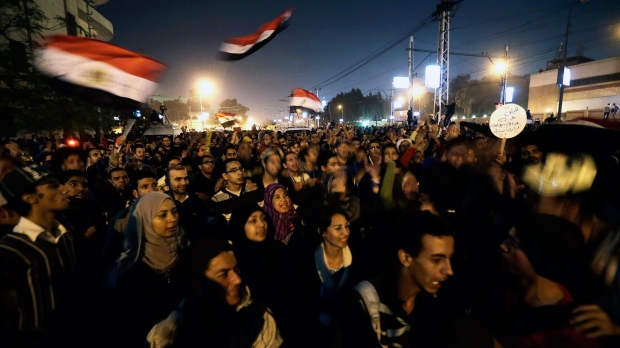
Egypt has become a country of duelling demonstrations and rising civil conflict. Today, Friday December 7, tens of thousands demonstrate in iconic Tahrir Square and outside the presidential palace demanding that President Morsi rescind his decree granting himself extraordinary powers and to cancel the divisive constitutional referendum scheduled for December 15. Thousands more demonstrate in Alexandria, Suez, Mahalla and around the country. This follows three other major demonstrations that have mobilized hundreds of thousands of Egyptians against the decree.

On the other side of town, the Muslim Brotherhood – from which Morsi hails and was a long-time senior leader – along with their ultra-conservative Salafist allies demand that Egyptians obey the “legitimate” president. They have massed outside the independent TV stations that are concentrated in one area of Cairo, demanding “unbiased coverage”. There were reports that they had stormed the buildings. Last weekend the MB and their allies mobilized hundreds of thousands to demonstrate their support for President Morsi and for Sharia law.

Beyond mere protesting, the conflict has quickly escalated to violence – people on both sides have been killed and likely thousands have been injured. It’s not clear who started the street violence first – scattered reports have suggested it was MB members attacking opposition protests – but there can be no doubt that the cause of this conflict lies squarely with Morsi and with the Brotherhood and their allies.

For months Morsi’s government has conciliated with the military and the old Mubarak apparatus, permitting torture and military trials of civilians to continue, restricting labour rights, refusing to recognize independent unions and more. They have bent over backwards to accommodate the wealthy, including agreeing an IMF loan that will lead to terrible austerity.

MUSLIM BROTHERHOOD CONSTITUTION

It is now clear that Morsi’s and the Brotherhood’s main goal was to pass a constitution that enshrined the principles of their organization as the main guiding principles of Egypt. The attempt to window-dress it with a few belated and minor concessions to the demands of the revolution – in particular re-trying those cops and regime officials who were acquitted of murdering revolutionaries – didn’t wash.

In some ways this isn’t surprising. The MB leadership were always very hesitant supporters of the revolution, holding back their members from participating in the demonstrations in Tahrir Square in the lead up to the February, 2011 revolution. It was only when the movement threatened to surpass and leave them behind that they threw their weight behind it reluctantly. Still, at every opportunity, they backed away from confronting the military, sought to conciliate with them and even met with the SCAF to work out a deal to reduce social tensions.

But it seems that Morsi and the MB leadership are too used to being the only organized opposition in Egypt. When demonstrations and rioting exploded onto the streets of Egypt they were caught off guard. They have handled the emergence of a mass opposition movement with utter incompetence and heavy-handedness.

The decree that granted Morsi extraordinary powers – more even than Mubarak was permitted – was written up without even consulting Morsi’s vice president let alone major opposition figures. Nor has Morsi shown any ability to compromise or seriously dialogue with the opposition that exists. At each step, when he hasn’t simply disappeared from view, he has escalated the tension.

His response to the unprecedented protests and strikes by judges was to speed up the already discredited constitutional process. The Constituent Assembly, undermined by the walk-out by pretty much everyone who wasn’t an Islamist, cranked out the constitution in 48 hours. It became clear that the intentions of the MB and their Salafist allies were to enshrine their agenda in law. Post-factum offers to talk about how the constitution might be changed after it is accepted have been taken as insults by the opposition.

The straw that may have broken the back of Morsi’s legitimacy, and which threatens to plunge Egypt into civil war, was the MB’s call for protestors to go to the “cleanse” the area around the presidential on Wednesday, even though an opposition sit-in of several hundred was camped out there. When an MB spokesman was asked by the media about the possibility of violence he replied “whatever happens, happens.”

Unsurprisingly it led to a major conflict with the result that seven people died, including a well-known reporter who supported the revolution, and over 700 were injured. The explosion of fury across the nation led to the torching of numerous Brotherhood and Freedom & Justice Party – the MB’s political party – offices.

The anger was made worse by the fact that the MB/FJP blatantly lied about what was going on. As their members were beating protestors with clubs and fists, and later with pellet and shot guns, they claimed that it was the other way around. They claimed that the dead, primarily opposition protestors, were all MB members. Official statements, including from Morsi claimed that all the violence was from the opposition side, hinting at a dark conspiracy that reminded many of Mubarak’s tactics for silencing dissent.

All of these missteps and escalations by the MB have now made it very difficult to pull Egypt back from the brink of major civil conflict. The spirit of the revolution – bread, freedom and social justice – is embodied in the opposition movement. But unlike Mubarak’s regime that could mobilize little, the MB have a large base of supporters who they can mobilize and who believe fervently in their organizations and their leadership. Street mobilizations alone will probably not be enough to defeat, convince and demoralize this deeply rooted organization. Ultimately, a real victory will require the same kind of strike action by workers that brought down Mubarak.
DreamHost Promotional Codes