Showing posts with label SCAF. Show all posts

Monday, July 8, 2013

Massacre in Egypt: Is Revolution Worth The Price?

As I sat down to write this post the news of a tragic massacre of at least 32 Muslim Brotherhood-affiliated protestors, and the injury of 300 more was plastered all over the internet. That much is clear, the rest is yet to be disentangled (if ever) from two completely opposing stories by the Egyptian military and people on the scene. This is now one more massacre in a two year revolutionary process in which hundreds have died, chaos has reigned and nothing has been settled. I'm sure that millions of people in Egypt and even more around the region and around the world are asking: Is this what is necessary to win democracy and freedom? Is the price worth it?

There is obviously the danger of being glib in writing a judgment on the value or danger of  revolution from the safety of my office in Toronto, Canada - a country founded on the solid business principle of avoiding the messiness of revolution; a country that hasn't seen war in any significant way in 200 years. I'll try to avoid that as much as possible.

For certain the revolutionary process in the Middle East more generally, since the launch of what has become known as the Arab Spring, has had its share of chaos and tragedy. Dozens died in Bahrain in the struggle for democracy against a US/Saudi client regime - and suffered greater repression as a reward for their efforts and aspirations. In Yemen hundreds died only to see their aspirations deflected into a shabby compromise  that suited regional power-brokers - Saudi Arabia and the US (their involvement in aborting democratic movements is a theme and not a coincidence). In Libya, the west and their backers in the Middle East, in particular the Qatari emirate, swooped in quickly to ensure that the initial explosion of grassroots opposition to the Gaddafi dictatorship was controlled using western arms and logistics to suit the ends desired by the big oil companies, the US state department and the agenda of the EU. In Syria the repression of a popular movement led to civil war and the sickening sight of various imperialist powers - all of whom have happily repressed democratic movements around the world for generations - jockeying to gain the upper hand through the cynical manipulation of the various players caught in the Syrian tragedy. As always it is at the expense of local civilians, whether man, woman or child. As a former US Secretary of State, Madeleine Albright, once put it when asked about US sanctions against Iraq that had killed perhaps a million children: "We think that the price is worth it."

And yet, it isn't as though the region or Egypt, in particular, is descending into tragedy from a state of pre-revolutionary bliss. The meddling of imperialism - from US financing of the military in Egypt and of the Occupation in Israel/Palestine to Russian arming of the Syrian dictatorship - has ensured a repressive and inhumane set-up in the region. And for the people of Egypt, in particular since the Camp David Peace Accords of the late 1970s, which won the compliance of the Egyptian state to the American agenda in return for billions of dollars in "aid", it has meant decades of, effectively, martial law, police repression, torture and dictatorship in all but name. The compliance of the Egyptian regime also freed Israel's hand to steal more land, kill more Palestinians and launch wars and attacks on their neighbours whenever it suited their colonialist agenda. All this was largely ignored by western media who, when they even bothered to notice, usually put the blame at the feet of "uncivilized Arabs" who needed "strong regimes" to maintain control and protect Israel, the "plucky little democracy" of the region.

What has changed in the present moment is that the masses, the tens of millions of people who have endured the tender mercies of imperialist-backed dictatorships, have attempted to force their way onto the political and historical stage. The "chaos" and "instability" that the media and governments bemoan is really the emergence of democracy in the form of the people waking up to their own power to control their destiny. In the first instance this is, by definition, chaotic as the old institutions, designed to guarantee dictatorship and the rule of both state and market capital, are destabilized and collapse. The ruling class loses many of the levers, primarily fear and quiescence, that it once had to maintain "order" and "stabillty". On the other hand, the newly awakened people haven't yet created their own institutions to replace the old. In this gap between old and new is a ferment of experimentation. Some of it involves the creation of new forms of organization - Egypt saw neighbourhood committees to defend the revolution appear and disappear, only to reappear again during the past two and a half years. There has been an explosion of independent trade unions involving millions of Egyptian workers, after decades of top-down, state controlled "unions". 

But they also attempt to use their old organizations and old institutions in new ways. Thus the Muslim Brotherhood, which has existed for almost a century as an organization that sought to alleviate the conditions in Egypt through charity and moral uplift (basically, obedience to a hierarchical and conservative interpretation of Islam) became the immediate beneficiary of a revolution that they didn't support. Similarly, the military has retained the allegiance of the masses from the reflected prestige of Gamal Abdel Nasser, who led the Free Officer's Movement that overthrew the Egyptian monarch and promoted a form of secular nationalism that challenged imperialism (before being sold off to US imperialism by his heirs) and delivered land reform and social progress. The revolution has become an intense testing ground for these institutions and organizations to see if they fit the needs of the masses.

First the Supreme Council of the Armed Forces took over the direct rule of the country after they facilitated the overthrow of the dictator Hosni Mubarak. But their habitual use of repression, torture and corruption, not to mention genetic opposition to the extension of democracy and social justice created growing anger and mobilization that forced them to surrender office to the Muslim Brotherhood. For the SCAF the conservative MB seemed an excellent vehicle to contain the aspirations of the revolution. They would allow the MB to implement their cultural agenda, a certain degree of Islamization of the Egyptian state, and in return the MB wouldn't touch the institutions of the state security apparatus, including the SCAF itself. The bourgeois led MB also happily went to the IMF for loans and imposed austerity on their own supporters at home in order to implement a neo-liberal agenda. The result was an increasingly mobilized opposition that drew up to 20 million demonstrators on June 30.

It was this "dangerous" mobilization, as with the overthrow of Mubarak, and the threat of major strikes that pushed the SCAF to remove Morsi from power and attempt to replace him with another set of faces, a grand coalition, that would be more acceptable to the masses, It was a pre-emptive attempt to prevent a deeper, more radical revolution. In this sense it was a major victory.

There are several dangers unfolding and that will continue to unfold until the revolution can be completed (and spread to other countries in the region at least, especially Saudi Arabia). Because the military facilitated the removal of Morsy it can empower and embolden them to use their renewed popularity to clampdown not only on the MB but also on the revolutionaries and the popular organizations as well. SCAF's intervention "from above" can also stop the rapid disintegration of the MB that was taking place "from below", giving them the mantle of victim of a Mubarak counter-revolution. This can draw even those skeptical of the MB leadership's intentions and abilities to rally round them in the belief that they are defending the revolution - a revolution that the MB leadership never supported and tried to abort as soon as Mubarak was gone, including supporting the SCAF at every turn (except the one that booted them out the door). This polarization of "masses against masses" as opposed to "masses against the state" opens the door to a potential civil war, on the one hand, and provides an excuse for the SCAF to elevate themselves as being above the fray and thus the legitimate vehicle to separate the two sides and impose a neutral order on the Egyptian people. 

It remains to be seen if the massacre of MB supporters outside of the Republican Guard barracks today was the result of a MB attempt to storm the facility and free former president Morsy from his arrest (with the side benefit of portraying themselves as victims of an army assault if they failed) or the army decided to raise the stakes to provide justification for declaring a state of emergency - or if it were all the result of trigger happy soldiers firing on riled up MB supporters who got too close to barricades (there is no shortage of such "accidents" of history). What is clear is that navigating this confusing terrain and clarifying the next steps in the struggle will require a clear leadership with roots amongst the Egyptian people in order to avoid the twin dangers of supporting the army against the MB or falling in behind the MB as the defenders of the revolution - either of which could lead towards a civil war and defeat of the revolution. That leadership isn't about a few brilliant individuals calling the shots, it will have to be a collective leadership of thousands and tens of thousands of revolutionaries whose collective experience will help them to navigate the chaos and work with others inside the revolution to move things forward. In other words, a revolutionary party.

That doesn't exist yet in Egypt but there are thousands attempting to build one. In the meantime, what is clear is that as in all places the people who have power have no interest in giving it up and will stoop to any depth necessary - murder, torture, conspiracies, lies - to defend what they have. The tragedy and chaos of the present moment is not the result of the revolution, it is the result of that unaccountable an unequally divided power. The solution to ending the tragedy of massacres and misery is not to surrender to the power that imposes such tragedy upon the people. It is to decisively defeat that power so that it is unable to prevent the people from living in freedom and true democracy.

Friday, December 7, 2012

Egypt In The Balance


Between hope & civil war?
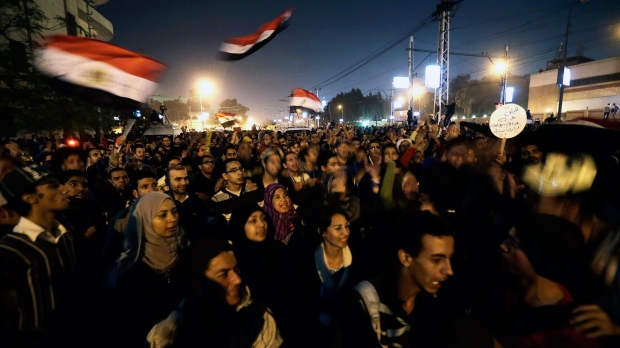
Egypt has become a country of duelling demonstrations and rising civil conflict. Today, Friday December 7, tens of thousands demonstrate in iconic Tahrir Square and outside the presidential palace demanding that President Morsi rescind his decree granting himself extraordinary powers and to cancel the divisive constitutional referendum scheduled for December 15. Thousands more demonstrate in Alexandria, Suez, Mahalla and around the country. This follows three other major demonstrations that have mobilized hundreds of thousands of Egyptians against the decree.

On the other side of town, the Muslim Brotherhood – from which Morsi hails and was a long-time senior leader – along with their ultra-conservative Salafist allies demand that Egyptians obey the “legitimate” president. They have massed outside the independent TV stations that are concentrated in one area of Cairo, demanding “unbiased coverage”. There were reports that they had stormed the buildings. Last weekend the MB and their allies mobilized hundreds of thousands to demonstrate their support for President Morsi and for Sharia law.

Beyond mere protesting, the conflict has quickly escalated to violence – people on both sides have been killed and likely thousands have been injured. It’s not clear who started the street violence first – scattered reports have suggested it was MB members attacking opposition protests – but there can be no doubt that the cause of this conflict lies squarely with Morsi and with the Brotherhood and their allies.

For months Morsi’s government has conciliated with the military and the old Mubarak apparatus, permitting torture and military trials of civilians to continue, restricting labour rights, refusing to recognize independent unions and more. They have bent over backwards to accommodate the wealthy, including agreeing an IMF loan that will lead to terrible austerity.

MUSLIM BROTHERHOOD CONSTITUTION

It is now clear that Morsi’s and the Brotherhood’s main goal was to pass a constitution that enshrined the principles of their organization as the main guiding principles of Egypt. The attempt to window-dress it with a few belated and minor concessions to the demands of the revolution – in particular re-trying those cops and regime officials who were acquitted of murdering revolutionaries – didn’t wash.

In some ways this isn’t surprising. The MB leadership were always very hesitant supporters of the revolution, holding back their members from participating in the demonstrations in Tahrir Square in the lead up to the February, 2011 revolution. It was only when the movement threatened to surpass and leave them behind that they threw their weight behind it reluctantly. Still, at every opportunity, they backed away from confronting the military, sought to conciliate with them and even met with the SCAF to work out a deal to reduce social tensions.

But it seems that Morsi and the MB leadership are too used to being the only organized opposition in Egypt. When demonstrations and rioting exploded onto the streets of Egypt they were caught off guard. They have handled the emergence of a mass opposition movement with utter incompetence and heavy-handedness.

The decree that granted Morsi extraordinary powers – more even than Mubarak was permitted – was written up without even consulting Morsi’s vice president let alone major opposition figures. Nor has Morsi shown any ability to compromise or seriously dialogue with the opposition that exists. At each step, when he hasn’t simply disappeared from view, he has escalated the tension.

His response to the unprecedented protests and strikes by judges was to speed up the already discredited constitutional process. The Constituent Assembly, undermined by the walk-out by pretty much everyone who wasn’t an Islamist, cranked out the constitution in 48 hours. It became clear that the intentions of the MB and their Salafist allies were to enshrine their agenda in law. Post-factum offers to talk about how the constitution might be changed after it is accepted have been taken as insults by the opposition.

The straw that may have broken the back of Morsi’s legitimacy, and which threatens to plunge Egypt into civil war, was the MB’s call for protestors to go to the “cleanse” the area around the presidential on Wednesday, even though an opposition sit-in of several hundred was camped out there. When an MB spokesman was asked by the media about the possibility of violence he replied “whatever happens, happens.”

Unsurprisingly it led to a major conflict with the result that seven people died, including a well-known reporter who supported the revolution, and over 700 were injured. The explosion of fury across the nation led to the torching of numerous Brotherhood and Freedom & Justice Party – the MB’s political party – offices.

The anger was made worse by the fact that the MB/FJP blatantly lied about what was going on. As their members were beating protestors with clubs and fists, and later with pellet and shot guns, they claimed that it was the other way around. They claimed that the dead, primarily opposition protestors, were all MB members. Official statements, including from Morsi claimed that all the violence was from the opposition side, hinting at a dark conspiracy that reminded many of Mubarak’s tactics for silencing dissent.

All of these missteps and escalations by the MB have now made it very difficult to pull Egypt back from the brink of major civil conflict. The spirit of the revolution – bread, freedom and social justice – is embodied in the opposition movement. But unlike Mubarak’s regime that could mobilize little, the MB have a large base of supporters who they can mobilize and who believe fervently in their organizations and their leadership. Street mobilizations alone will probably not be enough to defeat, convince and demoralize this deeply rooted organization. Ultimately, a real victory will require the same kind of strike action by workers that brought down Mubarak.

Friday, November 25, 2011

Egypt: Even Obama Knows The Military Are Toast

It's possible that the Supreme Council of the Armed Forces, the military junta that has ruled Egypt since Hosni Mubarak was overthrown last February, will regain the initiative but it will be very difficult. After months of whittling away at the momentum and morale of the revolutionary movement with arrests, torture and the suppression of protests and strikes - including committing a massacre against minority Copts protesting against sectarian terror that left 24 dead, by last week it seemed that SCAF had the upper hand.

But SCAF demonstrated once again that great historical lesson, that arrogant rulers who are contemptuous and out of touch with those over whom they rule will inevitably push too far. In this case it was their announced intention to implement constitutional amendments that would have elevated the military above the state, shielding it from oversight of its budget and granting it a veto over any civilian policies that affected it. It's worth noting that the military is not just confined to the military but owns and controls about one-third of the Egyptian economy. Their violent attack on the tiny, remaining encampment in Tahrir Square last Saturday was the final straw.

The re-emergence of the revolution's momentum has been so swift and so overwhelming that it has caught everyone by surprise. The military's response - to send in the hard cops, the Central Security Force - to suppress the swelling protests with a carte blanche on the use of violence backfired even further. It is a useful reminder that a revolution needs an enemy to battle and while the nibbles of repressive attrition can sap the will, a frontal assault, on the other hand, can provide a stable target on which people can focus their anger. As I write there may well be one million people in Tahrir Square demanding the overthrow of the military council that was loved and supported as an ally of the revolution only a few months ago.

What is even more surprising in this new phase is the apparent fracturing of the base of the Muslim Brotherhood. Around for a century, the MB have long been the largest and best organized oppositional force in Egypt. Millions follow the MB, which has hundreds of thousands of disciplined members. But the brutality of the Mubarak dictatorship made the MB appear more radical than they actually were and now that space has opened up for the possibility of real and profound change, the MB are demonstrating that they weren't so very radical after all. On the one hand, it doesn't do to be dismissive of the MB as a bunch of counter-revolutionaries, not only because tens of thousands of their members have played important and leading roles in the present revolution even against the wishes of their leaders. But also because it misses the point that the MB's quietism and desire to keep its head down and focus on the elections is, in part, a function of the experience of holding together an oppositional organization under a dictatorship where leaders and cadre suffered imprisonment and torture. The conservatism that was necessary in normal times now appears as pure opportunism when the political arena has been so radically transformed.

The irony of this new phase of the revolution is that it may well not only destroy the SCAF as the ruling force in the country - and profoundly weaken the command structure as middle level officers appear to be going over to the revolution in growing numbers. It may also shatter the long standing centre of opposition to the military.

The American government clearly sees this process unfolding and is panicking a bit at the direction the revolution could take its largest Arab ally - recipient of $1.3 billion in military aid every year (like the tear gas and rubber bullets being used on protestors). Remember back in January when vice president Joe Biden said in an interview that Mubarak was "our" friend and wasn't a dictator? Remember how Hilary Clinton preached a process of slow reform involving Mubarak? How Obama said nothing? They've learned to that they need to get ahead of the curve in order to control the revolutionary process - as they did in Libya where the "revolutionary government" is a pliant client regime for the west. And they clearly now understand that once things degenerate to a certain point, repression only makes things worse, something that the SCAF seems to have missed. But, given their preference for dictatorships over democracies the White House must think that things are pretty bad to come out publicly in support of the demands of the revolution.


Egypt Military and Protesters Dig In for Tahrir Square Standoff - NYTimes.com:

Tuesday, August 2, 2011

Egypt, Revolution & Islamism

Secular protesters retake Tahrir Square after Islamist's depart. They chant
for a secular state and against the military leadership.
While outside commentators have repeatedly suggested that Egypt's revolution has stalled or gone backwards, it seems more accurate to suggest that the revolution is maturing as it continues to develop. Revolutions are periods in which politics speeds up and processes that previously took decades - in terms of changes in consciousness, institutions and social conditions - now happen over night. There is an inevitable back and forth as new forces surge forward, while older established institutions may push back or, for a time, drive the revolutionary wave in order to better control it. A prime example of this was the support by the Supreme Council of the Armed Forces (SCAF) during the phase of the revolution leading up to the overthrow of Mubarak. With the explosion of protests and strikes sweeping Egypt, the generals - all of them Mubarak appointees, some of them lifelong friends - recognized that the only way to control the revolution was to force the resignation of Mubarak, declare their support for the revolution and use their prestige to try to undermine any further developments. Since that time they have combined verbal support for the revolution, along with limited concessions, with continued repression of activists, the outlawing of strikes and support for counter-revolutionary forces.

Nonetheless, the revolution has continued to advance, though it faces new challenges and serious dangers at each new phase in the struggle. Friday's Islamist dominated protest in Tahrir Square, including the forcible exclusion of secular parties, even though an agreement had been struck prior to the protest declaring it a "Friday of Unity & the People's Will", was a clear demonstration that the revolution has entered what might be considered its third phase.

In the first phase of the revolution, there was a spontaneous outburst of popular anger against Mubarak. All classes and ideologies came together with one clear purpose: to overthrow Mubarak. Under the general slogans of democracy and an end to the dictatorship very disparate groups could work together. In the case of the Muslim Brotherhood's leadership, it was very much against their instincts and often kicking and screaming that they were dragged into the revolutionary wave. This was an intense but relatively short phase that ended with the overthrow of Mubarak and a period of euphoria and support for the military, most clear exemplified by the slogan "the people and the army are one hand." The truth was that the army was itself not "one hand" but was divided between the lower ranks and the upper, with the danger that the conscript army might split or go over to the revolution wholesale, leading to its collapse. But because the SCAF came out quickly in favour of the revolution, they maintained and built their prestige amongst the population.
However, once Mubarak was gone, a new phase opened up. The central protests continued but these became less important than the local struggles. Strikes erupted in large numbers and there was an explosion of different forms of civil disobedience as local committees, newly formed independent unions and peasant organizations pressed their specific demands. As this excellent overview of "act two" of the revolution describes it, local struggles exploded. It is worth quoting at length:

The workers' movement has advanced since the strikes of early February which played a key role in convincing military leaders to remove Mubarak. Every area of industry has been affected, with numerous actions organised by workplace and union groups on pressing issues: wages, contracts, pensions, conditions, union rights, welfare provision, and bullying and corrupt managements....

According to activists in Cairo, during February there were 500 separate industrial actions, while in March the level dropped to 200. But in April the level rose again and in May there were new developments including the first nationwide doctors' strike. This demanded radical reform of the health service in the name of social justice. The doctors' syndicate, formerly a mainly conservative professional association, has been deeply affected by the mood of the mass of the population. It organised for indefinite strike action to secure improved wages and an increase in government spending on health from 3.5 percent to 15 percent of the national budget....

In the countryside there have been over 100,000 "encroachments" on private property since the revolution began. These are mainly actions by peasants attempting to retrieve land seized by landowning families of the colonial era who have benefited from a law imposed in 1997 allowing former landowners rights to land distributed to fallaheen (cultivators) under reforms of the 1950s and 1960s...

A new development is the establishment of independent peasant unions which support collective action including retrieval of land. In May a conference held in the village of Kamshish, a historic centre of peasant struggles, founded a new Union of Egyptian Farmers. Among its aims is the building of a national co-operative movement run by farmers at grassroots level.

In cities and villages across the country neighbourhood action groups have proliferated. As Popular Committees to Defend the Revolution they were formed initially to protect local communities from gangs of plainclothes police like those which battled activists in Tahrir Square in February. The committees have since led campaigns to purge corrupt officials, to reform public services including education, health, water supply and sewerage, and to tackle local issues such as control of traffic. Their national coordinating body met for the first time in Tahrir Square in April.

But while struggle was rising based upon "local" issues, the military rulers were applying growing pressure on the movements through the arrests of activists who were then sent to military tribunals. They increased their propaganda, accusing worker activists of acting against the interests of the revolution. Meanwhile police and former regime figures who were charged with murdering activists during the revolution or engaging in corrupt practices to enrich themselves, were set to be tried by civilian courts. Except that those trials rarely happened and the accused were given lax bail terms. By the time there was a renewed explosion of protest in Tahrir in June and July, only one former regime figure had been found guilty - and he was out of the country. It made it inevitable that the local and economic issues would begin to re-converge around questions of the direction of the revolution.

These battles also put pressure on the Muslim Brotherhood - the largest opposition force in the country. Composed of disparate social forces from big bourgeois to students and independent businessmen as well as the urban poor, the Brotherhood has a history of fracturing at key historical moments. Inevitably the different social forces are pulled in different directions under the pressure of polarizing events. In this case, the youth wing were drawn strongly to the revolution and worked side by side with secular and leftist activists. By June the Brotherhood leadership expelled some leading youth activists who were involved with the revolution's youth committee, which had been central to the early mobilizations that brought down Mubarak. There were also splits, including by some leading members who disagreed with the Brotherhood's strategies on the revolution, on the nature of their planned participation in the electoral process, on how radically to challenge SCAF, etc.

Faced with this pressure the Brotherhood's leadership seems to have responded in a couple of ways. Firstly, it now uses the rhetoric of the revolution, which is necessary to have any credibility in post-Mubarak Egypt. At the same time it has worked with the SCAF to try and corral the revolutionary movement into the least profound forms of democratic change. It has opposed attacks on SCAF and has backed SCAF's opposition to strikes and demonstrations, as discussed on this article.

In relation to the social deepening of the revolution with the great wave of strikes which were triggered by the uprising, the Brotherhood took the same position as the government and the Military Council, demanding "a return to work to save the Egyptian economy. The Muslim Brotherhood calls on all sections of the Egyptian people to keep the wheels of production and development turning. Demonstrations for sectional demands, albeit a fundamental right, are detrimental to production and damage the economy, particularly as the revolution is linked to keeping the motor of the economy turning. Citizens must feel that their sacrifices in the search for a dignified life were not just empty talk, so that the Egyptian people can prove that they are capable of a further achievement beyond the revolution, in other words, to lift Egypt out of its economic crisis."

It seems clear that these attempts to play the same game as the military in supporting the revolution all the better to strangle it, the Brotherhood has had as little success as the military. While strikes declined in March after the great explosion in February, they rose again in April and there continue to be more independent unions established every week. And, of course, the movement once again took up the demands of the overall revolution - for the resignation and prosecution of regime figures, especially Mubarak; for an end to military trials of civilians; for a raising of the minimum wage, etc. This reinvigoration came from the fact that the movement had built in strength and depth through its success in the local arena and because the military resisted implementing the demands of the revolution so completely that their betrayal was now apparent. The Brotherhood responded by backing some of the demands - though insisting that calls for the overthrow of the SCAF were removed from any protest in which it took part. But with Friday's Islamist hijacked protest, it seems clear that the Brotherhood has decided that a more forceful hand is needed to put a lid on the further deepening of the revolution.

What is interesting is that the Brotherhood's leadership doesn't feel confident to use their own organization as the direct battering ram to attack the secular and leftist leaders of the revolution. They instead used the Salafists - fundamentalists - as the battering ram to test the strength and resolve of the revolution in what can only be a first battle. It should be noted that the Salafists are not simply the Islamist arm of the revolution - as Khomeini's party was in Iran. They are counter-revolutionary. From the same article quoted above:

Salafists are currently the Islamic wing of the "baltagiyya"(the counter-revolutionary thugs who attacked protesters in Tahrir Square) and their relationship to the security apparatus of the former regime is much more important than their relations with the Muslim Brotherhood. Since 2006 the Mubarak regime allowed the creation of Salafist satellite channels, which have been airing their poisonous views since that time, broadcasting a permanent stream of reactionary anti-Christian, anti-woman propaganda, as well as agitating against Muslims who do not share their views, in an attempt to drag the masses back to the Middle Ages.

The protest itself was originally going to be a protest for the implementation of Sharia and the use of the Koran as the constitution of Egypt. It was directly posed as an attack on secularism. But a deal was struck at the last minute with secular activists to instead make it a "Friday of Unity & the People's Will", focusing on the demands of ending repression, speeding up the trials of regime figures, raising the minimum wage, etc. But early in the morning, the Salafists showed up and hung banners calling for Islam to be placed above the constitution, for the implementation of Sharia - obviously not popular with either secularists or Coptic Christians - and other religiously conservative slogans. The Salafists also excluded secular spokespeople from the stage and harassed them in the tent city sit-in in the centre of the square. While the Brotherhood's spokesperson distanced them from the actions of the Salafists, it is clear that the Salafists only acted with such confidence because of the tacit backing of the Brotherhood leadership. What is also clear, however, is that the Brotherhood couldn't use their own "troops" because they are profoundly split with many in their youth wing, in particular, seeing the secular activists as their comrades, as this account of the events by Egyptian journalist Hossam el-Hamalawy makes clear:

To be fair, some young Muslim Brotherhood organizers tried to intervene and control the situation, but they failed. The ones who mainly broke the agreement were the Salafis. Over hours and hours, till Friday 7pm, Tens of thousands of Islamists were chanting for Sharia, the Quran as a constitution, intimidated secular activists and non-veiled women...

While leaders of the Islamist forces are knee-deep in their opportunism and clientalism to SCAF, I continue to be hopeful that the Islamist youth, those who defied their leaders and took part in the uprising shoulder to shoulder with their leftist and liberal brothers and sisters, would break the ranks and join us.

This fragmenting of the base of the Muslim Brotherhood as a result of the radicalization and broadening of the base of the revolution will be a key dynamic in this next phase of the revolution. So too, it now seems clear, will be their increasingly open and bellicose relationship with the counter-revolution - both in their support of the SCAF but also in supporting the reactionary foot soldiers of the Salafis. So, it's inspiring and important to note that immediately after the departure of the Salafis and conservative Islamists on Friday, the Square filled with protesters demanding a civil and secular state. They also raised slogans against the SCAF - in contrast to the Salafis who chanted in support of the SCAF - ironic given that the army was used to crush the Islamists in the 80s and 90s. This reconquest of the Square was absent in western news coverage, which was filled with the Iran bogeyman - the threat that Egypt could go the way of Iran in the 1970s.

However, there is no Ayatollah Khomeini in Egypt and political developments are nowhere near similar to Iran at the point where the Islamists had gained the upper hand. It seems - at this point - unlikely that the Islamists can replicate the local struggles that are actually winning material gains for the Egyptian people and so while some big central demonstrations, as happened Friday, can be intimidating, it is rather more ephemeral than the explosion of workers' unions, peasant unions, and neighbourhood committees to defend and deepen the revolution. This is a revolution that has nowhere near run its course.
DreamHost Promotional Codes