Showing posts with label Amr Moussa. Show all posts

Friday, December 14, 2012

Egypt: Tension, Conflict & Chaos Rein On Eve Of Vote


 With only a few hours to go until the polls open in the first phase of Egypt’s referendum on a proposed constitution, tension is high. Alexandria has become a symbol of this tension when a controversial local imam, Ahmed El-Mahalawy, urged worshippers to vote yes.

Mahalawy has a long history of urging sectarian attacks against Christians and non-believers. But even in his mosque he was challenged by a worshipper who was immediately set-upon by Muslim Brotherhood worshippers who beat him.

Ultimately conflict spilled outside the mosque, including the arrival of conservative Salafists with swords and knives. A gathering of anti-constitution protesters disarmed and beat the men and torched their cars before the riot police arrived. However, as we went to press the mosque was still surrounded after the imam took several protestors hostage and tortured them.

It was unclear if any of the protesters were still inside, several had been released. 

There were also other scattered reports of oppositionists being attacked and Muslim Brotherhood offices being vandalized. It’s clear that tensions across the country are extremely high.

This situation hasn’t been helped by the continuing inflammatory rhetoric by Muslim Brotherhood leaders, including President Morsy, and their Salafist allies. Morsy made a speech denouncing the opposition as counter-revolutionaries. There has been talk of thousands of martyrs and death threats against TV news anchors.

It remains to be seen what will happen when the polls open but there is every possibility, given the shambolic way that the Brotherhood and Morsy have handled the present crisis up till the present, that chaos will be the order of the day.

The sense on the ground is that few preparations have been made and that there aren’t even enough neutral observers, let alone outside observers & NGOs, to guarantee a fair vote.

With the majority of judges boycotting supervising the election Morsy had to pass a law splitting the vote up into two dates. But even with this measure to ameliorate the pressure on the few that have agreed to supervise, it is possible that there won’t be enough. It’s not even clear if the government knows who will and who won’t supervise.

"The commission has published on its website the names of judges who are scheduled to supervise the referendum, but I assure you that among those names are 2,930 judges who decided to boycott the elections' oversight," said Judges’ Club spokesperson Shady Khalifa.
It’s entirely possible that people will show up at their polling stations – if they know where they are located – and won’t be able to vote or the poll will be unsupervised. The entire legal status of this constitution, rushed through by the Brotherhood and their allies, could be called into doubt.

There is every likelihood that the Brotherhood’s heavy-handed fumbling of this self-inflicted political crisis will haunt them and that even a formal victory in the referendum will lack legitimacy. Combine this with the looming austerity measures – announced and then withdrawn by Morsy this week – and there is a recipe for further social explosions.

Whatever else happens, the Brotherhood has badly damaged their reputation. It’s not clear how they’ll recover.

Friday, December 7, 2012

Egypt In The Balance


Between hope & civil war?
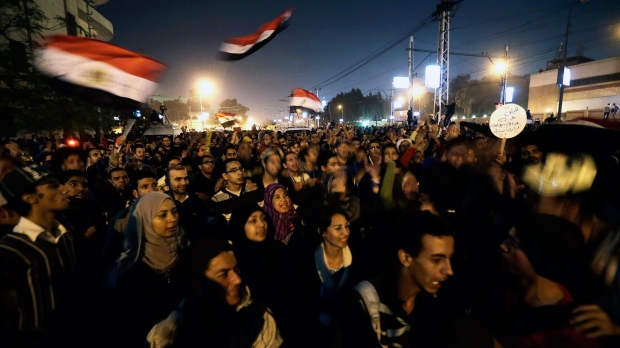
Egypt has become a country of duelling demonstrations and rising civil conflict. Today, Friday December 7, tens of thousands demonstrate in iconic Tahrir Square and outside the presidential palace demanding that President Morsi rescind his decree granting himself extraordinary powers and to cancel the divisive constitutional referendum scheduled for December 15. Thousands more demonstrate in Alexandria, Suez, Mahalla and around the country. This follows three other major demonstrations that have mobilized hundreds of thousands of Egyptians against the decree.

On the other side of town, the Muslim Brotherhood – from which Morsi hails and was a long-time senior leader – along with their ultra-conservative Salafist allies demand that Egyptians obey the “legitimate” president. They have massed outside the independent TV stations that are concentrated in one area of Cairo, demanding “unbiased coverage”. There were reports that they had stormed the buildings. Last weekend the MB and their allies mobilized hundreds of thousands to demonstrate their support for President Morsi and for Sharia law.

Beyond mere protesting, the conflict has quickly escalated to violence – people on both sides have been killed and likely thousands have been injured. It’s not clear who started the street violence first – scattered reports have suggested it was MB members attacking opposition protests – but there can be no doubt that the cause of this conflict lies squarely with Morsi and with the Brotherhood and their allies.

For months Morsi’s government has conciliated with the military and the old Mubarak apparatus, permitting torture and military trials of civilians to continue, restricting labour rights, refusing to recognize independent unions and more. They have bent over backwards to accommodate the wealthy, including agreeing an IMF loan that will lead to terrible austerity.

MUSLIM BROTHERHOOD CONSTITUTION

It is now clear that Morsi’s and the Brotherhood’s main goal was to pass a constitution that enshrined the principles of their organization as the main guiding principles of Egypt. The attempt to window-dress it with a few belated and minor concessions to the demands of the revolution – in particular re-trying those cops and regime officials who were acquitted of murdering revolutionaries – didn’t wash.

In some ways this isn’t surprising. The MB leadership were always very hesitant supporters of the revolution, holding back their members from participating in the demonstrations in Tahrir Square in the lead up to the February, 2011 revolution. It was only when the movement threatened to surpass and leave them behind that they threw their weight behind it reluctantly. Still, at every opportunity, they backed away from confronting the military, sought to conciliate with them and even met with the SCAF to work out a deal to reduce social tensions.

But it seems that Morsi and the MB leadership are too used to being the only organized opposition in Egypt. When demonstrations and rioting exploded onto the streets of Egypt they were caught off guard. They have handled the emergence of a mass opposition movement with utter incompetence and heavy-handedness.

The decree that granted Morsi extraordinary powers – more even than Mubarak was permitted – was written up without even consulting Morsi’s vice president let alone major opposition figures. Nor has Morsi shown any ability to compromise or seriously dialogue with the opposition that exists. At each step, when he hasn’t simply disappeared from view, he has escalated the tension.

His response to the unprecedented protests and strikes by judges was to speed up the already discredited constitutional process. The Constituent Assembly, undermined by the walk-out by pretty much everyone who wasn’t an Islamist, cranked out the constitution in 48 hours. It became clear that the intentions of the MB and their Salafist allies were to enshrine their agenda in law. Post-factum offers to talk about how the constitution might be changed after it is accepted have been taken as insults by the opposition.

The straw that may have broken the back of Morsi’s legitimacy, and which threatens to plunge Egypt into civil war, was the MB’s call for protestors to go to the “cleanse” the area around the presidential on Wednesday, even though an opposition sit-in of several hundred was camped out there. When an MB spokesman was asked by the media about the possibility of violence he replied “whatever happens, happens.”

Unsurprisingly it led to a major conflict with the result that seven people died, including a well-known reporter who supported the revolution, and over 700 were injured. The explosion of fury across the nation led to the torching of numerous Brotherhood and Freedom & Justice Party – the MB’s political party – offices.

The anger was made worse by the fact that the MB/FJP blatantly lied about what was going on. As their members were beating protestors with clubs and fists, and later with pellet and shot guns, they claimed that it was the other way around. They claimed that the dead, primarily opposition protestors, were all MB members. Official statements, including from Morsi claimed that all the violence was from the opposition side, hinting at a dark conspiracy that reminded many of Mubarak’s tactics for silencing dissent.

All of these missteps and escalations by the MB have now made it very difficult to pull Egypt back from the brink of major civil conflict. The spirit of the revolution – bread, freedom and social justice – is embodied in the opposition movement. But unlike Mubarak’s regime that could mobilize little, the MB have a large base of supporters who they can mobilize and who believe fervently in their organizations and their leadership. Street mobilizations alone will probably not be enough to defeat, convince and demoralize this deeply rooted organization. Ultimately, a real victory will require the same kind of strike action by workers that brought down Mubarak.

Wednesday, June 22, 2011

Is It The End Of NATO?

I suggested the other day that NATO was basically a zombie and that they had already lost - at least in terms of intended political consequences - the war in Libya. It hadn't occurred to me that within a few days there would be infighting, including between core European members of the alliance. Yet that's exactly what we're seeing. Amr Moussa, former head of the Arab League and a big proponent of the original operation is quoted in today's Guardian newspaper as calling for an immediate ceasefire. Moussa is angling for a kick at the Egyptian presidency this year or next and the optics just don't look very good of European fighter jets dropping bombs on an Arab country.

More seriously, Italy is now calling for an immediate ceasefire, while France is calling for an intensification. Italy - along with Germany - has the biggest European economic presence inside Libya. With it looking very unlikely that NATO will be able to oust Gaddafi, those two countries stand the most to lose if Libya retaliates by seizing the property of companies from belligerent countries. Italy has major oil investments in Libya.

If Italy's call for a ceasefire is picked up again by Germany, this could easily create an unstoppable momentum towards a solution that leaves the country looking exactly like it did before NATO came in and blew the hell out of the place - except that Gaddafi's hand has likely been strengthened by his ability to pose as an anti-imperialist. And if NATO leaves Libya with its tail between its legs, this will be the second in a row failure on the battlefield, after Afghanistan. The latter war is looking increasingly like it is starting to wind-down and that a settlement of some sort will be reached with the Taliban, allowing them into government or giving them control of part of the south of the country (according to commentary on Asia Times Online, this was the American proposal, which the Taliban rejected).

NATO has no pretensions of being like the UN, some kind of world parliament (where the big powers get a veto). It is solely a military alliance. But if the military alliance couldn't whup the widely despised dictator of a developing country with a population of six million; and if it can't subdue a ragtag insurgency led by a poorly armed and mostly illiterate guerilla army - then what the hell kind of military alliance is it? Not one that is of any use to America, I'm guessing. Already, departing Defence Secretary Gates has questioned the value of NATO. Look for some tedious soul-searching in the coming months. With the likely default in Greece - potentially a fatal blow to the euro - the discrediting of another venerable European institution is the last thing the ruling classes of Europe need.


Libya deaths trigger rift over NATO campaign - Africa - Al Jazeera English
DreamHost Promotional Codes