Showing posts with label neo-liberalism. Show all posts

Tuesday, November 19, 2013

Norm Kelly v Rob Ford: The Right Wing Mayor Is Dead. Long Live The Right Wing Mayor!

Happier days for the populist right

Well, it was indeed a circus at city hall yesterday. I wasn’t able to attend the performance live but did have the pleasure of watching some of it unfold via the miracle of the interwebs. Those Ford brothers sure know how to do a great imitation of The Sopranos – belligerent, bullying, pulling faces like a couple of 12-year old school yard pricks. Better writers than me have detailed the whole gory affair, including former fan club president, Christie Blatchford.

So, I won’t dwell on the specifics of their performance. Just to note that, in the end, Ford was stripped of much of his power. Of course, it came after a predictable performance that the Ford gang has realized will garner them international attention and ensure, if not a political future, it’s definitely building their media career. A lot of North Americans love UFC. The Fords played to that fan base.

What is more interesting, besides the easy to talk about spectacle, is just what we have gotten in replacement of Rob Ford: Norm Kelly. This is what the left voted for in stripping Rob Ford of his powers – they voted for Norm Kelly to take over the mayoral role. So, who is this guy? Well, certainly he will be less entertaining but will he be “better” for our city? I mean he must be, after all, even council lefty Gord Perks was tweeting that if the Ford bros. tried to remove Kelly before yesterday’s vote they’d just put him back in place so that they could make him interim mayor.


Kelly, made Deputy Mayor by Rob Ford himself, is a political veteran, having been in and out of various levels of office since Trudeau the senior was Prime Minister. He was also once the head of history at Upper Canada College – a prep school for ruling class boys in Toronto. And, most importantly, he’s just as odious as Rob Ford. As he himself said as recently as August, when he was made DM, on his role:
“There has to be a commitment to the core policies and core direction of the mayor...”

He’s not kidding there, in fact, he voted with Ford over 96% of the time. Like Denzil Minnan-Wong, Cesar Palacio and other council right-wingers, Kelly has happily played the role of Ford hatchet man whenever it was needed, removing the TTC chief General Manager Gary Webster back in February, 2012 – at a cost of hundreds of thousands of dollars – because he didn’t furnish Ford’s castle in the sky with the necessary furniture by endorsing his outrageously expensive and impractical subway plan. It should be noted that Kelly previously voted in favour of Miller’s transit city plan seven times. That’s the plan that Ford tore up as soon as he was elected because he wanted subways, not LRT. Of course, at the time Kelly was on Miller’s executive, which is both a demonstration of Miller’s judgment and Kelly’s opportunism.

Besides his role as chief toady, Kelly is also a climate-denier or, as he would say “we just don’t really know anything now do we?” Tell that to the families of the 10,000+ dead in the Philippines. Nor is this some recent aberration, according to this 2003 article in NOW:
[Kelly] holds the distinction of being the only TTC commissioner who doesn’t believe in increased funding for public transit. Member of the city’s powerful policy and finance committee and an unabashed supporter of the Island Airport expansion, Union Station, Front Street extension – you name it. Believes in privatizing waste, water and public housing. One of the worst voting records on council on the environment as well.

So, let’s be honest. Like Minnan-Wong and the rest of the Ford Nation minions at City Hall, the only thing that has changed for Kelly is that Ford’s incompetence has made it impossible for him to implement the austerity agenda that they support. Ford has fallen out of favour with the real powers that be in the city and with the mostly right wing, pro-austerity media. For certain this palace coup includes a fair share of careerist maneuvering by Ford’s former allies, but at its core it’s all about re-arming neo-liberalism on Toronto City Council.

And the left on council are playing the role of enablers – not of Rob Ford’s self-destructive, substance-abusing behavour – but of austerity and privatization. They are helping the right wing to re-arm by helping them remove the right’s own worst enemy. They could have exposed the tawdry nature of this whole spectacle, the dubious nature of the police surveillance operations and the opportunism of council’s right wing. Instead, what they seem to want is “business as usual”, calm and cooperation.

The city council left could have used this crisis as an opportunity to derail the austerity agenda. But they didn’t. And they aren’t alone. Andrea Horwath, provincial NDP leader raised no questions about what is going on at City Hall, endorsing the Liberal government's intention to now deal with Norm Kelly. “If Mr. Kelly is now the person who is the head action person when it comes to city of Toronto decision-making . . . then that’s the appropriate thing to do,” said Horwath. Really? All the NDP can do is big up right-winger Norm Kelly? And the union movement in the city has been no better sadly. Having failed to mobilize any sort of sustained fight against attacks on jobs and conditions by the council right wing, they did manage to make an effort to mobilize an audience in council chambers yesterday to support the right wing’s push to oust Ford. I’m sure Norm Kelly will reward Toronto’s public sector workers with better conditions…not.

Personally, I hope Rob Ford sues city council and exposes further the hypocrisy that resides here - like when Doug Ford opportunistically pointed out that the head of the Police Services Board going on a fishing trip with the Police Chief, Bill Blair, is a major conflict of interest. The more the flailing of the Ford bros tears apart the right wing, discredits these supposedly austere institutions helmed by the responsible elite, and sets them at odds with each other, the better. The left should not be aiding the right to be more effective, they should be "enabling" their self-destruction, helping them hoist themselves on their own petards and exposing their rotten politics in the process.

Seeing this debacle unfold has made me realize that the Rolling Stones had it all wrong. It’s not true that you can’t always get what you want. In this case the left got what it wanted but it most definitely isn’t what we need.

Thursday, November 14, 2013

Ford Saga: Left Gives Cover To Right Wing Palace Coup

Cuts, what cuts? It's all about bad behaviour
photo credit: @HeartsOnTheLeft

Not one word about cuts. Not one word about privatizing garbage collection. Nothing about his refusal to ever attend a single Gay Pride Parade. Zilch about his actual politics. No, everything is focused on his drinking, his drug use and his public displays of such activities. Oh, and in case you didn't notice: he's fat (because that deserves serious political discussion with regards to the mayoralty). The closest we get to something progressive is a councilor pointing out the hypocrisy in Mayor Ford’s “zero tolerance” stance on illegal drugs when he himself has purchased illegal drugs in the last two years.

Make no mistake, this is a right wing coup to get rid of a difficult former front man. That the left is getting caught up in this is a sign of how off the rails the left is, how disconnected it is from ordinary, working class people. I don’t expect much from the “left” on city council. The best that they could do when they were needed was to vote for a study of how efficient garbage privatization was after it was implemented. And, as I’ve said before, when Ford put forward a motion during the G20 debacle to laud the police, most of the left voted for it with 5 members walking out of the chambers in order to avoid having their vote counted. They couldn’t even bring themselves to publicly abstain on a pro-cop vote after all the round-ups of innocents, the kettling, the home invasions, Officer Bubbles, the display of "weapons"by Chief Blair that included a chainsaw and some medieval role playing gear. I’m not sure how you could manage to be more lame and still get out of bed in the morning.

But now they’re all over this, crusaders for truth, justice and democracy – and being led by the nose by right wing Rob Ford ally Denzil Minnan-Wong to, uh, depose Rob Ford. (edit - except for Gord Perks, who opposes deposing elected officials - though I will never forgive him for leaving the room during the G20 vote).

Besides the city council “left”, I’ve also been shocked by some of the stuff I see on Facebook. I’ve seen articles posted attacking Ford’s drug and alcohol use by people who I know have used drugs and alcohol to excess in the past. And done it in public. Some of them even got into fights while doing it. (For the record I have used both, and made an ass out of myself in public more than once. I also strongly believe in decriminalizing drugs so that users aren’t sent to prison and the drugs trade isn’t turned into a high stakes criminal activity involving guns and violence). Then of course there are the fat jokes, always the fat jokes. And the faux outrage because Ford said "eating pussy". Are you serious? I hear people say worse shit in the cash line at the grocery store for God's sake. Who. Cares.

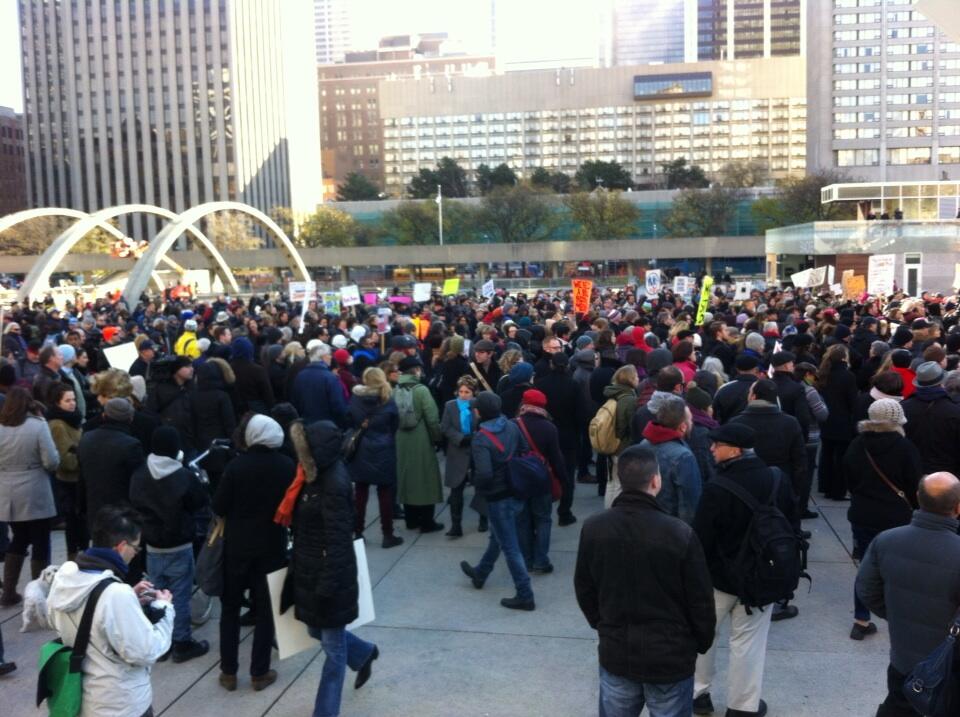
More seriously, look at the rallies to depose Ford at City Hall. I dare you to find a single sign opposing cutbacks, privatization or bigotry. You won’t because they don’t or, rather, these rallies aren't about that - they're about moral outrage. The kind of morals that are about contempt for the great unwashed, of which I am proudly a member. Let’s take a step back for a second here. As wildly delusional as Rob Ford and his brother are – I mean, they consort with Giorgio Mammoliti and Doug compared Rob to Jesus of Nazareth – they are right that this is a witch hunt. Perhaps, dare I say it, even a conspiracy.

The police staged an expensive and extensive investigation against Ford, including airplane surveillance, stake-outs, interviews, etc. all because he got wasted on tape. Does this strike no one as an unusual use of police resources? They found nothing, apparently, with which they could convict him – and yet the details of this surveillance of an innocent (yeah, the word chokes a bit in my throat) man are released to the media. Does nobody else find this disturbing? Would you be troubled if the cops staked out Maude Barlow’s house, or David Suzuki or Olivia Chow – and then the courts released photos, transcribed interviews and CCTV footage that smeared them without ever laying a charge? Do you think that this is a good precedent for dealing with politicians who rub the powers that be the wrong way? And rub them he does.

Ford is a populist windbag and right wing bigot with a neoliberal agenda that includes cutting services for the most vulnerable in society. But he was not the candidate of the city establishment – George Smitherman was. Ford won because, unlike the left (or Smitherman), he speaks a language and expresses an anger to which many working people can relate – including the non-white, immigrant heavy suburbs. That’s not the route of preference for the ruling elite who would rather see things stay respectable and passionless. (Unfortunately, it’s also not the route of preference for the polite left.)

Sure, after Ford won they were willing to work with him but it was begrudgingly because he’s such a loose cannon and because he’s not totally under their control. Doug Ford’s wild attacks on the Police Chief Bill Blair are demonstration enough of that. As the inability of Ford to drive through an austerity agenda became clear this very conditional support waned. And when he was unable to come up with a credible transit plan in a city where gridlock is costing significant profits (as in billions of dollars every year), there was growing alarm. Not to mention his (and Doug’s) tendency to come up with the most hare-brained ideas when it comes to city development (ferris wheels for the waterfront, anyone?).

At some point this draining of ruling class support became an active desire to remove him. Again, not because he was a right wing bastard but because he was an ineffective right wing bastard. And not because he stirred up some active opposition with his neo-liberal policies. Does anyone really think that the ruling class gives a rat's ass about some protests and a relatively small and contained strike by library workers? Really? Have you seen the ruling class of Greece veer away from implementing harsh austerity in the face of monthly general strikes? Opposition they can deal with - Mike Harris weathered a series of city-wide general strikes and a demonstration in Toronto of 250,000 or more people. He never once lost ruling class backing. This is not about the relatively minor (though welcome) opposition on the streets of Toronto. Mayor Miller, a candidate of the centre-left with labour backing, faced bigger resistance.

Whether the growth in the sentiment amongst the elite turned into active conspiracy, who’s to know. For myself, I have a hard time believing that there isn’t some coordination and discussion going on when the police dedicate a whole squad to following him (Including with airplanes!! I want to know how much that operation cost.), and then the results of those investigations lead to a progressive and systematic tightening of the noose. First, there are hints in the press that there might be some information damaging to Ford in the report. Then his driver, apparent muscle and probable dealer, Alexander Lisi, is arrested and charged with dealing pot. Then part of the report is released and the Chief of Police himself announces – at a press conference – that the crack video exists and that they have it. At each moment Ford has refused to step down and they have upped the pressure on him. My guess is that at some point, if he doesn’t cry uncle and leave office, there will be a warrant for our Chief Magistrate’s arrest. They will destroy him. I won't weep for the guy, given his mendacious and pathological behaviour, but I'll shudder at the precedent.

The left, by trailing along behind this palace coup and acting like it’s some sort of uprising from the people – have given cover to the right wing and the ruling class, putting a progressive gloss on the whole operation. They have facilitated a moral panic about drugs and alcohol and bad manners that won’t be used against cocaine snorting bankers, cavorting with high priced call girls. It will be used against “gangbangers” to launch attacks on visible minority communities and the poor. And the left will be tarnished as being responsible for these attacks and will be seen for the kind of downtown, whitebread, middle class snobbery of which Rob Ford has accused us.

A final note: in all this, where is Karen Stintz? She’s being very quiet and letting people like Minnan-Wong and del Grande – not to mention the left – haul down the big guy. Her name is conspicuously absent on the open letter calling for Ford to resign. She is positioning herself to be the grand unifier who has no blood on her hands. If Stintz, a Tory, wins next year, the left will have itself to blame. Stintz actually stood up to Rob Ford while the left was still cowering at the mention of Ford Nation. She doesn't need to attack him now, she already established her anti-Ford credentials - when it took a spine to do so - now she can reap the reward. The left is helping her become our next mayor. Good work, guys. Just what we need, a more effective conservative.

No, just because Rob Ford is a total bastard it doesn’t follow that all means of getting rid of him are good ways. And it sure doesn’t mean that all ways will lead to a better city. That so much of the left thinks so is a stark reminder that the left has lost confidence in itself and, even worse, lost confidence in the power of mobilizing, particularly working class people. This proxy victory – using right wingers, police chiefs, the courts and the media to eliminate a right wing mayor – is no victory at all. It is a hostage to fortune.

Wednesday, November 6, 2013

Three Reasons Why Ford Should Stay

Everyone’s clamouring for Ford to resign: he lied, he smoked crack, he was wasted on the job, the city needs a competent administration. Balls, I say. I’ve seen competent administrations and I can say for certain in the present climate that a “competent administration” will focus its attention on further austerity and attacking those who resist austerity. Need I remind that the entire left wing on council voted to applaud the role of the police in attacking G20 protestors? Well, a couple of them stayed away for the vote but you don’t get bravery points for that now, do you? So I can think of three good reasons why we will be better off as a city if Rob Ford stays and then runs in the next election:

1) His removal will be on a conservative basis that does nothing to strengthen the left. Sorry, folks – Police Chief Bill “martial law” Blair is the hero in this story, not the left, not the unions, not the LGBT movement. In fact the list of Ford’s enemies looks increasingly like a who’s who of the right in this city. The clamour for Ford’s head is not because he wants to close libraries, end daycare subsidies or because he refuses to attend Gay Pride. It is a moral panic about a guy who is too trashy to do the elite job of being a mayor. If he goes now he will be replaced by a new standard bearer who most of the right can rally around to implement the very same agenda pursued by Ford.

2) By Ford staying the right wing can spend the next year tearing the shit out of each other and can then proceed to split the vote three ways. A deeply fractured right creates more space to resist austerity and build a fightback. After Ford was elected there was a sense amongst the left on council and outside in the real world, that Ford Nation was unassailable. Pessimism leads to passivity and acceptance of austerity because there appears to be no alternatrive. Doug Ford’s call for Chief Blair and Polices Services Board chair Andrew Pringle to resign demonstrates that the dynamic duo have no red lines and they will escalate the fight as much as necessary to save their careers. These guys are not normal politicians. And Dougie is also correct: Pringle, the head of the body whose job it is to oversee the cops and keep them on a tight leash of accountability has no business going on a fishing trip with the damn chief. If the Ford's want to go down swinging and take down a bunch of right wing power brokers with them (saying things that the left has never had the spine to say) then I say let 'em rip. I'm not a fan of UFC but this is the kind of cage match that I could get into.

3) The left and the unions need time to rebuild confidence and activism. Let’s be honest – the left has been for shit. Besides the librarians – who fought a good strike and basically won – and one significant, union-led, anti-austerity protest of several thousand people at City Hall, Ford has faced less resistance than even David Miller. Garbage collection was privatized without a whimper from CUPE. If Olivia Chow is elected mayor – and, again, let’s be honest it will be with a Miller-esque team that includes “progressive” business leaders – and there is no anti-austerity movement in the streets or in the unions, she will implement a more socially progressive version of the same pro-business policies. I would bet money that her “cabinet” would include Karen Stintz, the anti-Ford Tory councilor who is chair of the TTC (and being touted as the person to beat Ford by the media). We’ve seen this story before with the Ontario NDP government – elected on high hopes, does progressive stuff for about a year, then collapses under pressure from the right into harsh austerity and scapegoating of the poor as the unions are split and provide little resistance. The unions, the NDP and the "social movement left" could start by mobilizing now against Ford on the basis of challenging his politics, not his lifestyle.

So, be careful what you wish for Toronto lefties because you just might get it. At worst you will end up with Stintz or, god help us, John Tory as mayor by this time next year. At best we will end up with effectively the same policies with a progressive gloss and the right wing will have ridden out a major crisis and been allowed to regroup.

Monday, July 23, 2012

Spain & The Madness of Europe

There's a saying that defines madness as doing the same thing over and over while expecting different results. By that criteria, it's clear that the European Union's response to the long and painful crisis unfolding on that continent is utterly and completely mad.

With the appearance a few years ago of a Greek sovereign crisis - it must be said for debt levels that weren't much higher than those of the USA - the alpha and omega of the EU's response has been to demand austerity. There's two things to be said for Greek austerity. The first is that Greece's difficulties - condemned by German politicians and capitalists as being the result of greedy workers living the high life - is actually the result of the fact that the Euro is too high given the level of development of the Greek economy. On the other hand, the downward pressure that Greek underdevelopment exerted on the EU had the effect of boosting German exports. Not only did German capitalism sell abroad, it also colonized the European economy, competing on an equal footing with unequally developed economies, like those of Portugal and Greece. So, German finger-wagging is utter hypocrisy. The greasy Euro notes that line the pockets of German capitalists were squeezed out of the pockets of Greek and Portuguese workers.

But the second thing that must be said about austerity is this: it doesn't work. As Larry Elliott notes in today's Guardian:

"The lesson from Greece is absolutely clear: slashing spending and increasing taxes when an economy is in free fall leads to higher, not lower, levels of debt. Spain is following Greece down the vicious spiral that starts with weak growth and rising unemployment and ends with expensive bail outs that do more harm than good."
And therein also lies the madness. Having haughtily and with much chest-thumping bravado, utterly destroyed the Greek economy, these idiots are now proceeding to perform the same savage surgery on the Spanish economy. But if the Greek economy represents merely cutting off an EU earlobe, the Spanish economy - the fourth largest in the EU - is like losing an arm or a leg. Such a large wound won't cauterize itself and Europe could easily bleed out with Italy following Spain down the path to ruin. European capitalists, again, led by the Germans, remind me nothing so much as a medieval leech, who cures the patient by killing them. The only hope for both Greece & Spain is that the revolt of the masses, still on a simmer in Greece and heading for a boil in Spain with demonstrations last week involving millions, forces the ruling class of Europe to give up on austerity as a strategy. The long term hope is that the masses kick out the ruling class of Europe and run the continent in the interests of the people who do the work, not the parasitic bankers and bond traders who brought the continent to this pass in the first place.

Friday, September 23, 2011

Harper-nomics Is Recipe For Global Depression & Trade Wars

I feel like I'm repeating myself, having just written that the global crisis is not a crisis of debt but, rather, that the debt is a symptom of the long term decline in the rate of profit. Now, I read Stephen Harper and British Tory Prime Minister David Cameron blathering on about how "This is not a traditional, cyclical recession, it’s a debt crisis," as Cameron put it. The only logical conclusion, if that is the case, is to attack the deficit. And, sure enough, the prescription that they're offering is precisely that.
[Cameron[ urged action on three fronts: • Tackle debt and restore credibility and confidence; • Make it easier to do business and create jobs by freeing up economies; • Work together to boost world trade, starting with the Doha Round.
The translation of those innocuous words is rather more disastrous than they seem at first glance - austerity, de-regulation and more de-regulation. But, as the saying goes, doing the same thing over and over and expecting different results is a sign of mental health problems. The present expression of the crisis was precisely the result of relying on debt to solve underlying structural problems - many of them the result of declining living standards that arose as either a direct result or side effect of past austerity that saw the chipping away at public services. When public services are cut, working people have to pick up the slack with stagnating or declining wages. They can only do so by going deeper into debt or, following the lead of the banks, by trying to boost income by taking advantage of speculative bubbles, either through various types of investment plans disguised as pensions or by cashing in an illusory increase in equity on their homes. In both cases, the chickens ultimately come home to roost - home prices stop rising as they reach the limits of what people can afford and, ultimately leading to a bursting of the price bubble, which causes more foreclosures, leading to a further price collapse and so on. And their pension plans - both private, corporate and, increasingly even public plans - go into crisis, having bet the farm on speculative bubbles and phoney investment "opportunities" sold by investment banks as collateralized debt obligations and other exotic and impenetrable "financial products" that were really just bags of shit painted with a smiley face on them. As far as deregulation is concerned, this is precisely what led to the financial crisis in the first place - as banks were able to package and sell garbage as well as themselves investing heavily in this toxic junk. Deregulation of the financial sector led (combined in many districts with previous cuts to taxes on the wealthy) directly to the present high levels of government (aka sovereign) debt. In other areas, deregulation means more Enrons - which combined with other electricity companies to jack up utility prices in California by illegally choking supply - or more Walkertons, where people died as a result of a water treatment system that was privatized to unqualified companies whose only interest was making money. With that kind of record, do you think that we'll be better off if we remove regulations from pharmaceuticals - which already buy positive research results - or nuclear energy (cough, cough, Japan), or the auto industry, or the food processing industry or... No, at best we'll end up with an economic recovery that is built on more danger and misery for ordinary people as companies produce what they want how they want with no reference to the quality, or safety of their goods. But, more likely the result will be that the Herbert Hoover Re-enactment Society will drive the global economy into a Great Depression Redux. You don't have to be a Marxist to know that smashing consumption at a time when business investment is contracting is about the most stupid thing that you can do. The great lesson of the Great Depression was exactly this: Hoover responded to the onset of the Depression with austerity, making it worse than it had to be. Roosevelt prematurely tried to rein in the deficit in 1937, leading to a steep decline in the economy until the approach of war led the US - and almost everyone other country - to pour resources into re-tooling entire economies towards war production, thus re-inflating consumption. Ultimately, the lesson from the Great Depression is that the real goal of idiots like Harper was to massively devalue the cost of commodities as a way to restore profits. Unfortunately for the mass of the population the main target of depreciation was wages and working conditions. The elephant in the room is China, with its decades long growth rates approaching (or surpassing) ten percent. Manufacturing is drawn to China like a moth to a backyard bug zapper because of the cheap price of labour, making it the envy of every corporation on the planet. And, for governments in developed countries, unwilling to invest in new infrastructure by raising taxes as an alternative way to compete, the idea of out-sweat-shopping China is appealing. Certainly China's living standards are rising at rates that would make western workers, with their stagnant living standards, drool. But they are rising from such a low rate that even after more than two decades of constant growth - at rates lower than the overall rate of growth, it's worth saying - they are still a fraction of living standards in the west. And that presents a problem not only for western workers who can't compete with such low wage rates. It also presents a problem for western capitalists. If the rise in China's living standards aren't enough to meet those of western societies in time to save their economies, then the living standards of western economies must be depreciated rapidly in order to compete with Chinese labour. This is the real meaning of calls to "boost world trade." They will boost world trade by making goods from the west cheaper and they will be made cheaper by reducing labour costs. While that seems horrific if you happen to be a member of the working class - i.e. of the majority - it would seem to a blinkered pro-capitalist politician to make a lot of sense. The trouble is, it won't work. It's an unbendable rule in physics that every action creates an equal and opposite reaction. China has a ruling class perhaps more cognizant than most about its long term interests. It is their intention to allow a slow and controlled rise in living standards as their economy approaches "development", rather than being a "developing economy". Their recent acceptance of a rise in their currency is an expression of this goal. But not only will the immediate effect of Harper's & Cameron's austerity recipe increase the possibility of a series of profound financial and economic collapses, they will be met be a reaction from China that will attempt to neuter the effect of a rapid decline of living standards in the west. History never repeats itself exactly but, in this case, austerity must be understood as a trade war by other means. AFTERWORD: As a side note, another option to which ruling classes have traditionally turned has been protectionism. At present the dominant thrust - with memories of World War Two, which emanated from protectionist responses to the Great Depression - has been towards austerity and deregulation as an alternative to protectionism; a sort of race to the bottom model. But the protectionist model is also a dangerous game to play and so it is deeply disheartening that the Ontario NDP in the present provincial election has made "Ontario first" a central plank of its job creation platform. First of all, on its own this will have negligible effect. But secondly, it's not the case that a government gets to impose protectionist measures and there is no reaction. Of course the WTO would step in but Ontario gets significant inputs and products from countries around the world and a trade war with a minor economy like Ontario's would be economically and politically devastating. It also suggests that the problem is a regional and not a class one, as though Quebec train manufacturing workers are less deserving of work than Ontario train manufacturing workers. It is fundamentally a politic built upon a passive acceptance of the status quo. It is not left wing at all and has no role for working people - across provincial, let alone national boundaries - struggling together to defend their living standards from the corporate predators and their representatives like Stephen Harper. That is, of course, the perspective of union bureaucrats who would rather the NDP pass meaningless legislation than mobilize their members but it is a disaster for working people.

Saturday, September 10, 2011

European Revolt Against Austerity Picks Up Steam

Strikers in Italy resist austerity.
It seems apparent that European politicians somehow missed out the economics class where they explain how massive cuts to public spending in the middle of an economic contraction makes things worse. They also missed the one about how simultaneous across-the-board austerity can cause resistance to spread from sector to sector and country to country, leading to a generalized revolt that could further destabilize profit-making.

Well, if they missed those classes while they were working on their MBAs, they're certainly learning those lessons now.

From Greece to Italy to Spain to Britain, the resistance to austerity is heating up. With meetings and protests and flash mobs happening this month in Toronto to try and halt our own austerity-loving mayor, it's worth seeing that this struggle isn't one that's isolated to us but is global in scope. If they can win in one country, it can inspire people in another country, which can lead to a domino-effect of anti-austerity struggles.

Perhaps the highest point of anti-austerity struggle is in Greece, which has now been feeling the hammer blows of massive cuts and attacks on jobs and pensions for well over a year. After a recent series of general strikes and battles with the police the government managed to pass a second round of austerity cuts through parliament. It seemed like they had won but students clearly thought otherwise. There are now something like 200 universities under occupation against government plans to not only bring the private sector into public education but to also attack and limit democracy on campus. This is a very important symbol in Greece, where the campuses led the fight against the Greek dictatorship in the 1970s. Since that time police have not been allowed to enter campuses without special permission from elected councils on campus. There is a big demonstration on September 8 that will include teachers from primary and secondary schools who will join the occupations in solidarity.

In Italy, Berlusconi has just voted through a massive austerity package worth $70 billion. Some of the unions in Italy have accepted that "there is no alternative" but the largest union in the country, the CGIL, called a general strike on the day that the austerity package was voted on. Up to 3 million people took part with 70,000 demonstrating in Rome and tens of thousands more taking to the streets around the country.

On Tuesday in Spain there was a protest strike and a demonstration by up to 25,000 in Madrid against a constitutional amendment that forbids budget deficits except in "emergencies". Spain has seen a protest movement, called Los Indignados (the Indignant) that exploded onto the scene in early summer, taking over public squares across the country in imitation of the Arab Spring across the Mediterranean. That movement seems to have subsided somewhat but hopefully this protest action by unions signals that it has spread into the previously acquiescent union movement.

In Britain, things are moving slowly towards a boil. Last fall there was a huge explosion of student protests and strikes against the tripling of university fees. The energy and anger of that movement spurred the union leadership - which had organized nothing to resist the Tories - into action. First there was a protest by hundreds of thousands of trade unionists and supporters in March. Then a number of unions held a coordinated one day strike in the summer, involving up to 750,000 workers. Now this fall is set to see some big protests - in Scotland, and at the Tory and Lib Dem conventions (they govern together in a coalition) - followed by an even bigger coordinated strike in November. The issue that has galvanized industrial action has been pension and this round of strike action could involve up to three million workers. This will be the biggest industrial action in Britain in decades.

A breakthrough in any of these countries could easily spur the growth of struggles in other countries. And, as Greece shows, a temporary victory by the politicians and bankers doesn't necessarily spell the end of the struggle, merely shifting it to another terrain. Here at home, we have our own opportunity to take on "austerity flu" on September 26 at Nathan Phillips Square at 5pm. Make the effort to be there - be part of an international movement for a better world.

Friday, September 9, 2011

Killing The Bob Rae Myth

Watching the Ontario election you'd think that there was nothing of much import going on in the world. Why else would there be so little difference in the platforms of the three major parties in this election? For instance, you'd never know that a majority of Ontario's workers live pay cheque to pay cheque with 40% expecting that they will have to retire later than they had planned.
A major contributing factor to the low savings rate [i.e. retirement savings - rbh] is that many Canadians are living close to the line. The CPA survey found that the majority of Canadian workers continue to live pay cheque to pay cheque, with 57% saying they would be in financial difficulty if their pay was delayed by even a week.
The numbers were even higher for younger Canadians aged 18 to 34 (63%) and single parents (74%). The regions with the highest percentage of workers living pay cheque to pay cheque were Ontario (60%) and the Atlantic provinces (64%), which may be the result of their slower recovery since the last recession.
Financial planners generally recommend that people have approximately three months of expenses (rent, mortgage, bills, groceries, etc.) as an emergency fund.
How is it that this fact never gets mentioned? We know why the Tories never mention it - because they helped contribute to it. Ditto the Liberals, particularly at the federal level. But why hasn't the NDP said a word about the decline in living standards amongst working people? We can get some idea from the present media onslaught on the legacy of the Bob Rae government in Ontario. Federal NDP president - and leadership hopeful - Brian Topp made sure to take a dig at Bob Rae this week, contrasting the Ontario NDP government with the "successful" governments in Manitoba and Saskatchewan. And Andrea Horwath made a point of attacking the government of Bob Rae in the early 1990s.
“I know there are probably many different opinions out there in this room about the NDP’s record in government. So I’m here to set that record straight. Contrary to what my opponents may tell you, New Democrats across Canada have a very good track record when it comes to managing books and balancing budgets,” Horwath said during comments at Mayor Jim Watson’s breakfast speakers series, which is held at City Hall by the Ottawa Chamber of Commerce and Ottawa Business Journal.
“I’ve got to say here, straight out: That not every NDP premier has had a stellar record. But since the premier with the absolute worst record is campaigning for another party nowadays, I am not going to take any lectures from my opponents,” Horwath said, laughing.
On the one hand, I'm loathe to defend Bob Rae for reasons that ought to be obvious. However, it is not at all for the same reasons as Horwath and Topp. The problem with the Rae government wasn't that it ran up a deficit trying to fight the recession of the early 1990s. In fact, I remember being impressed when Floyd Laughren, the then-finance minister, announced that with his 1991 budget he was faced with "fighting the deficit or fighting the recession - we're proud to be fighting the recession." Of course, the business media went insane, attacking Ontario's first labour government - Ontario's credit rating was downgraded and there were even bankers and businessmen demonstrating on the lawn at Queen's Park. Now, when Stephen Harper runs up a deficit nobody says boo. It was and is about a class war on Canada's party of the labour movement, an attempt to tame them into operating in the interests of the business class. So, when Horwath - who was supposedly the "left" candidate for ONDP leader - and Brian Topp laud the governments of Saskatchewan, Manitoba and Nova Scotia, what they are really celebrating is the fact that those governments capitulated utterly and completely to the agenda of big business. Oh, sure, they had some reforms here and there but, like the NDP in this election, their vision was so pathetic and pedestrian that business didn't need to protest - as long as they got the big picture right, which was to discipline the economy (i.e. the working class) and to orient towards business profits.

One look at Horwath's policy platform reveals just how low the NDP has set its sights. Whereas Rae's "Agenda for People" election platform called for nationalizing auto insurance, legislation to prevent the use of replacement workers (scabs) during strikes, better social assistance, and tax reform - Horwath's "Plan for Affordable Change" offers very minor reforms like reducing the use of consultants, forcing the government to buy Ontario goods, freezing transit fares and cutting HST on home heating. Not only is this basically indistinguishable from the Liberal platform - in fact, the Liberal platform appears more bold, promising 50,000 green energy jobs compared to the NDP's plan of creating jobs with a "buy Ontario" law - it appears on the surface to be indistinguishable from the Tories' platform. Our choices in the election have been reduced to a choice between brands rather than any substantive difference in political direction. Even the possibility that there might be a voice for something off-message needs to be stomped out - as we've seen this past week with the Ontario NDP's overturning of the democratic election by the riding association in Thornhill to run well-known socialist Barry Weisleder as the riding's candidate.

All of this speaks to the collapse of post-war social democracy into neo-liberalism - which is precisely what Bob Rae's government represented. Elected on a - by today's standards - bold platform of reform, by the end of their term the NDP government had firmly laid the groundwork for the Tories. They attacked public sector workers with a "Social Contract" that imposed unpaid work days. They demonized welfare recipients and began the war on the poor that Mike Harris took up in earnest. They eliminated grants for poor students attending post-secondary education. And they completely capitulated on public auto insurance, making it the last time that a serious proposal for nationalization would cross the lips of an NDP leader (not quite true - Horwath is talking about re-merging the Ontario hydro utilities and keeping big electricity producers publicly owned). By the end of their tenure, the majority government of the NDP couldn't even pass same sex spousal legislation, which wouldn't have cost the government a dime. Disappointment, betrayal and cowardice in the face of right wing, business opposition ought to be viewed as the mistakes of the Bob Rae years. The lesson ought not to be that we need to surrender having a big vision for a better society. If the point isn't to change the world, what's the point in having an NDP? If we accept that there is nothing we can do in the face of autocratic corporate power, what's the point of elections? My guess is that many people are asking themselves similar questions during this election campaign - or, perhaps more likely, they're just bored.


What is your most important provincial issue of concern? - The Globe and Mail

Tuesday, June 21, 2011

A View From The Volcano: Report From Greece

This is a fascinating interview from the British Socialist Worker Newspaper on what's going on in Greece. All we're really getting is the maneuverings and panic of the politicians and the bankers. This interview with a socialist gives a flavour of what's happening on the ground and in the movements.


Panos Garganas of the Greek Socialist Workers Party told Patrick Ward how resistance to austerity became a rebellion

Almost all of Greece’s public sector workforce took part in an enormous general strike which rocked the country’s government last Wednesday.

A huge number of private sector workers joined them.

The strikes happened as the government tried to force yet more austerity measures through parliament. Tens of thousands of protesters filled Athens’ central Syntagma Square and fought the police in an attempt to reach the parliament building.

The strike was accompanied by a wave of occupations.

The protests have plunged the Labour-style Pasok government further into crisis.

It’s not clear if the government will be able to pass its cuts, worth £25 billion, or even manage to hold together.

Panos explained the scale of the resistance, the fragility of the government—and where the struggle should go next.

How was this strike different to the previous general strikes?

Two things stand out. The first is the sense of political crisis. This general strike coincided with the most crucial stage of negotiations between the government and the International Monetary Fund (IMF) and European Union (EU)—and between the government and the opposition.

They were negotiating over how to reinforce the Greek government in terms of standing up to demonstrators and dealing with creditors.

The general strike intervened to show that resistance is not going away.

The second most important thing was the size of it.

People have gone through so much in the past 20 months that they are getting more and more angry. That’s why so many people came out and the strike was so solid.

Syntagma Square has been occupied for three weeks. Police tried to disperse the occupiers on the strike day, but they failed because there was even more determination to keep it going.

What kind of forces are involved in the struggle?

The occupation of the square didn’t start with the unions. It was much more spontaneous—largely organised by bloggers. At first the left wasn’t sure how to respond.

The media portrayed the occupiers as apolitical and opposed to traditional forms of organisation.

They presented the occupiers as hostile to the left. Some were, but they weren’t dominant.

The most important people in the occupation have taken part in many strikes and occupations over the past 20 months.

The occupation of the square is important because it has united strikers and demonstrators.

Sections of the left, including the Socialist Workers Party and the Anti-Capitalist Left, played an important role in arguing for this.

We should not let the media play one section of the movement off against another.

Who defended the square against the police? Were most people involved in “rioting”?

The occupation was peaceful. The occupiers were very clear that they didn’t want to provoke the police and allow them to attack.

On Wednesday, lots of people in the square denounced provocations. Police tried to set up an incident to create an excuse for them to attack.

Groups of anarchists were involved in fighting with the police, but the bulk of the demonstrators were not involved in rioting. The priority was to hold the square.

How does the government plan to get its austerity measures through parliament? Will the cabinet reshuffle make a difference?

There is a desperate attempt going on to keep the government alive.

Last Wednesday, prime minister George Papandreou offered to resign if the New Democracy opposition—similar to Britain’s Tory Party—agreed to join a coalition.

It was a clear indication of how far the government has failed economically and politically. It faces such strong opposition that it cannot form government on its own.

But then Germany and France told the Greek government that it couldn’t afford a political crisis and must press ahead.

So Papandreou did a U-turn, saying he’d reshuffle and press on.

It’s hard to tell how far the government will survive. Its majority is getting smaller and smaller.

There’s a vote of confidence on Tuesday night, and the following week Papandreou will try to pass the cuts. These are two crucial votes. They will take place with the government surrounded by demonstrations—and the demonstrations will be stronger.

The unions have called a 48‑hour general strike for when they try and pass the cuts.

Papandreou may twist MPs’ arms and win the vote. But implementing the cuts won’t happen.

I think the government will collapse—if not from votes, then from strikes. When the press and government say that resistance is futile, it is not true.

Power workers are on all-out strike from Monday. This can make the situation impossible for the government.

You don’t want the austerity measures passed. But wouldn’t it be worse for ordinary people if Greece defaults on its debt?

The first thing to say is that all the measures that are supposed to save working people from default aren’t working. So we are closer to default every day.

The cuts aren’t stopping the crisis and more cuts won’t either. Workers are suffering with no end in sight.

It’s important to ask how a default would come about. If it happens on the terms of the creditors, people will suffer.

But if the movement says we refuse to pay the debt, that’s very different.

Last year the Greek government paid 51 billion euros servicing the debt—that’s one billion euros every week.

If we stopped paying that billion a week, we wouldn’t need cuts in pensions, wages or services.

The wages bill for public sector is 16 billion euros.

A default organised by our side would lead to improvements for the working class in Greece.

Does Pasok’s relationship with the unions affect the resistance?

Traditionally, Pasok controls the main body of the Greek TUC. Pasok has held a majority in it for 30 years.

Every TUC leader has been a member of Pasok for 30 years.

Pasok doesn’t have a long history, unlike Labour in Britain. It has only existed since 1974.

But every Pasok government has been able to compromise with the unions to push through what capitalism needed.

This is changing.

A local government union has resigned from Pasok. It was against the agreement with the EU and IMF.

This is happening elsewhere too. And if this is happening at leadership level, imagine how it is among the rank and file!

Thousands are showing their opposition to Pasok.

It started in May last year—people booed the TUC leader at strike rally organised by the TUC.

For the first time the left is electing people in the unions. In smaller unions the Anti-Capitalist Left is getting people elected to steering committees and other leading trade union bodies.

Where can the movement go from here?

We want two things. First, we want rank and file control of the strikes. The strength of the mood now means we can get general assemblies in workplaces, with elected committees, for people to decide how to handle the strikes.

This has already happened in some strikes in the past 20 months.

The mood is now so strong that we should generalise this sort of thing. It strengthens the movement.

There is an alternative to austerity. We should push for nationalisation of the banks, cancellation of the debt and workers’ control of the banking system.

These demands are becoming more and more popular. Workers committees in strikes should adopt these demands. That’s the way forward.

We can stop this crisis on workers’ terms.

Wednesday, June 15, 2011

Support The Strikes To Defend Pensions

Usually even the mention of Margaret Wente's name can ruin my day but her article in today's Globe & Mail is actually not too bad in terms of laying out the terms of the strike and lock-out at Canada Post and Air Canada respectively. Of course, in the interests of "balance" she reaches the basic conclusion that while pensions were great while they lasted, they're unsustainable. My guess is that she won't be giving up her pension in order to save the Globe & Mail's bottom line but that's another story.

What is most important here is that corporate Canada and the government are opening up a new austerity front that is about reducing our living standards - both in the present and in the future - as a means to restore the economy to profitability. In the public sector the Tories intend to slash spending and reduce payrolls both through layoffs and attrition over the coming months, beginning with the soon-to-be-released budget. In the private sector, pensions are the big target.

Make no doubt about it, pensions are a component of wages, just like healthcare benefits. When Canada Post and Air Canada attack the pension plans of their employees, they are demanding wage reductions. But workers have the right to ask a number of questions when they're told to take the knife. The most obvious one that is printed in big letters on the picket signs of Air Canada employees is why should only CEOs get pensions and not workers? This must seem doubly infuriating to Air Canada employees who took it on the chin a few years back to "save Air Canada", agreeing concessions in a big way. Now, Air Canada is profitable again - and is coming back for more.

But there is a deeper question that has to do with the whole way the economy runs. Workers didn't cause the economic crisis of 2008 - the Great Recession. That was sparked by greedy and corrupt banks with their exotic and incomprehensible debt packaging schemes that came unraveled - and in the US housing market shows no signs of stopping the decline. Nor are workers responsible for the long term decline in western economies that have come more and more to rely upon "financialization" - that is, to have greater weight placed upon the casino of speculative investment - while China has become the world's manufacturer. These imbalances and contradictions are directly the result of the policies of neo-liberal government - from the Harper Tories to the Chretien Liberals and, beyond our borders, to every party across the spectrum from Labour to Republican and Democrat. They are also the result of decisions in innumerable boardrooms where investors, bankers and manufacturers have shifted resources and capital around the world in order to maximize profits.

The result of all this jerry-rigged global profit-taking has been that workers didn't benefit particularly during the boom times - with debt levels rising even in the peak periods of growth in the past three decades - while the global economy has become more dangerously unbalanced. Now, with it likely that the imbalance will lead to years of stagnation, workers are again expected to pay, this time with their future as well as their present wages.

And it's not just in Canada that this battle is taking place. Attacks on pensions are a central feature of the struggles and strike waves in Greece. There is also a massive public sector strike set to take place in the UK on June 30 that will involve teachers, civil servants, and more. This struggle is about whether we will continue to live in a world where the rich get richer in good times and bad and the working class gets driven ever downward towards immiseration.

That's also why what is needed is a united fight, not just piecemeal isolated actions. The Tories will legislate the Air Canada workers back to work by early next week - effectively eliminating the right to strike for a small group of non-essential workers (they're customer service agents and call centre staff, for God's sake!). This will be followed by similar legislation against postal workers in the Canadian Union of Postal Workers. There are two other unions at Air Canada, as well as the Pilots Association. They all oppose Air Canada's pension plans. They should all be out together - if the customer service agents are defeated, they almost certainly will have lost as well. In fact, union leaderships must see the writing on the wall as far as pensions go. The entire working class will either be picked off one by one, sector by sector, or they will come together in a joint campaign, which will probably need to include industrial action, to win. It's all of our future's that's at stake.


The unions at Canada Post and Air Canada are fighting a rearguard action - The Globe and Mail

Friday, June 3, 2011

Today's U.S. Economic News: This Parrot Is Dead

The jobs report is out and like all of the other economic indicators, it shows that the US economy is going nowhere fast. The whole of this year has been about watching the optimism that started the year turn sour bit by bit as the remaining effects from the stimulus spending have evaporated. The reality is, the Anglo-American model of market driven growth, deregulation and the repression of trade unions, has not done what it claimed - create a virtuous cycle of endless growth that superceded the stagnation in productivity and innovation that supposedly plagues economies that have greater state intervention.

The present "soft patch" - known in the jargon of regular folks as a recession - is one more stake through the heart of the neo-liberal consensus that has haunted us since the end of the 1970s. It's worth noting that this has never been about state vs market capitalism. Every capitalist state uses elements of both. Every American boom has, particularly since the 1980s, been about increasing the levels of debt in the economy as a means to reinflate it in the face of weak growth. This is, in economic effects absolutely not a whit different than Greek (or any other) state debt - as I've discussed elsewhere. In terms of an economy having room to maneuver - through state or corporate or consumer or combined purchasing - the level of total debt is the key number. Attacking state spending is just the latest way of attacking working class living standards, full stop. Now, I'm no fan of the capitalist state but to think that it was more rational to simply print money and drop interests to the floor so that uncontrolled investment and speculation could ensue - rather than focusing investment on things that the national economy needs - was always absolutely barmy.

American political and economic leaders (and Canadians and Brits) have been strutting around since the "Japanese model" went bust about 15 years ago, bragging about how effectively their model was generating wealth. In fact a significant portion of the "new" wealth was made up of phoney speculative wealth, exotic debt instruments, sub-prime mortgages and the like - the Chinese and others were directing investment into needed infrastructure. For example, China now has 13,000 km of high speed rail - more than the rest of the world combined - which will climb to 25,000 km by 2015. The USA (and Canada) have 0 km of high speed rail. Shall I repeat that: there are zero kilometres of high speed rail in North America. And when Obama suggested a role for the US state in spurring investment in high speed rail, the mouth-breathers in the Republican party and Fox News went apoplectic. The only welfare program they support is $1 trillion for the military, tax cuts for the rich and bailouts for the banks. Meanwhile, America has also fallen behind in renewable energy technology in relation to Asia in general and China in particular. Seven of the world's 10 largest solar manufacturers are Asian, with the number two company being China's Suntech Power. And China invests four times the amount in clean technology as the USA.

Don't get me wrong, I'm not at all suggesting that China is a utopian model - neither in terms of long term economic stability, nor in terms of basic freedoms - but if a crash comes in China, at least they can ride the trains. In the US all they'll have is guns and empty, foreclosed houses. Though, come to think of it, having the former could solve the problem of the latter. Who's going to evict a heavily armed squatters' movement?


U.S. jobs growth brakes sharply in May - The Globe and Mail

Wednesday, June 1, 2011

The Tories' Bankrupt Brains

"I see, said the blind man to the deaf dog, who wasn't listening anyway" is a phrase that comes to mind reading reports of federal Finance Minister Jim Flaherty's press conference on the economy. Generally speaking we expect governments to do more to solve looming crises than beg somebody else to do it for them. It is a sign of just how ideologically blinded are the Tories that they will ride the HMS Neo-Liberal to the bottom of the economic ocean before they will take any initiative to plug a leak using the instruments of state.

Capacity Utilization
Flaherty's response to flagging consumer demand has absolutely no hope of staving off a looming second dip in the as-yet-unfinished recession of 2008. The decline in consumer spending as we regular folk are saddled with historically high debt - there was a brief dip in debt as a percentage of income before returning to a generally upward trend toward 150% - means that 60% of what normally makes up economic expansion has been taken offline.

And while industrial investment and new machinery is up - in part because the rise in the Canadian dollar has made imported capital goods cheaper - has a number of inbuilt limits in terms of saving the economy. The first is the dead consumer demand to purchase goods of any new production capacity. The second is the fact that capacity utilization - the measure of how much new machinery is being used; is it running flat out or sitting idle part of the time? - is still at the lowest levels in a decade, sitting at 76% and levelling off.

And while manufacturing saw growth in 2010, it is still 15% below where it was at its peak in 2006. And even corporate debt levels, which declined during the recession, only declined by about 4% in relation to income from their peak and are rising once again. With the slowdown in the US and a slowdown looming in China, plus the disaster in Japan, along with inflation of raw materials running at a whopping 22%, this is hardly the moment when corporations are likely to find the dosh to ratchet up capital purchases to anywhere near what is necessary. In fact, when Flaherty says that the corporate sector is "relatively flush" with cash, they could easily reply that, in fact, total corporate debt to equity ratios - at 166% - is considerably higher than total government debt (i.e. federal, provincial, municipal, etc) to GDP, which is running at just over 107%. In other words an economic bailout from the fragmented corporate sector, each trying to gain competitive advantage over the other, just isn't in the cards.

And, as I discussed in my previous post, there is every chance that, in addition to weak economic figures, the government could face pressure to raise interests rates to deal with inflation, originating with the high cost of raw materials. And nothing kills an anemic recovery more effectively than high interest rates. The net result could easily be that the Stephen Harper's hope and dream of forming a majority government may come back to bite him in the ass. They don't have the Liberals to kick around anymore as a hindrance to doing what needs to be done. They will get all the blame if things start to really go south. Unfortunately, for the rest of us, we don't risk unpopularity - it's our livelihoods and ability to pay the bills that are at risk.


Time for business to take the lead: Flaherty - The Globe and Mail

Wednesday, May 18, 2011

Cops, Garbage Privatization, Crooks & Limp Noodles

In typical Toronto council fashion, a compromise bill was passed that both the left and the right on council are claiming as a victory but which will, in fact, hand a victory to the right. The privatization of garbage collection, a trojan horse that has used public anger against a 39-day garbage strike back in 2009, is just a prelude to further attacks on services.

But, let's be clear, privatization is a crock of shit.

First of all, if privatization is going to save money - a big "if" - it is going to do it in one of three ways - by cutting wages and benefits for the workforce, by cutting corners on service provision, by making workers work harder. There is no magic technology that is held in the private sector that allows them to do a better job than the public sector. This has to be seen for what it is - a gift to Ford's rich buddies and an attack on workers conditions. All those working class people who voted for Ford and think that he's going to make their lives better have another think coming. Very publicly attacking the wages and conditions of sanitation workers will be a checkered flag to other employers to use the same logic on their own workforce. It will also weaken public sector unions in the city - and the public sector is a union stronghold with unions have a much lower density in the private sector.

Furthermore, it is absurd to think that a company that wants to make as much profit as possible can provide better service than a public department whose mandate is to just provide a quality service (well, truth as a profit measure has also crept into the public sector in recent decades, undermining this straight-forward mandate). That's why wherever the private sector has made big inroads into a sector of the economy previously dominated by public sector provision, the costs have gone up and the service has gone down. A study a number of years ago of the effects of privatization on the British National Health Service demonstrated this clearly. The experience of water privatization in Latin America and elsewhere has also proven this - in Bolivia it led to a near revolution as private companies jacked up prices and restricted access to the poor.

The health care sector in the USA is another example of this dynamic - the richest country in human history has a terrible health care system dominated by high prices, parasitic middlemen and poor service for the vast majority. And last I checked the mighty private sector - banks, auto manufacturers and others - brought the economic system to the brink of collapse back in 2008. Hardly a solid record of delivering efficiency, savings or services - instead, after years of attacking public spending, they happily bellied up at the public trough while protesting any "intrusions" of public oversight into how they were spending our money.

And even on their own terms of "saving money" the Ford Bro Circus of Stupid is a dishonest, craven outfit. They happily gave the cops a big raise and Doug Ford made a big stink when it was suggested that some police services be contracted out to save money. Garbage on the streets for us, a well-paid police boot in our ass if we complain about it. Charming.

But if the Ford family freakshow are unmitigated assholes then the left on city council - and the union leadership - are sad and pathetic creatures. One shouldn't be surprised, I suppose that the "left" are as useless as tits on a bull. These characters did unanimously vote for a Ford inspired motion before he was mayor that lauded the police for the highest priced, most bungled, most repressive police operation in Canadian history during the G20 summit. On the grounds of political principle it demonstrated that the left has absolutely none. On the ground of political opportunism to vote with their executioner proves that they are just fucking stupid.

Sadly, the union leadership hasn't done much either. Last month there was an excellent demonstration of some 10,000 people organized by the unions but, like the Days of Action movement fifteen years earlier, the leadership appears to have had no strategy to maintain momentum beyond a one-off demonstration. One can't help but be impressed by the inability of the union leadership to learn a lesson from the squandering of the biggest opportunity to stop the attacks on unions the last time around. So, now the left and the union leadership declares that this is a limited victory - to have voted for a motion to support privatization as long as they get to oversee it. That's like celebrating the fact that you get to choose the knife that is used to cut your throat. Surely there must be some people with brains and principles to lead an opposition to Ford and his ilk.

Ford’s plan to privatize garbage collection passes - with concessions - The Globe and Mail

Sunday, January 25, 2009

Undigested Thoughts On The Present Economic Collapse

I haven't had a chance to sort through all the elements of what I've been reading regarding present economic conditions but I wanted to get down some preliminary thoughts. It's clear that things are bad. Very bad. The UK may well be driving down the fast lane on the road to Iceland. That is, it may be approaching a situation where its insolvent banking sector is too big to allow it to fail and yet it is too big to save - ie. the government can't afford it because no one will lend them the money. Or, if they go to the IMF, the IMF may well not have sufficient money. If that were to happen, look for disaster to unfold - a collapsing currency, a government forced (according to the rules of the game) to impose austerity measures against its population, and other such notable treats, as outlined by Nouriel Roubini:
"At best, the UK faces an economic and financial crisis that will be as bad as the US one: a severe and protracted recession that could last two years with very weak growth recovery once it is over; a near insolvent financial system, most of which will be formally or informally nationalized; a large fiscal costs of budget deficits surging because of the recession and the bailout of financial institutions; a weakening currency that may risk a hard landing if the crisis is not properly managed. "
It used to be that Roubini would outline the details of what the worst case scenario was but he doesn't any more. Could it be that even "Dr. Doom" is afraid of what might happen?
But lest you think it's only Britain, we shouldn't forget America's spiralling economy. The latest figures out regarding housing starts indicate the biggest collapse since records were kept, back in 1959. Just look at the graph, it's got a drop so sharp even one of those pot-smoking rock climber hippies would shit their pants. And it doesn't look much like its bottoming out.
It could be worse, of course, you could own an import/export business in Japan. The same report(pdf) that highlighted the collapse in US housing starts also points to the collapse in Japan's imports and exports - particularly exports. 
"December imports contracted by 21.5% on the year and were up by 7.9% for 2008 as a whole, but exports fared much worse, posting respective changes of -35.0% and -3.4%. This dragged the annual trade balance down to $20.4 billion, a level not seen since 1983 and a far cry from the 2007 tally of $92.1 billion."
In the face of this kind of global collapse in demand, alongside the spreading implosion of the international financial system, it is unclear what fiscal stimulus packages, such as the one planned by our very own Tories and the stratospheric one being mooted by Obama, will actually do to save the economy.
Obama and the Tories are both trying the same halfway house measures between Keynesianism and neo-liberalism, a combination of infrastructure spending and tax cuts, as a means to try and maintain consensus within different wings of the ruling class. And while the Keynesian side of the equation is still timid, with the Tories, for instance, insisting on forms of spending that aren't permanent programs, such as healthcare or daycare. The neo-liberals, like failed presidential candidate Senator John McCain want "to make tax cuts permanent, and we need to make a commitment that there’ll be no new taxes.”
Of course this is ideology written by idiots, not true bourgeois class consciousness. After all, if they want to save their consumer driven economy, they need to get the vast majority of the population to consume. The trouble is, it is those people who are most fearful right now, facing job losses, the loss of their pensions - often tied up in investment plans that have nose-dived in value, and suffering from a debt hangover the could drop a moose. If you handout tax breaks, like Bush did in spring 2008, it has no effect on growth because the cash is applied directly towards paying down debt. Money invested in infrastructure at least buys goods - even though the companies and individuals who will be paid for those goods and their construction will also probably sink a hefty sum of their wages and profits into lowering their debt load.
And there is the rub of the problem, taking us back to Mr. Roubini. Does the US or any combination of governments acting individually have the political will or, frankly, the credit rating, to "deleverage" their nation sufficient that the debt blockage to further growth can be removed? It's not at all clear that the US can even achieve this domestically. Just look at the insatiable appetite of the banking sector scrambling for more cash, on top of the $700 billion it sucked back quicker than a light beer in a heat wave. And the banks are merely one expression of a problem worth trillions upon trillions.
And the problem is international - so if the US fixes their problem, it won't solve China's, or Iceland's or Britain's, etc. 
That's why there is no agreement on Obama's plan. Even Liberals are suggesting that it won't work, that it's not enough. And certainly, if the system continues to unwind the way that it has over the past year and a half, with housing starts in freefall, employment dropping quicker than the 1980-82 recession and the banking sector doing a fine imitation of musical chairs on the Titanic, then a program of new investment that will be smaller than the present banking bailout package, will have negligible effect. As an article in The New Republic noted, it was the massive and unprecedented spending of World War Two that ended the Great Depression.
"Most economists agree that what finally pulled the U.S. out of the Great Depression was military spending for World War II... in 1936, unemployment was still at 16.9 percent; by 1942, after two years of war spending, it was 4.7 percent, strongly indicating that it was war spending that did it. I am not suggesting that the United States start a world war in order to solve the world's economic problem. But I am suggesting a strategy that could be called the fiscal equivalent of war."
However, I would suggest, it was more than just the spending. It was also the destruction that was key. Then, like now, there was the capacity to create too many goods. It has been sustained up till now with the massive accumulation of debt. But that strategy has come to an end. Capital must be destroyed on a vast scale to re-open the vistas for further accumulation. America must reconquer her markets - and thus there are noises from the new Treasury Secretary about China's currency manipulation to sell its products to US consumers. The next step will be trade barriers. China's factories will close, creating the space for factories to open in America.
And this creative destruction will also have the effect of lowering the price of capital (and other inputs) relative to labour. Labour is the source of all profit - which isn't a natural phenomenon but merely a social creation requiring some common source of comparison, in this case labour. When the amount of investment in capital rises in relation to labour, profits tend to fall (though there are a whole number of means to countervail this, including rises in technological efficiency leading to a fall in the price of capital goods, etc). When the investment in labour rises viz the investment in capital goods, profits can also rise.
I'll stop myself here before I get too deep into a subject I can only half defend. Suffice it to say, even on the basis of the need to destroy other capital to conquer new markets or reconquer old ones - the ultimate expression of which is war - the present system is utterly mad and getting crazier every day. Surely we can come up with a better way to run the world than this.

Saturday, January 17, 2009

Toronto's Blackout: Neo-Liberal System Failure?

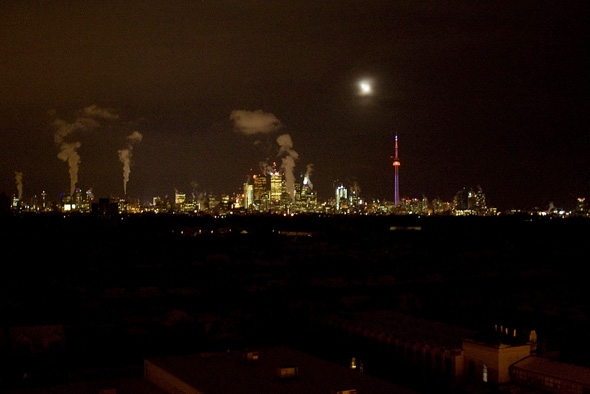
In case you haven't heard or lived it, Toronto's west end had a black-out beginning Thursday night and lasting for about 24 hours, on the coldest night and day of the year. Our house was in the thick of it and we were forced to endure something quite miserable. Thursday night I had to stay up from 3am till 9am tending our gas stove to keep the house warm so that my partner could get some sleep and our newborn wouldn't freeze to death. I know, I know, (well, now I know) you're not supposed to use a gas stove to heat the house because of the danger of carbon monoxide poisoning. Luckily our old house leaks like a sieve, so not much danger of running out of fresh air. But if running a gas stove in a house is so dangerous, why the hell is it allowed at all? I have on many occasions been cooking a big meal and had all four burners and the oven going all afternoon, including in our old duplex, which meant it was all happening on one floor. Do you mean to tell me that I could have killed us all, or made us very sick - and this is permitted? Something seems out of whack with this.
But a bigger question in all this is why the hell doesn't the Toronto electricity grid have any built in redundancies? Apparently a sprinkler went off at a transformer station near our house and they had to shut down electricity because of the flooding, turning out the power on 100,000+ people. So, let me get this straight: I could go into a transformer station with a $2 disposable lighter, hold it up to the sprinkler system and shut down all the electricity for an area and population the size of a small city? I'm glad I didn't know this when I was a mischievous and troubled teenager, the temptation might have been too great. 
Seriously, though, how can a first world city not have any back-up or extra capacity throughout the system that would allow power from other transformer stations to take up the slack? Perhaps I'm just demonstrating my ignorance by asking the question but it seems like an obvious one - especially after the disaster of the 2003 blackout. 
The answer I fear is that it is a side-effect of neo-liberalism. That is, it is more profitable to have less fail-safe systems, less redundancies built in to cover unusual - though not rare - eventualities like power lines and transformer stations knocked out by storms, fires or faulty plumbing. I suspect that the primary measure of service management is the quantity of profit that is generated for the corporation, not the service provided for the population. I haven't heard of any deaths as a result of tens of thousands of people losing heat on the coldest night of the year but it was certainly a possibility. Just down the street from us, for instance, is a seniors' home. They are particularly vulnerable to hypothermia. 
I hope that I'm wrong in my assumptions. But, if the failure of the system is the result of having created an "efficient" grid, then we should be exposing the fact that implicit in this definition of efficiency is the assumption that the risk of an "acceptable" loss of life is worth higher profits. And any human system that places profit above human life is indeed a system that has failed.
DreamHost Promotional Codes