Sunday, December 9, 2012

Egypt: Morsy Struggles To Get Out Of Crisis


President Mohammad Morsy and the Muslim Brotherhood, from which he comes, continued to resist popular pressure with a half-hearted concession combined with more threats on Saturday.
A meeting was held at the presidential palace with “opposition figures” that mostly included his supporters and opposition figures who are marginal to the present movement. No central figures or opposition parties were represented, having boycotted the summit.

Afterwards Morsy’s Prime Minister announced that his constitutional decree would be mostly rescinded but that the contentious referendum on the constitution draft would go forward.

This threatens to split the movement by granting what had been one of the demands of the movement. However, as many activists pointed out, this concession is effectively meaningless since the decree was intended to insure that the draft constitution that was agreed in a marathon session of the Constituent Assembly went forward.

More worryingly, statements by the Brotherhood leadership indicated a continued hardline against protests, which has already led to hundreds of injuries and several deaths. Morsy’s aides also mooted the possibility of declaring a form of martial law if protests continued. The military also announced that it would enter the fray if the instability continued.

This is an indication that the military leadership will come down on the side of Morsy and the Brotherhood. After decades of repressing the Brotherhood this seems like an anachronism. But in reality it’s not surprising since the constitutional draft guarantees that the military will retain its status as a “state within the state”. They are granted immunity from democratic oversight, including of the military budget. It also allows the military to try civilians in military courts and does nothing to challenge the military’s enormous economic power. Some estimates have the military controlling up to 20 per cent of the Egyptian economy.

The constitution draft also permits the repression of the media, including the arrest of journalists and shutting down media. It also effectively outlaws independent unions by forbidding any industry from having more than one union representing workers – meaning that the state controlled unions cannot be challenged.

The Brotherhood leaders also used sectarian attacks on the Coptic Christian minority in their press statements.

The main opposition organizations, however, continue to call for mobilizations before the referendum, set for December 15. The fact that Morsy is turning to the military is a sign of how desperate they are to contain the present crisis. Likewise the attempts at partial concessions. 

If the mobilizations can deepen and spread – as they seemed to do on Friday with demonstrations even in rural areas that have historically been Brotherhood strongholds - the slow and partial retreat of Morsy and the Brotherhood can become more pronounced. If nothing else it will ensure a large “no” vote in the referendum that will lay the basis for future struggles to extend the rights of woman, minorities and workers.

Friday, December 7, 2012

Egypt: Between Victory & Danger

The situation is moving fast in Egypt and it's hard to get a sense for what is happening on the ground. News media is reporting that President Morsy, 24 hours after saying he would change nothing, has agreed to postpone the constitutional referendum scheduled for December 15. 

No details have yet emerged, and it may well be a headline-grabbing claim covering up an unacceptable half-measure, but this marks a significant shift in tone. If Morsy climbs down on this demand and the other main condition for talks with the mainstream opposition, led by former UN Atomic Energy head Mohammad El Baradei, it could be a very big victory for the opposition. Based upon past experience, the former looks more likely.

Simultaneously, there is news that the Muslim Brotherhood has put out a general mobilization call for its members to come to a mosque only a few kilometres from the presidential palace where tens of thousands are demonstrating against President Morsy. Some have said that they are being kitted up with helmets and more in preparation for an attack.

But the level of tension is so high in Egypt at the moment that it is hard to know what is true, what are rumours and what are outright lies.

Earlier there were statements from media outlets that the military council was meeting without President Morsy, leading to fears of an imminent coup. But the army quickly denied this was happening.

There were also reports that Mahalla, the important industrial city and birthplace of the revolutionary movement, had declared independence from the "Ikhwan" (Brotherhood) state. Likewise in Alexandria, Egypt's second city. But these seem to be stunts by activists to make a point and get media attention - and not any sort of real insurrection.

What is clear most of all at this point - besides the incredible squandering of good will by Morsy and the fantastic mobilizations and rebirth of revolutionary energy - is that the tension and polarization of Egypt are so profound that rumours are flying fast and furious. Every action, every misstep or half-heard whisper in this volatile climate is being blown up and transmitted by a thousand (or more) tweets across the country and around the world.

The pot is on the boil in Egypt and this isn't over by a long shot.

Egypt: "A Real Uprising Against The Muslim Brotherhood"


“Red Card Friday” Protests Draw Hundreds Of Thousands Across Egypt

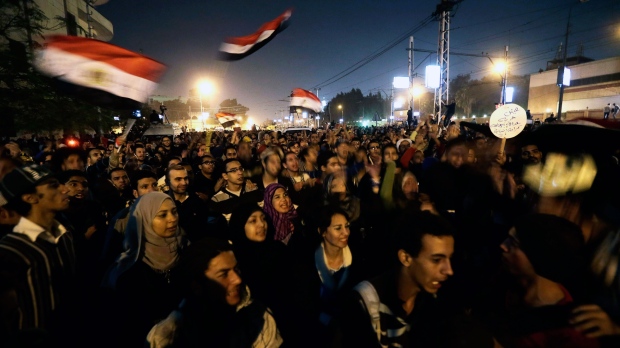
The opposition to Morsi has sustained its momentum and spread deeper into Egypt with perhaps hundreds of thousands protesting in cities and towns across the country.  

The picture that Mubarak and now the Muslim Brotherhood try to paint of political opposition is that it only exists to any extent in Cairo. “Tahrir is not Egypt” is a slogan that has been used many times since the January 25 revolution in 2011.

And it is true that the Muslim Brotherhood has historically been very strong in many provincial and rural centres of Egypt.

But that support may be in decline if the spread of protests is any indication.

Not only are there major demonstrations in Cairo, Alexandria, Suez and the militant union town of Mahalla where the movement that led to Mubarak’s overthrow began in 2008. Today there were also demonstrations of hundreds and of thousands in smaller centres.

There were, for instance, demonstrations in villages in the province of Beheira, historically a Muslim Brotherhood stronghold. In Sharqiya, President Morsi’s hometown there were major clashes between oppositionists and MB supporters near his family home.

In Damietta farmers burned images of Morsi. The farmer syndicate leader walked out of the Constituent Assembly after they failed to include the rights of farmers. There have also been protests at the Morsi’s failure to pass a law forgiving debts for Egypt’s poverty stricken farmers.

As Egyptian socialist journalist Hossam el-Hamalawy tweeted: “Egypt is witnessing a real uprising against the Brotherhood.”

Egypt In The Balance


Between hope & civil war?
Egypt has become a country of duelling demonstrations and rising civil conflict. Today, Friday December 7, tens of thousands demonstrate in iconic Tahrir Square and outside the presidential palace demanding that President Morsi rescind his decree granting himself extraordinary powers and to cancel the divisive constitutional referendum scheduled for December 15. Thousands more demonstrate in Alexandria, Suez, Mahalla and around the country. This follows three other major demonstrations that have mobilized hundreds of thousands of Egyptians against the decree.

On the other side of town, the Muslim Brotherhood – from which Morsi hails and was a long-time senior leader – along with their ultra-conservative Salafist allies demand that Egyptians obey the “legitimate” president. They have massed outside the independent TV stations that are concentrated in one area of Cairo, demanding “unbiased coverage”. There were reports that they had stormed the buildings. Last weekend the MB and their allies mobilized hundreds of thousands to demonstrate their support for President Morsi and for Sharia law.

Beyond mere protesting, the conflict has quickly escalated to violence – people on both sides have been killed and likely thousands have been injured. It’s not clear who started the street violence first – scattered reports have suggested it was MB members attacking opposition protests – but there can be no doubt that the cause of this conflict lies squarely with Morsi and with the Brotherhood and their allies.

For months Morsi’s government has conciliated with the military and the old Mubarak apparatus, permitting torture and military trials of civilians to continue, restricting labour rights, refusing to recognize independent unions and more. They have bent over backwards to accommodate the wealthy, including agreeing an IMF loan that will lead to terrible austerity.

MUSLIM BROTHERHOOD CONSTITUTION

It is now clear that Morsi’s and the Brotherhood’s main goal was to pass a constitution that enshrined the principles of their organization as the main guiding principles of Egypt. The attempt to window-dress it with a few belated and minor concessions to the demands of the revolution – in particular re-trying those cops and regime officials who were acquitted of murdering revolutionaries – didn’t wash.

In some ways this isn’t surprising. The MB leadership were always very hesitant supporters of the revolution, holding back their members from participating in the demonstrations in Tahrir Square in the lead up to the February, 2011 revolution. It was only when the movement threatened to surpass and leave them behind that they threw their weight behind it reluctantly. Still, at every opportunity, they backed away from confronting the military, sought to conciliate with them and even met with the SCAF to work out a deal to reduce social tensions.

But it seems that Morsi and the MB leadership are too used to being the only organized opposition in Egypt. When demonstrations and rioting exploded onto the streets of Egypt they were caught off guard. They have handled the emergence of a mass opposition movement with utter incompetence and heavy-handedness.

The decree that granted Morsi extraordinary powers – more even than Mubarak was permitted – was written up without even consulting Morsi’s vice president let alone major opposition figures. Nor has Morsi shown any ability to compromise or seriously dialogue with the opposition that exists. At each step, when he hasn’t simply disappeared from view, he has escalated the tension.

His response to the unprecedented protests and strikes by judges was to speed up the already discredited constitutional process. The Constituent Assembly, undermined by the walk-out by pretty much everyone who wasn’t an Islamist, cranked out the constitution in 48 hours. It became clear that the intentions of the MB and their Salafist allies were to enshrine their agenda in law. Post-factum offers to talk about how the constitution might be changed after it is accepted have been taken as insults by the opposition.

The straw that may have broken the back of Morsi’s legitimacy, and which threatens to plunge Egypt into civil war, was the MB’s call for protestors to go to the “cleanse” the area around the presidential on Wednesday, even though an opposition sit-in of several hundred was camped out there. When an MB spokesman was asked by the media about the possibility of violence he replied “whatever happens, happens.”

Unsurprisingly it led to a major conflict with the result that seven people died, including a well-known reporter who supported the revolution, and over 700 were injured. The explosion of fury across the nation led to the torching of numerous Brotherhood and Freedom & Justice Party – the MB’s political party – offices.

The anger was made worse by the fact that the MB/FJP blatantly lied about what was going on. As their members were beating protestors with clubs and fists, and later with pellet and shot guns, they claimed that it was the other way around. They claimed that the dead, primarily opposition protestors, were all MB members. Official statements, including from Morsi claimed that all the violence was from the opposition side, hinting at a dark conspiracy that reminded many of Mubarak’s tactics for silencing dissent.

All of these missteps and escalations by the MB have now made it very difficult to pull Egypt back from the brink of major civil conflict. The spirit of the revolution – bread, freedom and social justice – is embodied in the opposition movement. But unlike Mubarak’s regime that could mobilize little, the MB have a large base of supporters who they can mobilize and who believe fervently in their organizations and their leadership. Street mobilizations alone will probably not be enough to defeat, convince and demoralize this deeply rooted organization. Ultimately, a real victory will require the same kind of strike action by workers that brought down Mubarak.

Monday, December 3, 2012

Israel Blind To Its Own Isolation

I wrote less than two weeks ago that Israel was in an accelerating decline as a result of changed geopolitical realities in the Middle East, most recently and acutely the Arab Spring. That Arab Spring is now in the throes of a 2.0 reawakening and reconstitution of last year's settlements, as events in Egypt in the last two weeks have made clear, not to mention the momentum of Syrian rebels, rioting in Tunisia and renwed protests in Kuwait, Jordan, Bahrain, etc.

But like a Saudi Emir who can't see the protests outside his window past his line of servants, the Israeli regime appears to have no idea that they are more isolated than ever. Or, perhaps they do, but are unable to change their modus operandi because it is hard-baked into how the state operates, ie. by terror, humiliation and intimidation.

In any case, there's no doubt the world is a changed place when the UK and France call in Israel's ambassador to condemn plans to build 3,000 illegal settler homes as revenge for Palestinian leader Mahmoud Abbas seeking recognition at the UN. And the UK's mooting of the possibility that it will withdraw its own ambassador from Israel - a major diplomatic slap in the face - is a stunning development. You have to know that America's given its approval for this strong response - the UK is, after all, the tail that the American dog wags.

This is not really the result of Israel engaging in illegal or inhumane practices. Israel has been building settlements in the West Bank since it seized control of it, and Gaza, during the 1967 war. This is not a new event. What has changed isn't Israel, it's everything else.

The US and Europe all fear that Israel's uncontrollable brutality is inflaming the region, making it more unstable and more anti-American/anti-European. They are deepening the radicalization. Where once Israel's policy of armed fury towards all comers was useful to keep in line weak and despotic Arab regimes, it is now a hindrance. At a time when Mohammad Morsi, president of Egypt, is facing a revolt for being too much like Mubarak, despised in part for his refusal to confront Israel, Israel's actions could undermine Morsi's credibility further. Or it could force him to hit back at Israel to bolster his domestic position, putting the Camp David Treaty with Israel, which underpins American hegemony, at risk.

Israel really is shooting itself in the foot here. But it's not clear that they have any option. Already almost totally isolated - as the lopsided vote at the UN in support of granting statehood status to Palestine demonstrated - what is Israel to do? If it doesn't respond, coming after its perceived defeat in Gaza, it looks weak - which endangers its role as the American gendarme. And worse, it would look like it accepts the world's verdict that Palestine is a state, which would mean real negotiations towards a viable two-state solution. This it has never and will never accept. Israel has always played the long game, meaning it creates "facts on the ground" over time by stalling on negotiations as it pushes forward on settlement construction and economic strangling of the Palestinians. The end goal was always to gain control of all of Biblical Israel, in part because it provided a strong ideological underpinning justifying the right of European Jews to steal the land of the indigenous population, ie. Palestinians. But also because of the valuable natural resources - in particular water - that exists in the West Bank.

If the rest of the Middle East continues on its journey towards a deepening of democracy, Israel's bullyboy routine will put it increasingly in conflict with the policy of the Americans - and will stand out as anachronistic to the rest of the region. How this will play out in the end is unclear but if Israel closes off definitively the possibility of a two-state solution and the Americans place some distance between themselves (and their barrels of money) and Israel, they could be faced with their own Arab Spring - meaning a civil rights movement of Palestinians and Israeli-Arabs demanding full civil rights and equality.

France and Britain summon Israeli ambassadors - Middle East - Al Jazeera English:

'via Blog this'
DreamHost Promotional Codes