Saturday, October 17, 2009

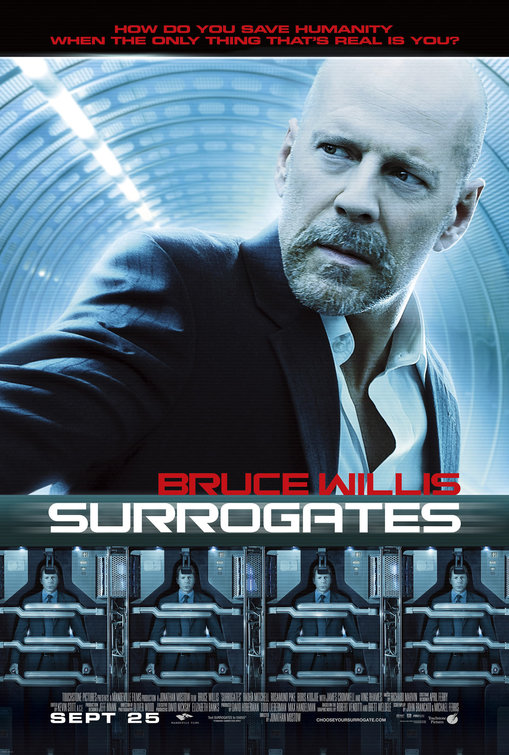
Surrogates: Philip K Dick Light

ANYONE WHO HAS READ PHILIP K. DICK can feel his influence in a lot of the better science fiction out there. His grappling with social power, identity, resistance, oppression, commodification make him one of the more visionary writers in a visionary genre. Surrogates is an example of a film that very clearly owes a lot to the creative mentorship of Dick's work.
It is a murder mystery and conspiracy thriller set in the relatively near future where robotics has advanced to the point that lifelike robots can live our lives, controlled remotely by us as we lay in a home-based hook-up. Bruce Willis, as police detective named Tom Greer, does a solid job portraying a man caught between the ambivalence of desiring the promise of safety provided by using a surrogate and the desire to actually live his own life. The family-centred backstory to the conflict in his personal life is a pretty typical cliché but it does a serviceable job making the point.
There's also a good supply of action to the film - including a fun chase scene by Greer's surrogate of the suspect in a territory controlled by anti-surrogate rebels who refuse to live their lives in any way other than in their own skins.
The problem is that it hasn't lived up to its mentor. It lacks the depth and texture of a Dick novel or film. We get the sense that living life through the experiences of our surrogate is a bad thing somehow. But to be honest, it's not clear why that's so: you can be beautiful. It's eliminated racism and sexism because you never know who somebody really is. You're safe and don't have to fear either crime or accidents. You're stronger and faster. And you experience all of the sensations of the surrogate as though it is your body. So, what's the big deal? And why does Bruce have to go an ruin it for the rest of us?
I realized afterwards that the world is just not dark enough. Dick had an uncanny ability to take the nastiness of our world and use technology and speculation as a means to highlight that nastiness, to shift our perspective so that which we normally take for granted can be seen for what it is. He taught fish to see water - if you catch my drift.
This film doesn't do that. It lacks edge. Even the rebel, played by Ving Rhames, feels neither inspiring nor threatening. The same with the authorities. The debate between them is banal - stop using surrogates, defend the right to use surrogates. Ho hum. 
And we have a hero who wants to change the world in order to fix the relationship with his wife. I'm all for counseling and everything but it's not exactly epic stuff and not a very good motivation to be a bummer on everybody else's good time. Basically, the filmmakers have low-balled all the motivations and elements, presumably to keep the movie mainstream. There isn't sufficient advantage taken of surrogacy's twisted potential. People could live as animal robots. You could be married to a black man who is actually a white woman or vice versa. How would we know if the president is really the president? But we never get more than hints of the complications of this world. It's a shame that the opportunity was wasted. Still, it was a fun ride and a decent twist to make us say "aaah" in the end. But it doesn't really require the big screen to enjoy. Save yourself some money and rent it.

Friday, October 16, 2009

Wall Street Is Corrupt: Discuss

This is my favourite quote of the day and comes from an article about a very big insider trading case that's given a kick in the ass to Wall St.:


"The case reinforces the perception that Wall Street is a place where well-connected insiders game the system and prosper, leaving small investors stuck with the losses when markets falter."


Uh, no shit...

Thursday, October 15, 2009

Liberals and NDP Work Hard To Lose

IT'S A BIT DEPRESSING READING THE POLLING NUMBERS from EKOS today. But what's most depressing about the Tories building their lead is just how unnecessary it all is. With the Tories now in striking distance of a majority government expect Harper to act as though he had a majority already. Anything that makes a slimeball like Harper and his neo-con toads happy is enough to make you pour yourself a stiff drink.
But we shouldn't get too miserable. After all, the Tories have been here before, on multiple occasions. Back in September, 2008, as the election approached in October, the Tories were at 39 percent, only to fall back to 34 percent by the beginning of October. When the election finally happened the Tories won 37 percent of the popular vote, which was up by 1 percent over the previous election but they actually received 165,000 less votes. It just so happened that the Liberals received 835,000 less than the previous election. Because, well, they sucked under Dion (unlike the roaring charisma of Ignatieff the neo-con professor). The bigger news was probably that the most people ever didn't even bother to vote.  Nearly a majority came to the realization that not only did Dion, with his incoherent and deeply uninspired Green Shit platform, suck - so did everyone else.
All this brings me back to where we started. The truly depressing thing about the Tories temporary climb in the polls is that this is the result of a lack of leadership on the part of any opposition party (I can't speak to the Bloc in Quebec because I'm not familiar enough with what's going on there but the Bloc has kept its support pretty stable, it seems).
The Liberals spent the better part of the last several years propping up the Tories by voting for whatever horribleness they were passing in the House. Their recent reversal looked exactly like what it was - a pathetic and opportunist attempt to take advantage of a heartbeat of growth in their support. No surprise that their unprincipled threat to bring down the government lost them support instead of inspiring it. It doesn't help that Ignatieff not only looks indistinguishable from pretty much any well educated Tory across the House. He is indistinguishable. It just so happens that he has the misfortune of sitting beside a turncoat weasel like Bob Rae.
As for the NDP, ah, well, I weep for the NDP. I received a fundraising email from them in the days following their grotesque about-face on supporting the Tories. Suddenly they were no longer the only party that stands up to the Tories. Now the Liberals were "playing politics" and they were the only party trying to make Parliament work. "So, let me get this straight: you want me to send you money so that you can vote for Stephen Harper's EI bill, which will actually screw workers?"(See page 8) I hate to say I told you so but I did, back when Jack was having tea with Stephen. You could smell it - and it wasn't bread or roses.
All this sounds a bit of a downer but have hope - it's Friday! And the Tories will sink again, as they always do. And next time you say something bad about Quebec sovereigntists, remember that if it weren't for the Bloc, the Tories would already have a majority.

Wednesday, October 14, 2009

JPMorgan Profits Soar On Wall Street, Housing Defaults Soar On Main Street

I SUPPOSE IT SHOULDN'T COME AS A SURPRISE that the biggest of the big banks in America that sucked up tens of billions in government aid are now rolling in profits. That’s how this game works. So, it was announced today that JPMorgan reported a 580% profit increase over last year to a whopping $3.6 billion third-quarter profit.
The reasons is pure and simple – the money that the US government pumped into the banking and financial sector has created a new Wall St. bubble – with stock prices rising by nearly 50% to top the psychological benchmark of 10,000.
The actual meaning of that number is a mystery to most of us not initiated into the occult world of the stock market. But the basic gist is that there’s a lot of cash floating around and people are doing to the stock market what they did to the housing market – bidding it up, out of relation to the value of the assets that they represent.
The trouble is, in the real world, the shithouse is still burning. Community banks in the US, which make their profit by loaning money to people to buy houses, finance small businesses, other consumer loans, etc. are tanking badly. The 7,000 banks have collectively lost about $2.7 billion. And many are outright failing:
“Ninety-eight banks, mostly small, have failed so far this year, and regulators predict the harvest from the current recession is less than halfway complete.”
The reasons why are straightforward, with loan delinquencies sitting at a record 4.35 percent and climbing – and real estate development loans have rocketed to 16 percent. Amongst homeowners, 7.35 percent were delinquent – another record. In previously frothy markets like south Florida the freefall is continuing. According to one real estate agent foreclosures have risen by 25 percent compared to last year and the trend is higher.
It is certainly possible that the present round of profit reporting – including a positive report from Intel Corp. boosting share earnings and projecting an extra $1 billion in revenue for the fourth quarter could in fact herald a recovery. But it’s also the case that, like previous recessions – going back to the Reagan arms boom – this one will have been ended by laying the basis for the next one.
In particular, what we have seen in recent decades is a game of debt ping pong, with debts being shunted back and forth between governments, private individuals and the corporate sector (including banks). Until that debt can be dealt with it will act as a drag upon the economy and create other problems that will increasingly limit the ability of governments (in particular the US government) to act.
My own view is that in the short to medium term, once the present round of “irrational exuberance” wears off – and I don’t think it will last long once stockbrokers remember that there’s a real world – will see us return to an extended period of stagnation. Some of the weaker centres of the system – droopy old Britain, for instance – may experience Icelandic types of crashes. As Nouriel Roubini might say, this ride ain’t half over yet.

Monday, October 12, 2009

Looming Defeat In Afghanistan?

IT'S HARD TO SEE THE PRESENT SITUATION IN AFGHANISTAN as anything other than a disaster for the occupiers. They are more hated, more attacked, more vulnerable than ever. Their supply lines are attacked, whether they originate from Pakistan or through allied Caucasian republics - like the fuel tankers that were stolen and then bombed by ISAF in Kunduz, in the north. As they try to fight against the insurgency, they end up killing civilians, making even more people hate the US-led occupation and the corrupt Kabul government.
While the insurgency - derisively called the Taliban but, in reality a much more complex, decentralized movement - is growing stronger, deeper roots, the Americans and their allies are in pretty serious retreat. The new strategy by the US - with a resonance in Britain - of shoring up bases of military and political support in the cities is a major retreat and a surrender of rural areas.
It also smells a lot like the Soviet's failed strategy: "Moscow's original intention was to secure the major cities and lines of communications, while stiffening the morale of the DRA forces. The Soviets apparently hoped that the DRA would do most of the counter-insurgency fighting... The Soviets soon found that the Kabul army was unreliable and often loath to fight. If serious fighting were to be done, the Soviets had to do it."
The Soviets with a nominal Afghan army of 300,000, plus 100,000 of their own troops under a single command structure were defeated. The present occupation has about 100,000 nominal Afghan troops and just over the same number of ISAF and US troops. The foreign component is made up of troops from 42 countries, formally under two command structures, making it much more vulnerable politically than the Soviet military. If one of the big contributors - like the UK or Germany - pulls out under the varying domestic political pressures they face, it could easily lead to a domino effect. With the current round of retreats, the ISAF alliance will be made even more unstable.
Already, there is a minor kerfuffle in Canada about the legislated end-date for the Afghanistan combat mission of July, 2011. The Tories have been successful, in the face of a complicit Liberal opposition, in playing a shellgame to avoid the political consequences of an unpopular war. They have extended the end dates more than once, moved Canadian troops back into their bases to avoid combat - and thus casualties - they have bullied the opposition with calls to "support the troops". But they have failed miserably at generating any lasting mass sentiment in favour of continuing Canadian involvement in the war, with a constantly rising popular opposition to the war: "A poll conducted over the summer showed 54% of Canadians opposed the Afghanistan mission. That number was only 20% in 2002 when Canada first started sending troops."
DreamHost Promotional Codes