Showing posts with label film review. Show all posts

Monday, August 30, 2010

Inception: Victory of the Banal


Look, I don't care what the reviewers say: Inception was just not that great a film. I guess after seeing the low ratings for Repo Men, a film of much greater intelligence and caliber, I shouldn't be surprised that the morons who write film reviews would be drooling all over this. After all, it had everything that they love - lots of cartoonish violence, some solid thrills, beautiful leading actors, and a turgid, pretentious and yet ultimately vacuous plotline.
Now, don't get me wrong but there were was lots of tension and many high speed thrills. With a budget this high - $160 million - you'd have to hire the most incompetent team of filmmakers on the planet not to come up with something at least impressive to look at. There were even a couple of clever ideas in the film.
But mostly it was so haphazardly orchestrated and directed and, yes, shot, that it needed all the bells and whistles (and the way over the top soundtrack) to cover up for all the emotional and plot holes within it.
Let's start with the acting and the dialogue. Until the action really ramps up and the actors stop talking except in urgent commands - "Get him to the safe!" - it is almost unbearable.
Writer/Director Nolan seems to have never heard of a contraction or he believes that actors should speak the Queen's English: "you would not want to do such a thing..." But it's worse than this, it's often unclear why the actors are saying their clunky lines. There is anger when there ought to be simple explication and there is DiCaprio's endlessly heavy droning about some pseudo science that makes no sense.
But at core the problem is that this is a heist film without any heist. In heist movies there's supposed to be some great prize as the main storyline. Could you imagine Ocean's Eleven without the stacks of cash in the basement vault of Bellagio's? Would Inside Man work if it weren't for the hidden information in the vault? What about Italian Job without the gold?
And that's just it: Inception's heist has no gold. It's no wonder that the motivation for the characters' actions is a total mystery.
Ellen Page is totally under-used in the story. In fact, after the introductory sequence where we see her ability to play the role of an architect she contributes nothing whatsoever to the "heist." She could be removed from the script and nobody would notice. All we're left with is her interest in the inner life of DiCaprio's character, for reasons that are obscure to say the least. And what of the rest of the team who aren't there for the thrill of entering the dreams of rich guys? Beats me.
Nor do we understand the motivation of Saito (Ken Watanabe), the Japanese businessman who hired DiCaprio to do the job of planting an idea in the mind of an heir to a business empire (Cillian Murphy). Does he just want to eliminate the competition, which would make him a fairly unsympathetic character, or is there some greater good in his mind, which would justify him being the palsy-walsy of DiCaprio. This is never ever made clear. And what super-powered businessman would put himself on the line to execute a dangerous job? Why does he take this risk instead of leaving it to the professionals?
So, we have a heist movie without a treasure and with no motivations for most of the major characters. What we're left with is a lot of razzle dazzle to make us forget that we don't care about what they're going after. In fact, the whole central storyline is so irrelevant that, in the end, we don't even know whether it worked and what the fall-out was from their "inception".
This leaves us with DiCaprio's subplot about wanting to get back to his kids because he's been accused of killing his wife and needing to get over the guilt surrounding her death. Not a bad B-story except that it doesn't really affect the main story - sorry, the brief intervention of a train was fun but it didn't change anything - and it isn't really much of an obstacle in the heist story when push comes to shove.
Besides acting and motivation, even the shot choices are not particularly interesting or well chosen. Often times the shots are out of focus or too close or just not particularly interesting.
There are a number of slow motion shots within the van that the characters are riding in within a dream. Almost all of these shots have a close-up on Joseph Gordon-Levitt, DiCaprio's sidekick, with Watanabe seated behind him. But these guys are tertiary characters by this point. Where is our lead? We don't see DiCaprio and rarely even see Ellen Page, who are now the central characters.
And, finally, not to rain on anyone's profundity parade but the thematic exploration of "what is more real: our dreams or reality?" is not particularly original in content nor in its presentation. The story never managed to rise to the level of speaking to some kind of general experience in the way that The Matrix did or, earlier, Blade Runner. Or, frankly, the much maligned Repo Men.
That film reviewers have gone ga-ga over Inception is not particularly surprising, I suppose. They also drooled over writer/director Nolan's previous offerings in the Batman franchise. And his film Memento is supposed to be a "big idea" film by a "big idea" filmmaker.
Inception, like Batman, is a product of its own massive marketing campaign: tens of millions have been spent telling us what to think of the film (it's deep, complex and visually stunning) and the reviewers play their dutiful role of parroting Hollywood's self-aggrandizement.
In fact, you don't even need to go see the movie. You already know that it is great; an "entertainment experience" as they say. You will be moved, changed, transformed. This is an IMPORTANT FILM. Except that it's not. It's just weak, bloated and pedestrian.

Wednesday, August 25, 2010

Repo Men, Social Satire & How Reviewers Are Dumb As Posts


The other night I had the pleasure of being deeply disgusted by Jude Law removing a man's liver. Tonight I was disgusted to see that most of the reviewers on Rotten Tomatoes managed to completely miss the point of the film and give it a negative review.
I'm not surprised that a film that (literally) rips apart the brutality of private healthcare in the USA didn't do well. As a species we are more than a little squeamish about watching entertainment that speaks to us about contemporary concerns in a direct way. Witness the near total failure of recent war films about Iraq. The Hurt Locker may have won the Oscar but it didn't make any money at the box office.
But I guess I expect the film reviewers who watch a lot of films would enjoy the pleasure of the satire embedded throughout the piece, the self-referencing of action movies for the purpose of tearing them apart.
Peter Howell from the Toronto Star, for instance, writes: "The film is set in the near future, where a terrible thing has happened. There's been some kind of apocalypse, stripping Hollywood of new ideas. This leaves rookie helmer Miguel Sapochnik, as well as screenwriters Eric Garcia and Garret Lerner, with no choice but to make do with refried plot devices about heartless capitalism and mechanized humanity."
Is Howell dumb as a post? Hollywood has been making the same damn movie for thirty years. There's so little originality in Hollywood that we should shout for joy whenever something appears that isn't a remake of a TV series or film from the 60s or 70s or another Cinderella story. What's more, Repo Men stands in the tradition of satires of the caliber of Robocop. In other words, the action hero form is clearly intentional and satirical. Did these guys not pay attention to the last ten minutes of the film? It's about cultural fantasies of the hero who rescues us all as much as it is about the perils of American-style healthcare. And, frankly, I'll take "refried" plot devices about "heartless capitalism" any day over the usual horseshit about love conquering all or "try and you shall succeed." At least it attempts to engage with the lived reality of millions of people. Cinderella stories engage with fantasies that are meant to mask that reality in a way that is just insipid and stupefying.
Besides, you'd think reviewers would figure out that there was something deeper than a run-of-the-mill action film going on here by the presence of Forrest Whittaker; hardly a typical action hero. There's a strong echo of Gilliam's Brazil here, of the inside man who finds himself on the outside (and it's a reference in more ways than that but I won't spoil it). And the climactic fight scene, which was so over the top stylized and gory that only an idiot wouldn't figure out that it was meant to be a satire - and a set-up for the end of the film. It was a hilarious and beautiful send-up of The Matrix rescue sequence. Likewise the fairly erotic but absolutely bonkers sequence in which Jude Law and his kick-ass, sidekick girlfriend Anna Braga falsify the return of their overdue organs by cutting each other open and then inserting a barcode scanner.
And you can't help but laugh and shiver at the casual brutality expressed by the men whose job it is to physically retrieve the delinquent organs. The darkly comic brilliance reaches its peak when Forrest Whittaker's character borrows a kitchen knife from Jude Law during a BBQ at his house so that he can nip out front and repossess the kidney of a man in a passing taxi.
Somehow, the reviewers missed all this.
The Globe & Mail reviewer Liam Lacey was so asinine as to ask: "Surely an artificial organ could have a remotely controlled off-switch which would avoid the bloody splatter and the reason for this movie." Are you serious? Surely Alice would have broken her neck when she fell down the rabbit hole to Wonderland. Surely a man in red underwear and blue tights can't fly or see through walls. Surely the Marine operation in Avatar wouldn't depend on the ability and loyalty of one man to guarantee a resource upon which the entire earth is dependent. It's called a story as distinct from reality. And the brutal violence that made even a veteran action movie watcher like me wince and turn away was EXACTLY the point of it. It was meant to shock us into seeing the reality of privatized, corporate healthcare (or the real estate crisis for that matter). Newsflash: people die because of it and it ain't pretty. And while Lacey calls the film smirking and dully disgusting, all he betrays is that he is a sneering uptown snob with his title "Does the Hamlet set really want Saw-like gore..." as though such a film as this is beneath people with real cultural taste.
The script itself veers and bounces a bit - but for a good reason - and mostly it follows clear lines of development. The act changes are in the right place, the story is comprehensible and motivated. In the end it's a bit grim but it was so much fun getting to the grimness - wincing and all - that you're able to leave without needing a drink to dull its effects.

Saturday, October 17, 2009

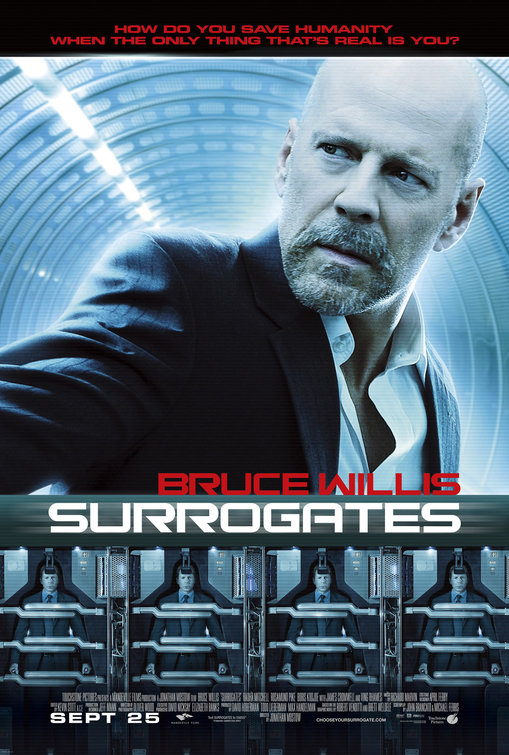
Surrogates: Philip K Dick Light

ANYONE WHO HAS READ PHILIP K. DICK can feel his influence in a lot of the better science fiction out there. His grappling with social power, identity, resistance, oppression, commodification make him one of the more visionary writers in a visionary genre. Surrogates is an example of a film that very clearly owes a lot to the creative mentorship of Dick's work.
It is a murder mystery and conspiracy thriller set in the relatively near future where robotics has advanced to the point that lifelike robots can live our lives, controlled remotely by us as we lay in a home-based hook-up. Bruce Willis, as police detective named Tom Greer, does a solid job portraying a man caught between the ambivalence of desiring the promise of safety provided by using a surrogate and the desire to actually live his own life. The family-centred backstory to the conflict in his personal life is a pretty typical cliché but it does a serviceable job making the point.
There's also a good supply of action to the film - including a fun chase scene by Greer's surrogate of the suspect in a territory controlled by anti-surrogate rebels who refuse to live their lives in any way other than in their own skins.
The problem is that it hasn't lived up to its mentor. It lacks the depth and texture of a Dick novel or film. We get the sense that living life through the experiences of our surrogate is a bad thing somehow. But to be honest, it's not clear why that's so: you can be beautiful. It's eliminated racism and sexism because you never know who somebody really is. You're safe and don't have to fear either crime or accidents. You're stronger and faster. And you experience all of the sensations of the surrogate as though it is your body. So, what's the big deal? And why does Bruce have to go an ruin it for the rest of us?
I realized afterwards that the world is just not dark enough. Dick had an uncanny ability to take the nastiness of our world and use technology and speculation as a means to highlight that nastiness, to shift our perspective so that which we normally take for granted can be seen for what it is. He taught fish to see water - if you catch my drift.
This film doesn't do that. It lacks edge. Even the rebel, played by Ving Rhames, feels neither inspiring nor threatening. The same with the authorities. The debate between them is banal - stop using surrogates, defend the right to use surrogates. Ho hum. 
And we have a hero who wants to change the world in order to fix the relationship with his wife. I'm all for counseling and everything but it's not exactly epic stuff and not a very good motivation to be a bummer on everybody else's good time. Basically, the filmmakers have low-balled all the motivations and elements, presumably to keep the movie mainstream. There isn't sufficient advantage taken of surrogacy's twisted potential. People could live as animal robots. You could be married to a black man who is actually a white woman or vice versa. How would we know if the president is really the president? But we never get more than hints of the complications of this world. It's a shame that the opportunity was wasted. Still, it was a fun ride and a decent twist to make us say "aaah" in the end. But it doesn't really require the big screen to enjoy. Save yourself some money and rent it.

Saturday, January 3, 2009

America Is Doomed

Yeah, I bet the title caught your attention. But this isn’t a sophisticated analysis of the decline of US manufacturing viz China, or of its sclerotic, corporate dominated political system. It’s about Death Race, the remake of the 1973 Roger Gorman film, Death Race 2000.
It’s a shit film to be honest, which is too bad because it got off to a good start. It opens in a near-future America in which the economy is in collapse; where workers have to fight riot cops to get their fair severance pay when they’re laid off; and where the prison system is run by private corporations for profit. (Hey wait, isn’t that, like, right now?)
But after that promising beginning it’s all down hill and becomes about shots of Jason Statham’s seriously hot, cut body and his hot female side-kick, what’s-her-face – it doesn’t matter because she serves no dramatic function other than to be hot.
There are next to no dramatic obstacles of interest for Jason to overcome. We already know he’s going to win the race and escape from jail and we never doubt it for a moment. So, why are we watching it? Well, because of the shots of Statham’s hot body and what’s-her-face’s mathematically perfect ass.
The only good thing about this movie intellectually is that it got me thinking about dystopias in American film, ie. imaginary, corrupted and decaying societies that demand resistance in some fashion. It occurred to me that no culture more than that of the US of A has generated so many stories about their own, ultimate demise. And the pace of their creation seems to be speeding up.

PACE OF DOOM

Think about the last few years in film. We’ve had: Children of Men, Wanted, the Batman movies, The Matrix, V for Vendetta, Wall-E, Aeon Flux, The Island, Equilibrium, A Scanner Darkly, 28 Days Later, 28 Weeks Later, Land of the Dead, Diary of the Dead, I Am Legend. I’m sure I could go on.
Each of them has a specific take on the causes or solutions of the decay, which reflect the political stance of the filmmakers (and studios and marketing directors, etc). But they all start from the premise that society will turn inward or collapse in the not too distant future.
Incidentally, remember when dystopias used to be in the 24th century, like Brave New World (1931) or at least a generation off, like 1984 (1948). Now they’re set in 2012 (Death Race), Today + 1 day (28 Days Later), 2027 (Children of Men – though the collapse is to have started in 2007), and again in 2012 (I Am Legend).
It seems Doomsday has gotten closer.
It’s possible that the proliferation of dystopic films is simply a fashion cycle, like bell-bottom jeans. Certainly the early 1970s saw its share of dystopic, doomsday type films – some of them now being remade today, like Rollerball, Omega Man (I Am Legend) with Chuck Heston, and Death Race 2000. There was the deeply trippy Maoist parable, Zardoz, that featured Sean Connery as a red guard in, uh, red diapers. And who can forget Soylent Green, also with Heston. (I tell you, is it any wonder that Heston was such a gun nut? Poor guy lived through more biblical disasters and collapsing civilizations than any actor in history.)

DEEPER PATTERN

But I think there’s a deeper pattern here than simply the whims of decadent fashionistas – and that is that both now and the early to mid-1970s were periods of social crisis. However, while the early 70s marked the beginning of the end of the cycle of radicalization that started with the Civil Rights Movement, we are in a period of unresolved stasis.
Certainly there is no generalized political upheaval, such as the movements of the 60s. But nor is there the conservative hegemony of the Reagan years or, God forbid, the 1950s. Instead what we have is a primarily directionless but growing alienation experienced by the population – that sense of disconnect that most of us feel from any and all social institutions and their values – combined with fractures in the hegemonic ideas and dominance of the American state. The former is the product of deteriorating conditions in a context of barely existent alternatives, like socialist or mass movement organizations or vibrant trade unions. The latter is as a result of the fact that America is an empire in decline and the ruling class doesn’t know how to escape that decline.
We have experienced this most dramatically in the last year with the nuclear detonation of the neo-liberal consensus about the efficiency of the market. The return of Keynes in a big way, including the effective nationalization of a significant chunk of the US financial system, put the nails in that coffin.
But it was also felt with 9/11, the sense that the United States was vulnerable. That feeling of weakness has grown with the never-ending war in Iraq and the deteriorating situation in Afghanistan. And it was supplemented by the disaster of New Orleans after Katrina. The nation that had once, almost single-handedly, rebuilt Europe after World War Two, couldn’t even run a decent rescue and repair operation on one of its smaller cities.
On top of these “macro-events” there is just the day to day sense amongst Americans of going backwards – in a nation where more and more lose access to health insurance each year, where indebtedness grows and real wages fall year after year. And where everybody knows that politicians are corrupt and corporations rip off workers. Is it any wonder that there is a cultural openness to dystopic stories? They are cultural documents that historians will look back on one day as signposts on the highway to the coming doom of America.

Saturday, February 2, 2008

Blowback is Hell

It’s been described as the “Blair Godzilla Project” in reference to its combination of a city devouring monster and shaky cam aesthetics. And it’s breaking all records for a film released in January, hitting $41 million on the first weekend.
So, what, exactly, is all the fuss about?
On the surface Cloverfield is just another monster movie, no different from any other – monster appears in the middle of a good time being had by the main characters; monster wreaks havoc; monster picks off the actors one-by-one as the rest try to survive and/or destroy the monster; a flawed/broken relationship between the lead and his lady finds new meaning in the danger of the moment. Films ends with a set-up for a sequel.
Cloverfield, which stars unknown actors, is about the night some mysterious and massive monster attacks New York City. It is filmed by the guest at a surprise going-away party who has been given a camera to document the party and who now films the whole disastrous night unfolding. Occasional problems with the video camera reveal that they are filming over top of a previously shot video of the lead and his girlfriend spending a day at Coney Island.
After the initial attack, Rob, the young man who is the reason for the party, his brother Jason, Jason’s girlfriend Lily and two other friends, Marlena and Hud, run through the streets trying to escape. First the monster destroys the Brooklyn Bridge and prevents them from getting off of Manhattan. Then the crew head towards mid-town – and the monster – to rescue Rob’s girlfriend Beth, who has left him a message on his cellphone that she is trapped in her apartment.
I’ll spare you the details of who dies when but suffice it to say that the monster and its spawn are winning the war, such that the plan by the US government is to simply flatten the city.
Along with I Am Legend, Cloverfield marks the second time in just a few months that Hollywood has flattened New York. The people who live there must all have anxiety disorders.
What is most interesting about Cloverfield, in an otherwise pretty conventional plot, and what I think drives its popularity, is its unique perspective.
Think about the remake of Godzilla from 1998 as a contrast. This is also about a city-devouring monster. But its story is told from the perspective of the people in the know – scientist Matthew Broderick, military and political chiefs, etc. Because they know what is going on – that the giant lizard is the result of nuclear testing – we know what’s going on. We understand the nature of the monster, even if we don’t yet know how to kill it.
In Cloverfield what we experience is disorientation. What the people in control know is unknowable to us and to the characters in the film. We are made to identify with ordinary people, just trying to live their lives and then just trying to survive this horror. Like the actors, we are unknown.
The monster is a hideous mystery. Our only source of information is from what is right in front of us at a given moment. There are snippets of corporate news, overheard conversations by low-level military personnel, personal experiences of the monsters’ attacks, etc. The only clue we have to its origin comes from the segments of Rob and Beth at Coney Island. As they ride the ferris wheel, something large can be seen to fall in the ocean behind them.
This shift from Godzilla to Cloverfield is reflective of a big shift in consciousness in American society post-911. There is a sense of being under attack; that something is wrong, that government doesn’t have the answer and is perhaps making things worse. It isn't insignificant that one of the first casualties of the attack is the Lady Liberty.
Imperial blowback anyone?
It’s the same sense as pervades I Am Legend of a world where the rules have changed dangerously and we might not be able to know them though they just may kill us.
We have lost the confidence reflected in Godzilla that we can identify our problems, classify them, pursue logical deductions and scientific methods to understand their properties, and then solve them. In this sense, it is not just New York that is being destroyed. It is the Enlightenment with its rationality and order, like the grid-pattern of New York’s streets being erased by the monster’s rampage and US bombs.
In the first instance, Americans, like the character of Rob, seek out what they know – family, romantic relationships – as a salve for their pain and fears. But in this New America, love doesn’t conquer all. And holding hands or standing alone, the beast strikes you down without discrimination.
The nihilism of the piece, its utter hopelessness tells us something else about the United States of America: there is no alternative available. When the old order begins to crumble and come apart, all that exists to answer it is the destructive force of the state. But the tanks and guns of the army are totally inadequate to the task of this new world.
Like the B2 bomber that carpet bombs New York City in the film, the state looks impressive as it flies above you, you can cheer its raw power, but the problems it tries to solve cannot be destroyed in this way. It only makes it more angry.
Cloverfield is about an America that is losing faith in itself. It is vulnerable. And this being America, they are dealing with their decline in the way that they deal with everything else: they are turning it into a spectator sport. It’s a bit like watching a car wreck at the racetrack. It’s a great ride and cool to watch – after all you were secretly hoping it would happen – but you don’t want to be in the path of the cars zooming out of control.

Friday, January 11, 2008

Zombies in the Street of America

The zombie film as a metaphor for political and social unconsciousness has a long and illustrious history. If they don’t begin with George A. Romero’s series of films, then certainly they have found their clearest political expression in them. Which is not to say that all, or even a majority of, zombie films are politically interesting.
Compared to, for instance, the mall setting of Romero’s Dawn of the Dead as a critique of consumerism and conformity, films like the stylish and beautiful 28 Weeks Later are intellectual ca-ca - at least after the first act's interesting commentary on the American Army in Iraq viz. the zombie-free "Green Zone".
But even the anti-conformist message of the Canadian film Fido is depressingly distanced from contemporary experience, so that all it manages is a pretty banal and hackneyed critique of the Leave It To Beaver 1950s. Hardly a revelation.
I bring this up because when I sat down to watch I Am Legend I figured that I’d have the usual experience – only more Hollywood: stunning effects that only a $150 million could buy, snappy one-line acting by a big star, and a hackneyed story line bled dry of any broader relevance, all wrapped-up in a structure so formula that Robert McKee would give it a hearty thumbs up.
Boy was I wrong.
It is 2012 and a re-engineered virus, designed to wipe out cancer, has killed off ninety-percent of humanity with most of the remaining turning into vampire-like monsters. I know this means I've been misleading by talking about zombie films but the role that the creatures play is more typical of zombies than vampires, which is why the other adaptation 28 Days Later treated them this way.
Army virologist Robert Neville (Will Smith) is seemingly the only uninfected survivor to be left in New York City, if not the world. He spends his days hunting and gathering with his dog, Samantha, working on a cure and watching news re-runs and Shrek.
He’s also coming undone from lack of human contact. He talks to his dog like a person and carries on conversations with mannequins he’s set up in the video store he frequents.
Certainly this was a big budget film with spectacular monster effects and remarkable production design. You can’t watch this “last man on earth” film and not wonder how they achieved the look of an utterly abandoned New York returning to a state of nature. Grass grows on the streets and deer lope away from hunting lions, as not a human is to be seen.
But director Francis Lawrence (Constantine) has understood that having boatloads of cash doesn’t mean you have to jam-pack every scene with toys and gadgets. For instance, there is no soundtrack, other than the occasional Bob Marley song played on the stereo of Neville. This gives the empty city a serenity it wouldn’t otherwise have. And it forces Lawrence to rely on visuals and acting to generate the plentiful tension.
And tension he has lots of. During a hunt for deer, Neville’s dog runs into a darkened building and he has to go after her. But the dark is where the mutated human creatures hide from the sunlight. And these creatures eat flesh. As Neville goes deeper and deeper into the darkness to find his dog, Smith’s acting and the shots will have you on the edge of your seat. The lack of music gives us a cleaner, more visceral experience of this abandoned city filled with danger.
And when there is music, as when Neville plays Bob Marley’s song Stir It Up to Anna (Alice Braga), it retains it’s poignance and emotional impact.
One of the most interesting aspects of this film is the politics behind it. Neville on several occasions describes New York City as “ground zero” – in reference to the man-made virus that was let loose there.
Ground zero, of course, is how New York was described after 9/11. And the virus that has been unleashed has turned the survivors of the city into hate-filled monsters. This hatred has spread outwards to engulf the entire planet. I Am Legend is thus an allegory for the post-911 world in general and of America in particular. Even the portion of Shrek that we see, and which Neville knows by heart, is a scene in which Shrek takes on a mindless lynch mob trying to drive him from his home in the swamps. Everything points us in the direction of seeing this film as a critique of the madness of bloodthirsty jingoism and prejudice.
What’s more, the survivors that we see are an African-American, a Brazilian woman and a little boy. This is refreshing from the point of view of a still mostly lily-white Hollywood but is also an interesting statement on who will be the agents of a global redemption. Of equal interest is the destination of Anna and her young companion, which is to the hills of Vermont. That probably doesn’t mean much to us Canadians but in the lore of the American Revolution and some of the more radical conceptions of early American democracy, Vermont is an important touchstone. For redemption they must literally return to the revolutionary vision of America – or at least it’s myth (and the myth or reality of the Vermont “colony” is a point of dispute in the film as well).
This film is on many levels a questioning of the current direction of the USA and the world and it is also successful as a story. Sure, there are flaws with the third act and if you look up the wikipedia page on the film there is an alternative ending that would have helped save the third act from eating itself (which it does). But as far as Hollywood blockbusters go, this is the thinking person’s cotton candy.

Sunday, December 23, 2007

Golden Compass gets lost in cash


I really want to like Golden Compass. It is about a rebellious and courageous girl resisting an authoritarian and repressive regime. It has great CGI effects, including those spectacular polar bears. It has a Mark Twain character – the United States’ best known anti-imperialist, though this aspect of his career is mostly forgotten. And it features Nicole Kidman, of whom I am a big fan.
So, why do I dislike the film so much? Well, to start with there is something obscene about spending close on $200 million for a film in the first place. Not as obscene as spending $400+ billion on the military budget of the USA but it nonetheless speaks to the fact that Hollywood has its priorities ass backwards.
It is one more demonstration that the movie industry thinks that if it can throw a bucket of money large enough at a film then the audience will flock to the product. Sooner or later it is bound to blow up in their faces, if only because the potential audience isn’t big enough to cover the bill.
The hideously bad Beowulf is discovering the same thing and not even the almost exposed virtual nipples of Angelina Jolie can save that film.
What the filmmakers of Golden Compass – and Beowulf – failed to realize is that flash and pomp can only cover up so many story flaws. Eventually we are bound to notice that behind the swelling music and incredible visuals is an empty vessel.
The story of the film is potentially rich, and the book did well for a reason, I suspect. It is the story of a world in which a repressive regime, the Magisterium, wants to eliminate all critical thinking and opposition. To do this means nipping it in the bud while children are still young.
Strangely, the source of critical thought is somehow connected to space “dust”, which links together all the different, possible worlds in the many universes. This, I suppose, is meant to represent the different possibilities inherent in free will.
One manifestation of this dust, this free will, is in the souls of the people. In the world of The Golden Compass, unlike our own, people’s souls live outside of their body in the form of “demon” animals. And prior to adulthood, these demons are changeable and unfixed. But once they are adults, the space dust (free will) flows through their now fixed demons into the owners.
The Magisterium, with the usual obviously evil characters prone to the equivalent of mustache twirling and irrational violent outbursts, wants to eliminate free thought by separating children from their demons, sort of a demonectomy. They have set up a laboratory in the north pole where they perform experiments on kidnapped children, violently separating them from their demons.
Into this backdrop steps Lyra the orphaned niece of a controversial professor/explorer a la Indiana Jones, who is an expert in the cosmic dust. He sees the dust’s power to expose the lies of the government and set the people free. However, she discovers that the government wants to kill him. After warning him in time Lyra becomes entangled in a complicated plot driven, in part, by a desire to save her kidnapped friend from the laboratory and also by her desire to protect and help her uncle in his quest.
It this sounds like a mouthful of detail to try and cram into a 90 minute film, well you are right and the result is a massive amount of exposition by various characters to explain the world, the backstory, the plotline. For a film that spent so much on its production we spend a lot of time watching talking heads tell us the story.
This serious flaw is compounded by the fact that a key means of driving the story forward is the “golden compass” aka the “alethiometer”. This semi-mystical device, given to Lyra by the head of the university, is meant to tell those who know how to use it, the hidden truth.
Pretty much every key moment in the plot is resolved by Lyra falling into a sort of trance while staring at the golden compass, which then answers the problem or question at hand. It literally is the ghost in the machine – a force outside of the characters resolving the story on their behalf.
It is both sloppy and boring. After all, we’re there to see the story’s characters struggle using their own hard won skills and experience. If it’s done for them, well, what’s the point?
The filmmakers should have used some of the $180 million to pay for story editors.
I’m sure there are some who will agree that this is all true but be willing to excuse the film because, after all, “it is meant for children, isn’t it.”
But this is to disrespect children who, as the film itself explains, aren’t as silly as we might think. What’s more, we should be teaching our children using the best techniques of storytelling and technological flimflam doesn’t count.
If I may permit myself a final, more general comment, I’ve noticed in many of the politically inclined films of this year many of the same faults – a didactic tone, too much exposition, one dimensional characters, etc.
To be fair I think this is the result of a certain immaturity, a newness in attempting to tell socially engaged stories amongst a broader section of artists. They haven’t yet internalized politics in a way that it becomes organic to the story and not a club to beat the audience with. Redacted was an example of this. In spades.
This, I think, is a normal part of the politicization process. My only fear is that because film budgets are so high and Hollywood so terminally timid, that these failures of youth will be written off as failures of form. The political baby will be thrown out with the didactic bathwater.
I hope this isn’t the case. A bad Golden Compass, which valorizes both children and rebellion against unjust authority, is better than a (much) more entertaining Lord of The Rings, with its racist, War on Terror boosterism.
DreamHost Promotional Codes