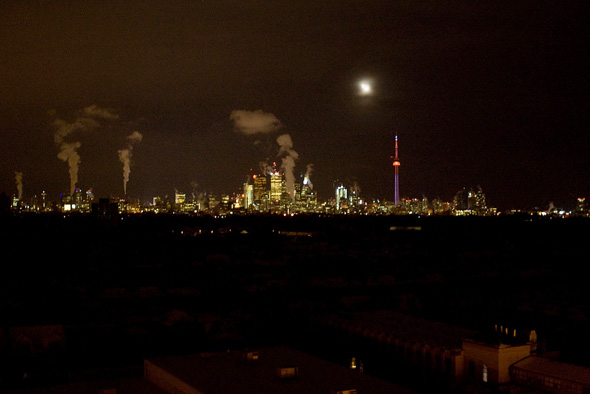
 In case you haven't heard or lived it, Toronto's west end had a black-out beginning Thursday night and lasting for about 24 hours, on the coldest night and day of the year. Our house was in the thick of it and we were forced to endure something quite miserable. Thursday night I had to stay up from 3am till 9am tending our gas stove to keep the house warm so that my partner could get some sleep and our newborn wouldn't freeze to death. I know, I know, (well, now I know) you're not supposed to use a gas stove to heat the house because of the danger of carbon monoxide poisoning. Luckily our old house leaks like a sieve, so not much danger of running out of fresh air. But if running a gas stove in a house is so dangerous, why the hell is it allowed at all? I have on many occasions been cooking a big meal and had all four burners and the oven going all afternoon, including in our old duplex, which meant it was all happening on one floor. Do you mean to tell me that I could have killed us all, or made us very sick - and this is permitted? Something seems out of whack with this.
But a bigger question in all this is why the hell doesn't the Toronto electricity grid have any built in redundancies? Apparently a sprinkler went off at a transformer station near our house and they had to shut down electricity because of the flooding, turning out the power on 100,000+ people. So, let me get this straight: I could go into a transformer station with a $2 disposable lighter, hold it up to the sprinkler system and shut down all the electricity for an area and population the size of a small city? I'm glad I didn't know this when I was a mischievous and troubled teenager, the temptation might have been too great.
Seriously, though, how can a first world city not have any back-up or extra capacity throughout the system that would allow power from other transformer stations to take up the slack? Perhaps I'm just demonstrating my ignorance by asking the question but it seems like an obvious one - especially after the disaster of the 2003 blackout.
The answer I fear is that it is a side-effect of neo-liberalism. That is, it is more profitable to have less fail-safe systems, less redundancies built in to cover unusual - though not rare - eventualities like power lines and transformer stations knocked out by storms, fires or faulty plumbing. I suspect that the primary measure of service management is the quantity of profit that is generated for the corporation, not the service provided for the population. I haven't heard of any deaths as a result of tens of thousands of people losing heat on the coldest night of the year but it was certainly a possibility. Just down the street from us, for instance, is a seniors' home. They are particularly vulnerable to hypothermia.
I hope that I'm wrong in my assumptions. But, if the failure of the system is the result of having created an "efficient" grid, then we should be exposing the fact that implicit in this definition of efficiency is the assumption that the risk of an "acceptable" loss of life is worth higher profits. And any human system that places profit above human life is indeed a system that has failed.


1 comment :
I think it wasn't pleasant situation for the energy supplier too and cost him lot of expenses. I am not an engineer, but I don't think it's possible to backup all possible ways and lines and stations. You are blaming neo-liberalism - take a look on socialistic countries. Blackouts are their daily bread (or more usually, they don't have electricity at all...).
Best wishes
Lorne
Post a Comment